

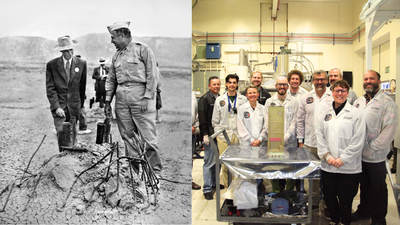
C. Robert Oppenheimer and Major General Leslie R. Groves inspects Ground Zero after the Trinity Test in New Mexico, July 1945 (left), members of the Los Alamos National Laboratory team behind the design, assembly and testing of the Independent Ion Mass Spectrometer (AIMS) observing instrument (right).
Hidden among the plateaus of northern New Mexico lies a community unlike any other in the United States. Los Alamos, once a secret city built to support the Manhattan Project during World War II, is now known as the most educated county in America by one notable metric: Nearly one in five adults ages 25 and older has a doctorate degree.
Its academic profile goes even further, with nearly 70% of residents holding at least a bachelor’s degree, nearly double the national average. The transformation of this once classified scientific station into a global center for advanced research, innovation and education continues to shape its economy, workforce and reputation decades after the first atomic bomb was developed there.
How the Manhattan Project turned Los Alamos into the most educated district in America
Los Alamos was founded in 1943 as the secret headquarters of the Manhattan Project, the top-secret American program that developed the world’s first nuclear weapons during World War II.
The physicist chose J. Robert Oppenheimer Mesa New Mexico is remote because of its isolation, making it an ideal location for top-secret research.The project brought together some of the greatest scientific minds of the 20th century, including Enrico Fermi, Richard Feynman, Hans Bethe, Edward Teller, Stanislaw Ulam, and many famous physicists, chemists, engineers and mathematicians. Thousands of scientists, military personnel and support staff worked behind barbed wire in complete secrecy, and many residents were unaware of the project’s true purpose.
After the war, the laboratory remained operational rather than closing, and developed into one of the leading national research centers in the United States. This decision permanently changed the area’s identity, attracting generations of highly educated scholars whose presence still defines Los Alamos today.
Nearly one in five adults has a doctorate degree
According to the U.S. Census Bureau’s American Community Survey, 19.7% of adults age 25 or older in Los Alamos County have a doctorate degree, the highest percentage of all U.S. counties.To put that into perspective, the national average is about 2.5%, meaning Los Alamos has nearly eight times the national share of Ph.D.s. There are few places anywhere in the country that come close to concentrating so many highly educated professionals within a single community.This number reflects the county’s unique workforce, where physicists, chemists, engineers, computer scientists, mathematicians and national security professionals make up a large percentage of the population.
Many employees hold doctoral degrees because their research involves advanced scientific disciplines ranging from nuclear physics to artificial intelligence and quantum information science.
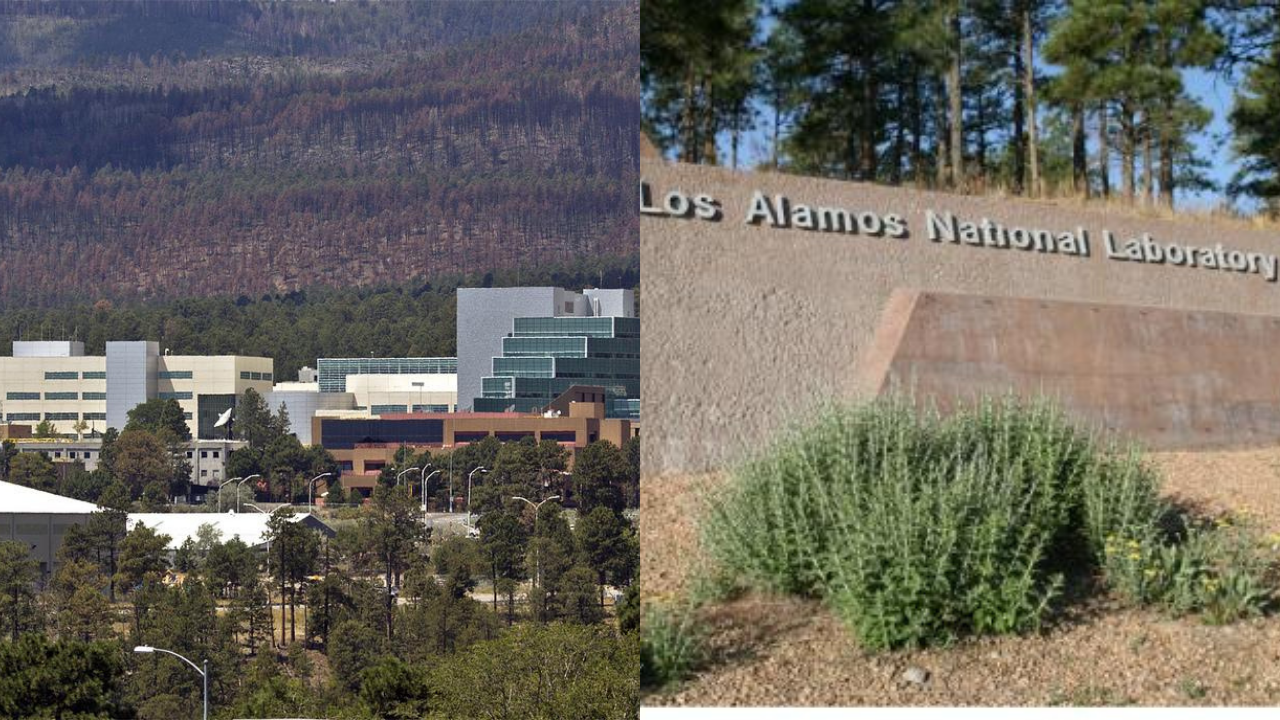
Los Alamos National Laboratory.
Nearly 70% of the population has at least a bachelor’s degree
The province’s educational profile extends beyond doctoral degrees. Census data shows that 69.7% of residents ages 25 and older have at least a bachelor’s degree, compared to 35.7% nationwide.This means that nearly seven out of every ten adults in Los Alamos have completed a college education, making the county one of the most academically accomplished communities in the United States.The high level of educational attainment reflects decades of recruitment by research institutions and federal agencies searching for highly qualified professionals. Scientists, engineers, software developers, statisticians, and technical specialists continue to transfer to Los Alamos from leading universities across the United States and abroad, contributing to a workforce with extraordinarily high academic credentials.
Role of Los Alamos National Laboratory
The biggest reason behind these extraordinary numbers is Los Alamos National Laboratory (LANL), one of the world’s leading scientific research institutions.The laboratory was originally established during the Manhattan Project, and now operates under the supervision of the US Department of Energy’s National Nuclear Security Administration. The company employs more than 15,000 people, making it one of the largest employers in northern New Mexico.Today, LANL’s work extends beyond nuclear science. Researchers conduct cutting-edge work in artificial intelligence, supercomputing, quantum computing, cybersecurity, climate modeling, renewable energy, biosciences, materials science, space exploration, nuclear medicine, and national security.
The laboratory also houses some of the world’s most powerful supercomputers, enabling scientists to solve complex problems in physics, engineering and climate research.Because many of these positions require master’s or doctoral qualifications, the laboratory continues to attract one of the most highly educated workforces in the country.
A county built on science and innovation
Unlike many communities that rely on tourism, manufacturing, or agriculture, Los Alamos has developed around scientific research and technological innovation.
Its relatively small population of 19,000 to 20,000 means that a large national laboratory has a greater impact on local education and employment statistics.The county consistently ranks among the wealthiest counties in New Mexico, with median household income significantly exceeding the national average. Highly skilled jobs in research, engineering, and national security support a strong local economy, while public schools regularly rank among the state’s best-performing districts.The community’s scientific culture also extends beyond the workplace through educational outreach programs, internships, and collaborations between laboratories, universities, and local schools.
Nobel Prize connections and scientific achievements
Los Alamos has long been associated with some of the world’s most influential scientific discoveries. Many Nobel Prize winners have worked at Los Alamos National Laboratory or collaborated with its researchers over the decades.The laboratory has contributed to advances in nuclear physics, materials science, high-performance computing, astrophysics, chemistry, and medicine. It has also played a major role in developing technologies for nuclear stockpile management, radiation detection, medical imaging, energy security, and global nonproliferation.Today, scientists at LANL continue to publish internationally recognized research while partnering with universities, government agencies, and industry to address emerging scientific and technological challenges.
Why does Los Alamos continue to attract the world’s brightest minds?
Researchers from leading universities regularly move to Los Alamos to pursue their careers at the national laboratory. The combination of cutting-edge facilities, large-scale research projects, and interdisciplinary collaboration makes it one of the finest scientific workplaces in the United States.Scientists and engineers from institutions such as MIT, Stanford, Caltech, Harvard and other major universities often begin or continue their careers at LANL, where they work on projects ranging from fusion energy and quantum technologies to advanced computing and planetary science.]The laboratory also welcomes researchers from around the world through collaborative programs, ensuring a continuous exchange of ideas and helping to maintain Los Alamos’ reputation as one of America’s leading scientific communities.
More than a historical city
Although Los Alamos is forever associated with one of the most important scientific achievements in history, its identity today extends far beyond its wartime origins. The same spirit of discovery that once fueled the Manhattan Project now drives research in artificial intelligence, clean energy, quantum science, advanced materials, climate modeling, and national security.Visitors can still explore the remains of the Manhattan Project through the Manhattan Project National Historical Park, while state-of-the-art laboratory facilities continue to push the boundaries of science and technology. More than 80 years after its founding, Los Alamos remains a place where history and innovation go hand in hand.