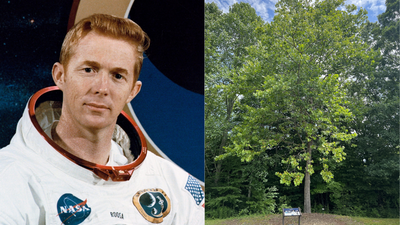
More than five decades ago, Apollo 14 carried an unusual payload into deep space when it accompanied hundreds of important tree seeds on its journey around the moon. While astronauts Alan Shepard and Edgar Mitchell were exploring the lunar surface in February 1971, command module pilot Stuart Rosa remained in lunar orbit with the seeds packed inside his personal collection.
After safely returning to Earth, many seeds germinated and were planted throughout the United States, creating what became known as “Moon trees.” Today, these trees can be found in parks, schools, courthouses, universities and government sites, serving as a living reminder of one of NASA’s most unusual and enduring spaceflight experiments.
How the Moon Trees project started
The idea for the experiment came from Stuart Rosa’s background before he joined NASA.
Before becoming an astronaut, Rosa worked as a smokejumper for the U.S. Forest Service, parachuting into remote forests to fight wildfires.Before the Apollo 14 mission, the Forest Service collaborated with NASA to send several types of tree seeds into space. Forest Service geneticist Stan Krugman selected seeds from pine, sycamore, sweetgum, redwood and Douglas fir trees for the experiment.The seeds were sealed inside small containers and placed in Rosa’s personal preference kit aboard the Kitty Hawk’s command module.
Journey around the moon
Apollo 14 was launched on January 31, 1971, becoming the third successful mission to land humans on the moon.Although the seeds never touched the moon’s surface, they traveled farther than almost any plant material had ever gone before. While Shepard and Mitchell conducted their activities on the Moon, Rosa and the seeds remained in lunar orbit, orbiting the Moon before beginning their return journey to Earth.The seeds experienced launch, deep space travel, lunar orbit, and return, making them part of one of the earliest biological experiments associated with lunar exploration.
What happened after the mission?
After Apollo 14’s return, seed containers accidentally exploded during post-flight processing, scattering seeds and raising fears that the experiment would be ruined.Scientists recovered the seeds and began germination tests. Despite the unfortunate incident, many seeds germinated successfully. The researchers later compared the seeds that were flown into space with control seeds that remained on Earth and found no significant differences in growth or appearance.The trees looked completely natural, which is an important discovery. Space travel did not significantly change their development.
Where are moon trees found today?
By the mid-1970s, young trees were ready for distribution and planting. Many were dedicated during America’s bicentennial celebrations in 1975 and 1976.Moon trees have been planted at locations including the White House, NASA facilities, state capitol buildings, universities, schools, parks, and memorial sites.
Some of them were sent abroad to countries such as Brazil, Switzerland and Japan.Today, many of these trees are still standing throughout the United States. However, a complete master record has not been preserved, making it difficult to determine how many original moon trees have survived.
Why most people never notice it
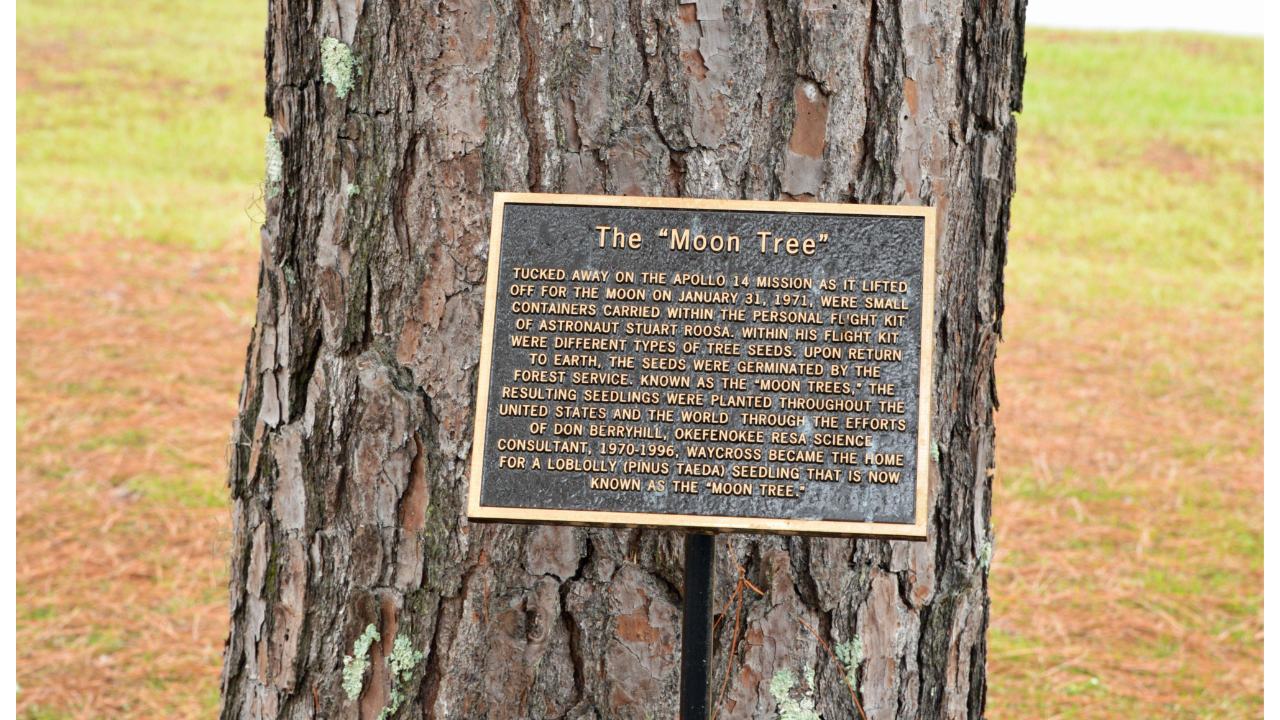
One reason moon trees remain relatively unknown is that they look no different from any other mature tree. A sycamore, pine, or redwood growing from a seed orbiting the Moon appears almost identical to one growing entirely on Earth.In many cases, only a small plaque marks the tree’s fascinating history. Over time, some of the paintings disappeared, and the story behind some of the Moon Trees was forgotten.As a result, countless people walk under these living relics of spaceflight without realizing their connection to Apollo 14.
The legacy lives on through Artemis
The success of the Apollo 14 experiment inspired NASA to reconsider this concept during the Artemis program.The tree seeds were transported aboard the ship Artemis 1, which traveled thousands of miles beyond the moon before returning to Earth.
NASA and the US Forest Service later distributed Artemis Moon Tree seedlings to schools, museums, universities and public institutions across the country.The program continues the tradition of connecting space exploration to everyday life by turning journey through deep space into something that can grow in local communities.
A living reminder of the Apollo era
Unlike spacecraft, moon rocks, or museum exhibits, moon trees are living relics. They continue to grow, provide shade, and change with the seasons while bearing a direct connection to one of humanity’s most ambitious periods of exploration.More than 50 years after Apollo 14, these trees remain a unique symbol of how a small experiment conducted during the Space Race created a lasting legacy firmly rooted on Earth.