


Green Party candidate Hannah Spencer speaks after winning the Gorton and Denton byelection, Manchester, England, Friday, February 27, 2026. (AP Photo/John Soper)
British politics has entered a dangerous phase for its two dominant parties. The Green Party’s surprise by-election victory in Gorton & Denton is not just a local upset. It is a structural warning that both Labor and the Conservatives are losing control of their traditional coalitions.
The UK Reform Party is cannibalizing Conservative votes on the right, while the Greens are beginning to erode Labour’s urban strongholds on the left. For Keir Starmer, this is not just an embarrassing defeat. It is a sign that the political coalition that brought Labor to power may already be divided.The numbers alone reflect the scale of the Labor Party’s collapse. The Green Party received 14,980 votes, representing 40.7 percent of the total electorate.
The British Reform Party came in second place with 10,578 votes, or 28.7 percent. The Labor Party was pushed into third place by obtaining only 9,364 votes, equivalent to 25.4%. The presence of the Conservative Party, which was the main competitor to the Labor Party, was reduced to marginal, obtaining only 1,721 votes, or 4.7 percent. The participation rate was 47.6 percent, indicating a serious electoral competition and not a marginal protest.
What represented a majority for the Labor Party of more than 13,000 votes in the last general election was erased during one parliamentary term.
Trump warns Starmer about Chagos deal ahead of possible strikes on Iran details
This was not a marginal swing. It was a systemic rupture.
the green Swinging
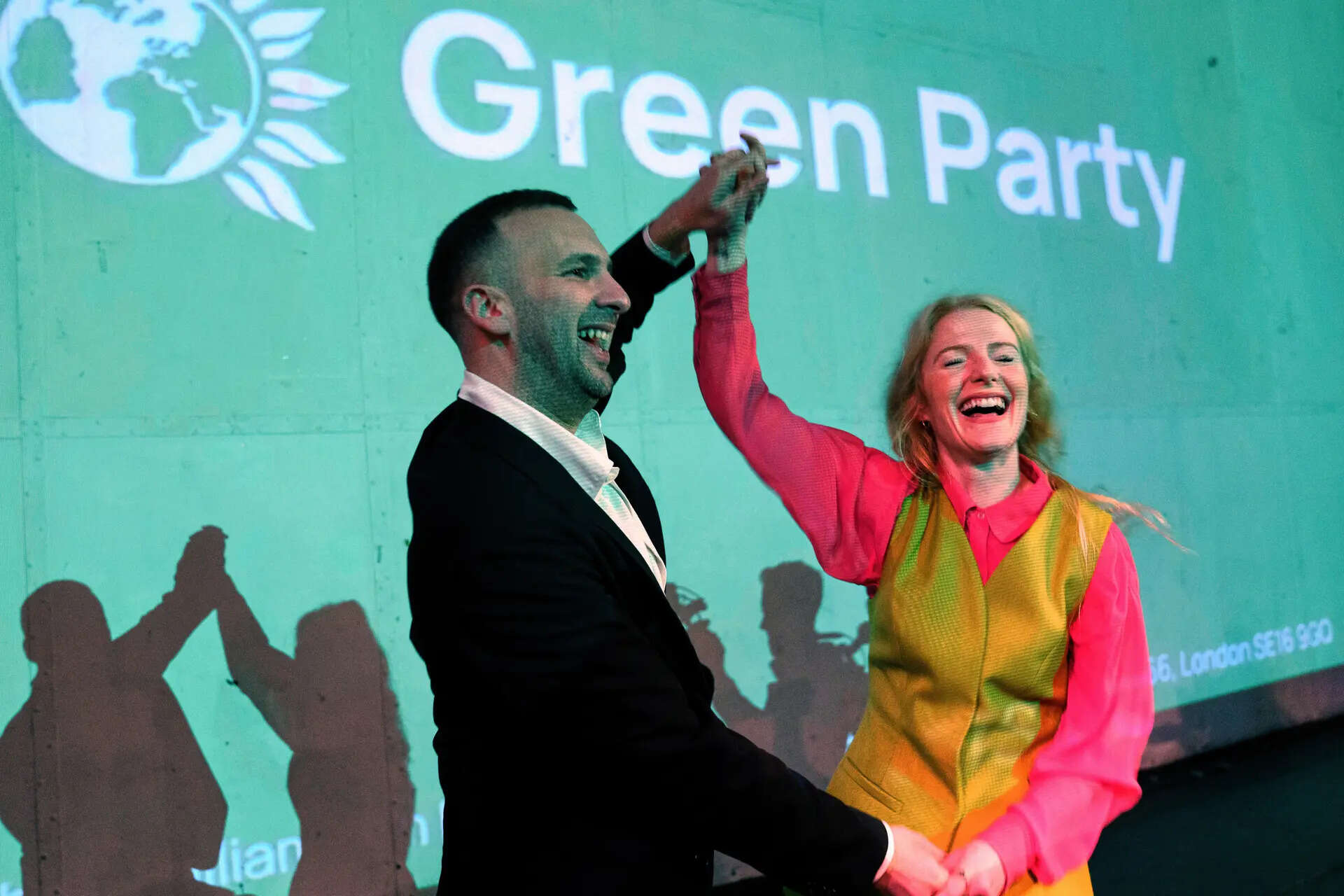
Green Party candidate Hannah Spencer, right, celebrates with party leader Zach Polanski at a thank-you event for volunteers after they won the Gorton and Denton by-election, Manchester, England, Friday, February 27, 2026. (AP Photo/John Soper)
For decades, the Green Party existed as an ideological conscience rather than a contender for governance. Its voters were usually driven by principles rather than expectations. The Greens’ support allowed voters to signal dissatisfaction with Labor while accepting that Labor would eventually win. This arrangement protected Labour’s electoral dominance, because progressive voters returned when the risks became real.The Gorton and Denton result changed this psychological balance. The Green Party did not simply increase its share of the vote. They proved they could win decisively in a seat that had long been considered safe for Labour. Once voters see that an insurgent party is capable of converting support into victory, the risk of voting for it disappears. What was previously a symbolic vote has become a viable alternative.This shift is extremely important because the strength of the Labor Party has always depended on rallying progressive voters behind a single electoral instrument.
Urban constituencies with younger populations, large student communities, and diverse demographics have traditionally constituted Labour’s safest base. These same constituencies now represent fertile ground for green expansion. Younger voters, in particular, show a weaker attachment to traditional partisan identities and a stronger attachment to specific issues such as climate policy, housing affordability, and foreign policy.
When Labor appears cautious or gradual, these voters become more receptive to alternatives that make clearer ideological commitments.
The problem of reform in the Conservative Party
While Labor faces erosion from the Greens, the Conservatives face a more dramatic collapse at the hands of the UK Reform Party. Reform’s second place finish with 28.7% of the vote, combined with the Conservative Party’s collapse to less than 5%, demonstrates how well Reform has captured the right-wing, anti-establishment electorate.

Elon Musk and Nigel Farage
This forms part of a broader national pattern in which Reform has emerged as the main challenger to Conservative dominance among voters disillusioned with immigration policy, economic stagnation, and perceived political weakness. For these voters, reform offers ideological clarity and conviction, while the Conservatives appear vulnerable because of their years in government.The result was a mirror crisis for Britain’s two main parties.
Labor is losing progressive voters to the Greens, while the Conservatives are losing nationalist and anti-establishment voters to Reform. Both parties are being hollowed out simultaneously, not by each other, but by insurgent rivals positioned on their ideological flanks.This symmetrical erosion represents a structural shift in British politics.
Britain is moving from a two-party system to a four-party system
The joint rise of the Green Party and the Reform Party indicates the emergence of a real political scene that includes four parties.
Labor and the Conservatives no longer dominate their ideological territories unchallenged. Instead, they must constantly compete with insurgent parties that present clearer ideological identities.In the traditional two-party system, Labor could lose some progressive votes because the Conservatives remained the only viable alternative government. Likewise, Conservative voters dissatisfied with their party often remained loyal to prevent Labour’s victories.
This logic strengthened the stability of the regime.This logic is now collapsing. When rebel parties prove their ability to win seats, voters feel less obligated to vote tactically. Progressive voters no longer automatically unite behind Labor, and right-leaning voters no longer automatically unite behind the Conservatives. This fragmentation weakens the structural dominance of both major parties.
The ruling Labor coalition is divided
Labour’s electoral victory under Keir Starmer depended on assembling a broad and internally diverse coalition. This coalition included moderate centrists seeking stability after years of conservative turmoil, as well as young progressive voters demanding structural change in the areas of climate, housing and inequality.Maintaining such an alliance requires balancing competing priorities. Governing from the center reassures moderate voters but risks alienating more ideological supporters.
When progressive voters see Labor as insufficiently ambitious, they become more open to alternatives that more closely align with their priorities.The Greens’ victory at Gorton & Denton reflects precisely this dynamic. It shows that Labor can no longer command the automatic loyalty of progressive voters, even in constituencies it once overwhelmingly dominated. Once this assumption collapses, Labour’s electoral map becomes even more vulnerable.
The strategic pressure facing both Labor and the Conservatives
Now both Labor and the Conservatives face the same structural dilemma. If Labor shifts left to win back voters from the Greens, this risks alienating moderate voters and enhancing the appeal of reform. If it remains entrenched in the centre, it risks accelerating Green Party defections. Conservatives face a parallel challenge. A move to the right to win back Reform voters risks alienating moderates, while a move to the center risks further losses to Reform.And this is y It created political pressure that neither party could easily escape. The rise of insurgent parties forces ruling parties to defend multiple fronts simultaneously while maintaining internal cohesion. Failure to manage this balance leads to fragmentation.
Why is this defeat particularly serious for Keir Starmer?
Keir Starmer’s leadership has been characterized by competence, moderation and institutional stability. These qualities helped Labor regain power by reassuring voters after years of political turmoil.
However, insurgent parties thrive in environments where voters seek ideological clarity rather than administrative competence.

British Prime Minister Keir Starmer, right, visits a Premier League youth training facility with Michael Owen, left, in Mumbai, India. Access Point/PTI(AP10_08_2025_000239B)
The Greens’ victory exposes a flaw in Starmer’s model of governance. While moderation may win elections against a discredited opponent, it does not necessarily prevent defection and joining insurgent rivals who present clearer ideological identities. If similar losses occur in other urban constituencies, Labour’s parliamentary majority may gradually be eroded.This is what makes the Gorton & Denton result so important. This indicates that Labour’s dominance in urban areas in Britain is no longer assured.
The beginning of a new political era
The deeper significance of this by-election is what it reveals about the future of British politics. The traditional Labor-Conservative dualism is now being replaced by a more fragmented and volatile system, where insurgent parties can win seats and reshape the electoral competition.Reform in the UK is dismantling Conservative dominance on the right. The Green Party has begun to challenge Labour’s dominance on the left. Both major parties are losing the automatic loyalty that has sustained them for generations. For Keir Starmer, the warning is clear. Winning by force was only the first challenge. Maintaining a fragmented coalition in a rapidly changing political landscape will be much more difficult.