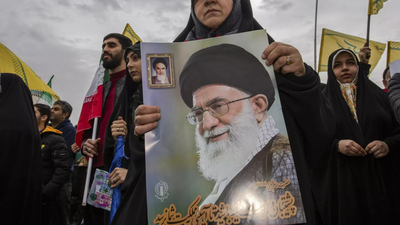
US President Donald Trump announced on Saturday that Iranian Supreme Leader Ayatollah Ali Khamenei was killed in joint US and Israeli air strikes.“Khamenei, one of the most evil people in history, is dead,” he wrote, calling the strike “justice for the people of Iran” and for Americans and others allegedly harmed by Iran.
Shocking announcement by Iranian state television regarding Khamenei: “He joins the supreme kingdom and drinks the nectar of martyrdom”
The death of the 86-year-old supreme leader has sent Iran into the unknown, with Khamenei leaving center stage without naming any designated successor.Meanwhile, Iranian President Masoud Pezeshkian and two other senior officials will lead Iran in the transitional period, state television reported on Sunday. Judiciary head Gholamhossein Mohseni-Ejei and another official from the country’s legal council will be part of the trio overseeing the transition process, state television reported, citing Mohammad Mokhber, one of Khamenei’s advisors.
How does succession take place in Iran?
An 88-member committee of Shiite clerics – called the Assembly of Experts – appoints Iran’s supreme leader. Clergy are popularly elected every eight years, and their nominations are approved by the Guardian Council, Iran’s constitutional oversight body.According to Iranian law, the Assembly of Experts “must, as soon as possible,” choose a new supreme leader.But until then, the leadership council could step in and “temporarily assume all leadership duties.”
The council consists of the current Iranian president, the head of the country’s judiciary, and a member of the Guardian Council chosen by the Iranian regime’s Expediency Discernment Council, which advises the Supreme Leader and settles disputes with Parliament. If that happens now, Iran’s reformist President Masoud Pezeshkian and hard-line judiciary head Gholam-Hossein Mohseni-Ejai will be on this leadership council.There has been only one other transfer of power in the office of Iran’s Supreme Leader, the top decision-maker since the country’s 1979 Islamic Revolution.In 1989, Grand Ayatollah Ruhollah Khomeini died at the age of 86 after having been a symbol of the revolution and leading Iran through its bloody eight-year war with Iraq. This shift comes now after Israel launched a 12-day war against Iran in June 2025 as well.
After Khamenei who?
Mojtaba KhameneiThe Ayatollah’s son, Mojtaba Khamenei, is considered one of the most prominent candidates to succeed the Supreme Leader. He is the second eldest son of the deceased leader, and has long been viewed as the rational successor to the terrorist financing regime, Reuters reported, citing informed sources.Those familiar with the matter told the outlet that the 56-year-old is in line with his father’s hard-line policies.Mojtaba Khamenei was named by the US Treasury as one of the parties responsible for transferring $1.5 billion from Iran last month, with Secretary Scott Besent accusing the leadership of “abandoning ship.”Hassan KhomeiniAnother regime insider is Hassan Khomeini – the grandson of the father of the Islamic Revolution, Ruhollah Khomeini.Hassan Khomeini, 53, has emerged over the past month as a serious contender and is seen as a more conciliatory option – both internationally and domestically.Mariam RajaviShortly after the strikes, the head-elect of the Paris-based National Council of Resistance of Iran, Maryam Rajavi, called for the overthrow of Iran’s ruling regime and the establishment of a democratic republic as the conflict over Tehran’s nuclear and missile programs intensifies following Saturday’s strikes by the United States and Israel.“Our nation continues to suffer more pain and destruction under the rule of religious fascism,” Rajavi declared in a joint statement with The Washington Post, urging Iranians — especially the country’s “brave youth” — to protect civilians amid rising instability.According to the New York Post, the National Council of Resistance of Iran, which was formed after the 1979 Islamic Revolution, presents itself as a government in exile and says it has a blueprint ready for a six-month transitional administration that would organize free elections and transfer sovereignty to the people.Reza PahlaviReza Pahlavi, the son of Iran’s last king, is also planning a democratic transition if the Islamic Republic collapses.In a post on X, Pahlavi described the US action as a “humanitarian intervention” targeting the regime – not the Iranian people.“Final victory will be achieved by us,” he wrote. He added, “We, the people of Iran, are the ones who will finish this mission in this final battle. The time to return to the streets is approaching.”Pahlavi also called on President Trump to exercise “the greatest possible caution” to protect civilians if strikes continue, adding that the Iranians “will not forget your help during the most difficult period in Iran’s contemporary history.”Rajavi urged members of the Islamic Revolutionary Guard Corps and other security agencies to lay down their weapons and stand with the people.Pahlavi warned security personnel that they would “sink with Khamenei’s ship” if they continued to defend the regime instead of “protecting” the regime.[ing] Iran and the Iranian nation.”Rajavi pointed to her “10-point plan” calling for free elections, separation of religion and state, gender equality and a non-nuclear Iran as the framework for a transitional government.At the same time, both Trump and Israeli Prime Minister Benjamin Netanyahu encouraged the Iranian people to take to the streets and seize power in their country.“Our joint action will create the conditions for the brave Iranian people to take their destiny into their own hands,” Netanyahu said, encouraging the Iranians to “seize your government.”