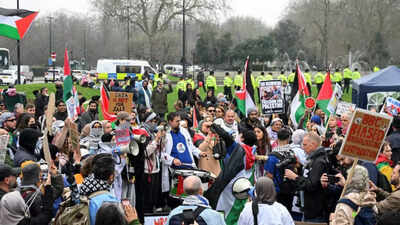
Authorities in London issued a stern warning ahead of Sunday’s annual Jerusalem Day demonstration, saying participants could face arrest for chanting “uprising” slogans, displaying banned symbols, or showing support for banned groups.The Metropolitan Police Service said officers would “act decisively” if protesters crossed the line and turned to hate speech or supported organizations banned under UK law. About 12,000 people are expected to participate in the march, which expresses solidarity with Palestinian rights and is traditionally celebrated on the last Friday of Ramadan.
Marching was banned, and only static protest was allowed
The annual march through central London was banned this year after Shabana Mahmood, Britain’s home secretary, agreed to a police request for restrictions.
Instead, demonstrators will be allowed to hold a two-hour static protest between 1pm and 3pm along the Albert Bridge on the south bank of the River Thames.Police said the move was necessary to prevent clashes between rival groups and manage what they described as a potentially volatile situation.“This is a unique set of circumstances and we needed a unique tactical plan,” Ade Adelekan said, adding that the decision to ban the march was not taken lightly.
The Times to separate the demonstrators from the counter-demonstrators
Authorities will use the River Thames as a physical barrier to separate the main rally from counter-demonstrations – a tactic believed to be the first of its kind at Scotland Yard.While Quds Day protesters will gather near the Vauxhall and Lambeth bridges, counter-protesters – including pro-Israel groups, critics of the Iranian regime and Iranian activists in exile – are expected to gather across the river near Millbank.Lambeth Bridge will be closed to the public except for emergency vehicles, and marine police units will patrol the river to ensure the two sides remain separate.
Warning against the slogans of the uprising
The police confirmed that chants calling for “intifada” could lead to arrests depending on the context.The Arabic word means “uprising” or “resistance,” but some Jewish groups say the phrase is increasingly being used to call for violence against Jews.“Officers on the ground will be informed of banners, flags and chants that cross the line and turn into a hate crime or support for a banned organisation,” Adelkan said.Anyone trying to organize a march, or encouraging others to do so, could also be arrested.
Controversy over the assembly
The demonstration is organized by the Islamic Human Rights Committee, which has defended the event as a peaceful march that has been ongoing for decades.However, past rallies have sparked controversy after some participants were seen carrying flags linked to Hezbollah, a group designated as a terrorist organization by the UK government, and chanting anti-Israel and anti-US slogans.Organizers said they warned participants against displaying symbols associated with banned groups.
Tight security measures throughout the city
Police say around 1,000 officers will be deployed across central London, with additional patrols around places of worship, embassies and community centres.Police said the restrictions, the first imposed on the Jerusalem Day march since 2012, would only apply to these demonstrations and were not intended to set a precedent.Authorities expect a difficult weekend but stressed that the goal was to allow legal protest while preventing unrest.