6 fingers and technical glitches: Internet claims Netanyahu’s war speech amid tensions between Iran, US and Israel is fake, and AI-produced video goes viral
A new controversy is sweeping social media after a recent video of Israeli Prime Minister Benjamin Netanyahu sparked a storm of online speculation, with thousands of X (formerly Twitter) users claiming the footage may have been created or edited using artificial intelligence.
The video, which emerged amid the rapidly escalating war between Iran, the United States and Israel, became the center of intense online discussion.Screenshots, slow-motion clips and frame-by-frame analyzes have been widely circulated, with many users insisting that the footage shows classic signs of AI-generated media. From claims of extra fingers to “digital glitches,” the clip ignited what some observers described as an all-out internet storm.
Netanyahu A speech that raised claims of artificial intelligence amid the war between Iran, the United States and Israel
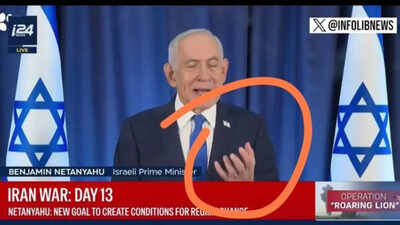
The speculation began when social media users began examining Netanyahu’s video headline in microscopic detail. A particular frame quickly became the focal point of the discussion. In that still image, Netanyahu’s hand appears distorted as he gestures near the microphone.
Many users claimed that the image showed six fingers instead of five, something often cited as a clear sign of AI image creation.
Generative AI tools have historically struggled to make human hands accurate. As a result, deformed fingers have become one of the most recognizable signs people use when trying to identify synthetic images.
Within hours, tweets and Instagram posts highlighting this supposed anomaly began spreading rapidly across social media platforms. Viral threads included enlarged screenshots with arrows pointing toward the alleged “extra digit,” accompanied by comments such as “look closely at the hand,” “classic AI finger glitch,” and “this video is clearly artificial.”
The posts have collectively amassed millions of views, pushing the controversy into trending territory.
Hashtags and threads in Netanyahu’s speech fuel rumors amid the war between Iran, the United States and Israel
As the debate raged, several hashtags related to the video began trending on X. Some posts framed the clip as evidence of AI manipulation, while others suggested more dramatic possibilities. A number of viral threads have speculated that the video may be part of a digital propaganda strategy, likely created to deliver messages during the ongoing war without the need for a live appearance.
Other publications went further, claiming that the video was evidence that political leaders are increasingly using AI avatars or synthetic footage during wartime communications. While one user shared, “BREAKING: Latest video released by the Israeli government shows it was produced by AI because Netanyahu has 6 fingers. Is Netanyahu dead? (sic),” another tweeted, “Did this really happen? Why did Israel give Netanyahu’s AI speech last night? Where the PM was literally playing with 6 fingers? Where is he? Where is Ben Gvir? And why isn’t there a Western news outlet asking these questions? #Irán #Israel (sic)” and another posted, “There is no getting away from the fact that the video purporting to be of Netanyahu 🇮🇱 is influenced by AI. Why has a man who enjoys murder, lies and propaganda not been seen in public for days? Surely the less the world sees of this monster the better (sic).”
Although these claims have not yet been verified, they reflect how quickly online speculation can build up into elaborate narratives during geopolitical crises.
The “age of deepfakes” and public skepticism amid the war between Iran, the United States and Israel
The controversy over Netanyahu’s video highlights a broader phenomenon unfolding online: deep-seated paranoia. AI tools capable of producing highly realistic videos have improved dramatically in recent years. With the right software, it’s now possible to produce videos of public figures speaking words they’d never say.
Because of this technological shift, viewers have become more skeptical about the authenticity of digital media. Today, when unusual visual elements appear in a video, whether it’s a strange shadow, a distorted hand, or a flashing background, many viewers immediately suspect AI tampering. The Netanyahu clip arrived at the moment when such suspicions are likely to explode.
War, propaganda and viral disinformation amid the war between Iran, the US and Israel
The video also emerged during one of the most turbulent periods in Middle East geopolitics in years.
The ongoing standoff between Iran, Israel, and the United States has produced a massive surge of wartime content on the Internet. Across social media platforms, users are already circulating alleged footage of missile strikes, battlefield photos, military announcements, and satellite screenshots.
Many of these posts turn out to be misleading, outdated, or digitally altered. As a result, the environment is ripe for uncertainty.
Every new video linked to the dispute faces intense scrutiny from an online audience trying to determine whether it is real or not. In this climate, even minor visual irregularities can spark widespread speculation.
The rise of “citizen video forensics”
Another factor behind this widespread controversy is the growing trend of outsourced media analysis. Instead of relying solely on journalists or investigators, social media users are increasingly trying to analyze trending videos themselves.
In the case of the Netanyahu clip, users slowed down the video frame by frame, enhanced screenshots, used image filters to highlight edges, and asked AI tools to evaluate the footage.This practice, sometimes called “citizen forensics,” has become a defining feature of the modern Internet. While it can sometimes reveal genuine digital manipulation, it can also lead to misinterpretations when artifacts are mistaken for intentional modifications.
However, once a suspicious screenshot starts circulating, the narrative can spread much faster than any attempt to explain it.
Why hands keep turning to the Internet’s ‘AI detector’
The intense focus on Netanyahu is not a coincidence. Hands has become one of the most popular AI detection guides on the Internet. Early AI image generators often produced odd hand shapes, extra fingers, or merged digits. As a result, internet users now instinctively check their hands when they suspect that a photo or video may be produced by artificial intelligence.
Even memes about “counting fingers” have become a recurring joke in online discussions about artificial intelligence. So when a screenshot of Netanyahu’s video appeared showing a mutilated hand, the reaction was almost immediate.
Conspiracy culture in the age of artificial intelligence
Beyond technical speculation, this controversy also reflects a deeper trend in internet culture: the merging of artificial intelligence fears and political conspiracy theories. hay The Internet increasingly features accounts of public figures being replaced by digital figures, discourses being created by artificial intelligence, and governments secretly deploying artificial media to send messages.These theories particularly flourish during moments of uncertainty, when official information is limited and the public searches for alternative explanations. The controversy surrounding Netanyahu’s video fits directly into this environment. Whether the video is ultimately proven to be authentic or manipulated, the viral reaction itself reveals a profound shift in how the public consumes information.For decades, video footage has been widely viewed as one of the most reliable forms of evidence, but in the age of generative AI, that assumption is rapidly disappearing.
Today, every clip, especially those involving political leaders, faces instant scrutiny from millions of online viewers armed with editing software, artificial intelligence tools, and a healthy dose of skepticism.Thus, Netanyahu’s video debate may represent something bigger than just one widely circulated rumor. This may be a glimpse into the future of information warfare, where the battle is no longer just about the events themselves, but about whether people believe the images they see.