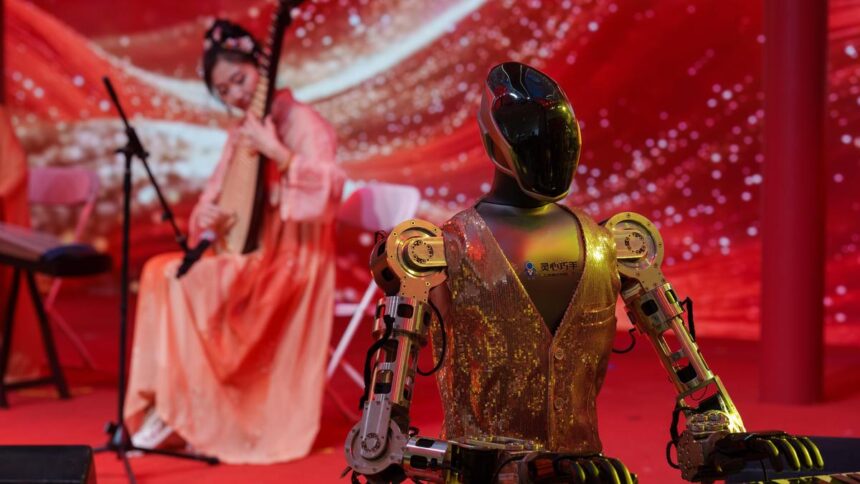

A robot performs traditional music on stage at the Lunar New Year Tech Temple Fair in Beijing on February 19, 2026. | Photo credit: AP
It’s been an eventful week for Chinese robotics company Unitree, which has been at the center of national conversations in China and India.
First, in its home country, Unitree’s latest humanoid robots made a splash on February 16, performing complex martial arts on China’s most-watched television spectacle, the annual Chinese New Year gala, watched by more than half a billion people.
Then, a few days later, one of Unitree’s older robotic models, the quadrupedal “Robo Dog”, inadvertently made headlines due to its demonstration by the private Galgotias University at the AI Impact Summit in New Delhi. The university was forced to close its stall on what some of its representatives claimed was an indigenous design, which turned out to be the unitary Go2 Quadrup. The Go2 model can be purchased online for $1,600.
Watch | Humanoid Robots Steal the Show at China’s 2026 Spring Festival Gala
Unitree, the private company started by tech entrepreneur Wang Jinxing, 36, who built his first robot at university, said this week it plans to sell 20,000 humanoid robots, a nearly fourfold increase from 2025. The company name comes from “universe” and “tree”. South China Morning Post The report is derived from the famous Chinese phrase “lighting up the technology tree”.
The presentation of its latest fully autonomous G1 robot on February 16 drew wide attention in China, marking a significant improvement from the show only a year ago, where the robots mostly demonstrated hand-waving movements. This year, they demonstrated martial arts and punches and kicks with flexibility. Mr. Wang’s latest kung fu-demonstrating humanoid robots, he told state media this week, “lay the foundation for future robot expansion.”
Unitree, in fact, is just one of the many robotics companies reshaping the nation’s tech landscape. asAccording to a Post report, the country accounted for 40% of the global robotics market last year, and the domestic market is expected to grow from $47 billion in 2024 to $108 billion in 2028. Unitree and AgiBot lead the pack of 7,40,000 most reported companies in the robotics sector. The competition is so intense that Chinese media reported that Unitree and AgiBot entered a bidding war, offering more than $10 million to showcase their products in the New Year program (reports that the companies rejected).
Also Read | Robot dogs and AI drone swarms: How China could use DeepSeek for an age of war
As with China’s crowded electric vehicle market, Chinese analysts worry that many of these companies may struggle to compete or even survive due to rapid and unbridled expansion. Robotics is one of the industries prioritized in the country’s fifteenth five-year plan (2026-2030), to be approved next month. In October, the Communist Party’s Central Committee approved recommendations for the plan, calling for “rapid progress in securing breakthroughs in key technologies in key sectors” and “redoubled efforts to develop emerging pillar industries.”
“We must launch industrial innovation projects and make comprehensive moves to build innovation facilities, promote technological research and development (R&D), and product upgrading,” the document said, also calling for “accelerating the development of industrial clusters in strategic developing sectors.” It also called for state support to “explore market regulatory rules and promote new drivers of economic growth such as quantum technology, biomanufacturing, hydrogen and nuclear fusion power, brain-computer interfaces, embodied artificial intelligence (AI) and 6G” and “cultivate unicorn companies”.
Unitree’s growth reflects how quickly China’s tech space is evolving. Its founder, Mr. Wang developed his first prototype while still in university ten years ago and spent just 20,000 yuan (about ₹2 lakh then) to develop his first model, a quadrupedal robot, according to Chinese media reports. That model won him a grant of 80,000 yuan from a competition in Zhejiang province, where he enrolled at Zhejiang Science-Tech University. By industry Another model he developed while pursuing his master’s in Shanghai brought him national attention at a time when China launched an ambitious “Made in China 2025” plan to upgrade and boost innovation, releasing a flood of funding to universities and regional governments. This drive has spurred innovation and fueled the growth of companies like Unitree.
Published – February 19, 2026 04:40 pm IST