

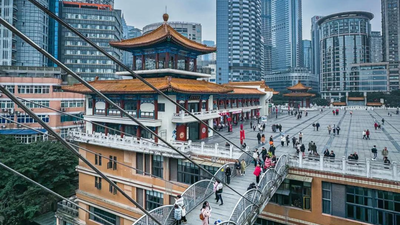
A visitor exits a shopping mall in Chongqing and steps onto what appears to be an ordinary street. Cars pass by. Pedestrians weave through the crowd. Restaurants and shops line the sidewalk.
Everything looks exactly as it should. Then comes the surprise. Leaning over a nearby barrier reveals a stunning drop to another path far below. The street that appeared to be located at ground level actually lay dozens of meters above the city below it. For many first-time visitors, this moment of disorientation is an introduction to Chongqing, the sprawling Chinese city that has earned an unusual nickname online: “3D Magic City.”
Geography behind 8D magic city in China
Videos of Chongqing have become a staple on social media. Some trains are shown disappearing into apartment buildings. Others capture the mazes of elevated roads winding between skyscrapers. A few show bewildered tourists trying to figure out whether they need to go up, down or cross over to reach a destination that seems tantalizingly close.The confusion is understandable.In most cities, people navigate using a relatively simple mind map.
The streets intersect on a flat level. The buildings rise from the same level as the ground. Trends are measured in two dimensions. Chongqing largely ignores these expectations.Here, a building may have entrances on several different floors, each connected to a different street. A pedestrian might leave the shopping center and emerge onto what appears to be the ground floor, while another person enters the same building from a road several floors below.
The addresses make sense to locals. Visitors often need time to adjust.The city’s reputation as an “eight-dimensional” landscape is less about technology and more about perception. The terrain creates an urban environment that may seem almost impossible to understand at first glance.
A Huge city It is formed by mountains and rivers
To understand Chongqing, it helps to look beneath the concrete and glass.The city is located at the confluence of the Yangtze and Jialing rivers in southwestern China.
Unlike many of the world’s largest urban centers, it was not built on vast plains. Instead, it occupies a rugged landscape of steep hills, ridges and valleys.For centuries, settlements have adapted to these natural features. As Chongqing expanded into one of China’s largest urban areas, engineers and planners faced a challenge rarely faced by cities like Beijing or Shanghai: How do you accommodate millions of people when there is a shortage of flat land?The answer was to build on the landscape rather than erase it.The roads climbed the hillsides. Bridges connect separate areas. Tunnels boring through the mountains. Residential towers rose from slopes that would have been considered impractical elsewhere. Over time, the city grew vertically as much as it grew horizontally.The result is a place where height matters almost as much as distance.
The train that became an Internet sensation
No icon embodies Chongqing’s extraordinary character better than Lisiba Station.Pictures of the station are regularly circulated online because the city’s monorail appears to run right through the middle of an apartment block.
To people seeing it for the first time, the scene looks like a special effect from a science fiction movie.Reality is more practical.When the transportation system was expanded, engineers faced severe space constraints. Instead of demolishing existing buildings or rerouting the line, they integrated the station into the building itself. The train doesn’t pass through people’s living rooms. Custom station flooring takes up the space, with noise reduction measures built into the design.The solution reflects a broader pattern throughout Chongqing. Rather than forcing a city into traditional planning, planners often found ways to adapt infrastructure to the available geography.This willingness to embrace unconventional solutions has produced some of the city’s most iconic landmarks.Behind the viral videos lies a serious case study of urban planning.As the world’s population continues to migrate toward cities, planners are increasingly looking for ways to accommodate growth without endless expansion into the surrounding countryside.
Chongqing offers a glimpse of one possible future: dense development organized across multiple vertical levels.The city shows the opportunities and challenges of this approach.Efficient land use can support large populations while limiting sprawl. Conveyor systems can be combined on steep terrain. Different layers of a city can perform different functions.However, complexity comes at a cost. Navigation can be difficult.
Infrastructure projects are expensive. Emergency planning, accessibility, and transportation require constant adaptation.These are issues that many rapidly growing cities may face in the coming decades as available land becomes increasingly scarce and urban populations continue to rise.
Living in three dimensions
For residents, the novelty eventually wears off.Roads that leave tourists confused have become part of the daily routine. The elevators connecting the different street levels are just another means of transportation.
The dramatic elevation changes that inspire viral videos become background scenery.However, the city continues to develop. New developments, transportation projects and commercial districts are reshaping Chongqing while maintaining the characteristics that make it special.Its growth raises an interesting question. As urban populations grow and technology allows for more ambitious construction, will other cities begin to resemble Chongqing? Or is its unusual shape a product of so specific geography that it cannot be easily replicated elsewhere?
A city that changes the way people see cities
Most cities teach residents to think in two dimensions.
North or south. Left or right. Near or far.Chongqing offers a third consideration. Up or down.This simple difference transforms the experience of moving through the city. A destination just across the road may require several elevators, stairs, and elevated walkways to reach it. A street that appears anchored to the ground may actually be hovering high above another neighborhood.