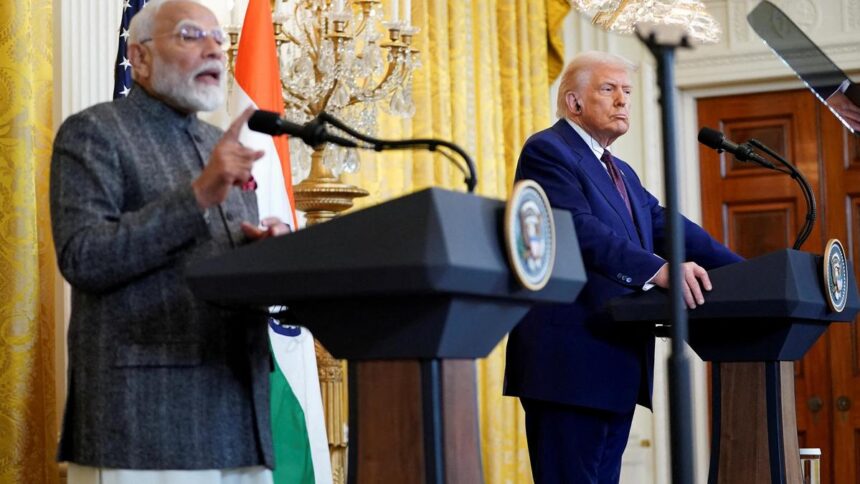
Publications From US President Donald Trump and Prime Minister Narendra Modi US reduces “reciprocal” tariffs on India from 25% to 18% It is a major relief for Indian exporters and indicates that relations between the two countries are improving after a year of intense tension.
A US Embassy spokesperson confirmed that the 25% penalty duty imposed on India last August has been pushed to 50%, making it the highest tariff imposed on any country in the world along with Brazil.
“Out of friendship and respect for Prime Minister Modi and at his request, effective immediately, we have agreed to a trade agreement between the United States and India whereby the United States imposes a reduced reciprocal tariff, reducing it from 25% to 18%,” Mr Trump announced before, in a lengthy social media post, India cut a number of oil tariffs, including a ban on Russian oil imports. “to zero”, and buying US goods, including more than $500 billion in energy.

In his response, Mr. Modi did not mention any of the terms mentioned by Mr. Trump or give details of the trade deal.
“Happy that there is now 18% lower tariff on products made in India. Big thanks to President Trump on behalf of the 1.4 billion people of India for this wonderful announcement,” Mr Modi said in the post. “When two of the world’s largest economies and largest democracies work together, it benefits our people and opens up immense opportunities for mutually beneficial cooperation,” he said.
External Affairs Minister S. to participate in Critical Minerals Ministerial Meeting. The move to cut US tariffs came after a phone call between the two leaders during Jaishankar’s visit to Washington and weeks after US Ambassador Sergio Gore arrived in Delhi and has been welcomed by the governments and chambers of commerce of both countries.
“Our wonderful relationship with India is only going to get stronger. Prime Minister Modi and I have done things that most people can’t say about…” Mr Trump continued.

However, several differences remain between Mr Trump’s version of the deal and Mr Modi’s, which need to be reconciled.
1. Where is the US-India trade agreement?
Mr Trump’s reference to a trade deal is not clear whether he is referring to an agreement to cut reciprocal tariffs or talks between trade teams after the larger “first tranche” of the India-US Free Trade Agreement (FTA). PM Modi’s visit to Washington in February 2025. As a result of the FTA, both sides were expected to drop tariffs, but neither government has yet released any details of the FTA, which includes tariffs and non-tariff barriers, market access and investments. Unlike the EU-India FTA concluded last week, the outlines of the final India-US agreement, the negotiated text, have not been disclosed.
Further, Mr. Trump’s statement that India will “reduce tariffs and non-tariff barriers against the United States to ZERO” has not been confirmed by New Delhi, nor has there been an explanation as to which lines will be reduced to zero. In addition, the question of market access remains unanswered in agricultural sectors such as soybeans and dairy, which India is reluctant to open up. In January, US Commerce Secretary Howard Lutnick said a deal had been prepared months ago, but could not be implemented because he said Prime Minister Modi had not called Mr Trump to reach it. The MEA had denied this claim.
2. Will 18% address India’s disadvantage in this region?
each other The tariff rate imposed by the US in April 2025 is 25%. It was a double whammy for Indian exporters as it was higher than its regional rivals Bangladesh and Vietnam (20%), Pakistan (19%) and China (34%), but most of it was delayed until November 2026. The new reciprocal duty rate of 18% is a welcome step, especially for apparel manufacturers and exporters of gems and jewelery who have been hit hard by the tariffs.
3. What will happen to India’s imports of Russian oil?
In his post on Monday (February 2, 2026), Mr Trump said PM Modi had “agreed to stop buying Russian oil and buy more from the United States and possibly Venezuela”, which he said would help end the war in Ukraine. The MEA did not respond to requests for comment on the matter. While the government insists it has no role in these trade decisions, Mr Trump’s claim that PM Modi has agreed to cut off Russian oil is a contradiction.
In a statement on August 6, 2026, An MEA spokesperson had issued a statement slamming the US penalty tariffs by 25%. For India’s purchase of Russian oil, they are “unfair, fair India’s purchases of Russian oil, which had peaked in 2024, continued unabated for the next few months. However, in October, Indian refiners began cutting orders for Russian Urals oil, by nearly 38% from a year earlier in October and then again in December.
“India’s Russian crude imports have recorded a month-on-month reduction of 29%, the lowest since the implementation of the price cap policy,” European Center for Research on Energy and Clean Air (CREA) said. On January 6, 2026, Reliance Industries, one of India’s largest refiners, said in a statement that it will not receive any oil from Russia in January 2026 and has not received any Russian oil in the last three weeks.
4. Is India Bowing to US Sanctions?
In 2019, India “zeroed out” its imports of Iranian and Venezuelan oil after Mr Trump threatened sanctions and sent US Ambassador to the UN Nikki Haley to Delhi to press the point publicly. After the abduction of Venezuelan President Maduro by US forces in January this year, Mr Trump signaled that the US would “allow” countries to import Venezuelan oil. This may be a relief for India, but raises questions about its autonomy over key strategic decisions such as energy procurement.
The US has threatened to impose 25% tariffs on countries that “trade” with Iran, which includes India, and has decided to waive restrictions on Indian investment in Iran’s Chabahar port. Government sources have indicated that India is willing to give up its “minimum level” of trade with Iran in exchange for higher tariffs. The Union Budget presented on February 1 shows no allocation for Chabahar in the coming year, suggesting the Modi government is preparing to back out of the 23-year plan, at least until threats of US sanctions ease.
5. How much India is committed to invest in US?
In his post, Mr. Modi said he was committed to “buy American” and “buy American” to the tune of more than $500 billion in US energy, technology, agriculture, coal and many other products. Mr Trump has similarly said the European Union, Japan and others are committed to investing $500 billion after announcing trade deals with him. The MEA declined to comment on whether such a commitment had been given, but the size of the figure suggests it would have to be done over several years and cover multiple sectors. Remember, India-US bilateral trade in goods is about US$ 131 billion and India’s investment in the US is US$ 40 billion.
India Gets Tariff Relief From US – What Does It Mean?
US President Trump and PM Modi announced that US tariff rates have been reduced to 18%. | Video Credit: The Hindu