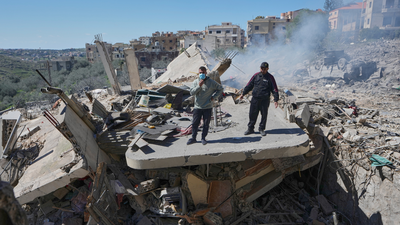
People stand on the ruins of destroyed homes bombed by Israeli air strikes in the village of Sir al-Gharbiyya, south of Lebanon. (AP photo)
Human Rights Watch claimed on Monday that the Israeli army “illegally” struck a village in southern Lebanon using shells containing white phosphorus, a controversial incendiary munition.The organization said in its report that it identified the geographical location and verified seven photos that it says show Israeli artillery firing white phosphorus at residential areas in the village of Yahmar in southern Lebanon. The raids occurred hours after the Israeli army warned residents of the village and dozens of other communities in southern Lebanon of the need to evacuate.
Human Rights Watch said it could not independently determine whether civilians were still present in the area at the time of the attack or whether anyone was harmed.“The Israeli army’s illegal use of white phosphorus over residential areas is extremely disturbing and will have serious consequences for civilians,” said Ramzi Qais, Lebanon researcher at Human Rights Watch.
The Israeli military has not issued a statement, but has said in the past that white phosphorus is used to create smokescreens rather than directly target civilians.Human rights groups, including Human Rights Watch and Amnesty International, have previously claimed that Israel used munitions during its recent war with Hezbollah, including in parts of southern Lebanon where civilians are still present.
What is white phosphorus and why is it controversial?
White phosphorus is a chemical that spreads through artillery shells, bombs and missiles and ignites when it comes into contact with oxygen. Once ignited, it burns at extremely high temperatures and can set fire to homes, farmland and other civilian buildings.Under international humanitarian law, the use of air-burst white phosphorus in indiscriminate populated areas is illegal, because it spreads burning fragments over a wide area and can cause serious injury to civilians.The weapon can burn human tissue and continues to burn when exposed to oxygen, making its effects particularly devastating. Because of these risks, international law requires militaries to take all feasible precautions to avoid harming civilians when using such munitions.
Clashes continue between the Israeli army and Hezbollah
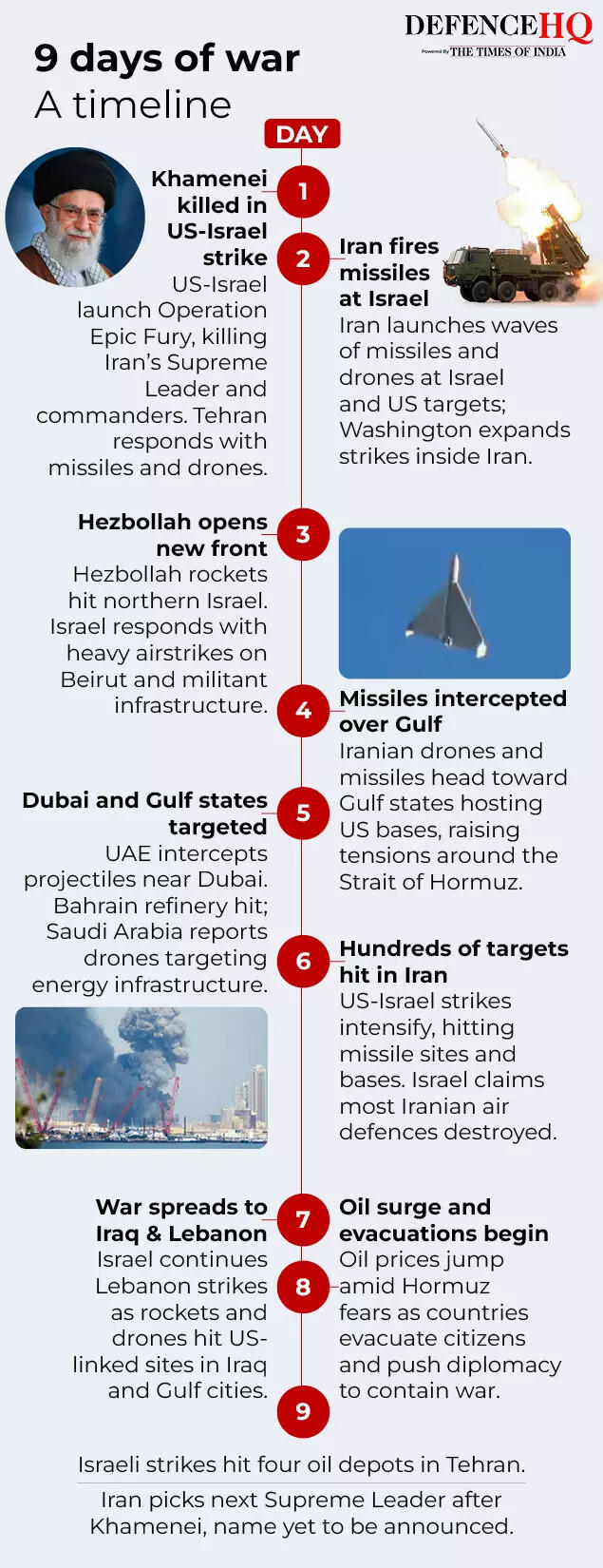
Hezbollah said on Monday that its fighters clashed with Israeli forces that landed by helicopter in eastern Lebanon across the Syrian border, in the second such operation since the outbreak of the recent conflict with Israel.Lebanon was drawn into the widening Middle East war last week when the Iranian-backed Hezbollah group launched attacks on Israel following the killing of Iranian Supreme Leader Ali Khamenei during joint US-Israeli strikes on Iran.Israel, which has continued to target Hezbollah despite a 2024 ceasefire, carried out multiple waves of strikes across Lebanon last week and deployed ground forces near border areas.Hezbollah said in a statement that it had detected “the infiltration of about 15 Israeli enemy helicopters” into eastern Lebanon from the Syrian side of the border, an area where the group maintains a strong presence. The group said that the fighters “engaged with the helicopters and the infiltrating force with appropriate weapons,” adding that the clashes were continuing.The National News Agency in Lebanon reported earlier that “violent clashes” took place near the outskirts of Nabi Sheet, where Israeli forces landed a helicopter.
In southern Lebanon, Hezbollah said it targeted Israeli soldiers who entered the border towns of Al-Adaysah and Aitaroun with artillery shells and clashed with forces in Al-Adaysah.Lebanese Health Minister Rakan Nasr al-Din said on Sunday that Israeli strikes across Lebanon led to the killing of 394 people over the past week, including 83 children and 42 women. The death toll includes four people killed in an Israeli raid on a hotel in central Beirut early Sunday – the first attack on the city center during the recent war.The Israeli military said it carried out a “precision strike” targeting five commanders of the Islamic Revolutionary Guard Corps’ Quds Force, the foreign operations arm of Iran’s Islamic Revolutionary Guard Corps, as they met at the hotel.