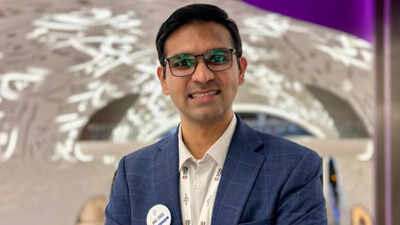
Startup founder Nikin Tharan
An Indian-origin businessman based in the US spoke about the difficulties he faced in his immigration journey, including being denied a green card twice despite obtaining an O-1 visa and creating several successful startups.Nikin Tharan, now a Bay Area-based founder, traced his path from building drum-playing robots as a teenager in Bengaluru to studying and launching companies in the US, while also facing repeated visa hurdles that he says almost ruined his career.Tharan moved to the United States when he was 16 after winning a scholarship to Northeastern University. He later worked on advanced radiation detection systems before entering the world of startups.
With five friends, he co-founded Medsix, a medical technology startup that won two MIT awards. He has since co-founded several ventures, including GreenCard Inc. and Openventure, a platform designed to help highly skilled immigrants manage admissions, housing, jobs and visas.
He watches
Explained: How US’s new H-1B bill could disrupt the study-to-work pathway for Indian students
Recalling his early years, Tharan said: “I grew up in Bangalore as a child interested in science and innovation, building circuits, and learning to build chips and boards as a teenager.
My parents were very progressive, and when they saw that I was advanced, they started homeschooling me. Since I did not fit the age criterion for the traditional Grade 10 exam, I took the Grade 10 IGCSE exam, according to the UK board, as a private candidate, and after passing it, I registered for Grade 11 two years ago.
“He said that his ambition to study abroad was limited due to financial constraints, until he obtained a scholarship that allowed him to pursue education in the United States.Tharan began his career journey on an F-1 visa and later worked within the CPT and OPT programs while building his early projects. He said he was careful about legal compliance throughout his early career, even while founding his first company, MedSix.However, his migration journey became increasingly complex as he progressed. His O-1 visa was quickly approved but his EB-1 green card applications were repeatedly denied.“I think that’s the immigration blind spot that we all have,” he said. “We think that if we do everything right, and excel in our fields, it will take care of itself. But for me it ended up killing me.”“I learned that you cannot overlook immigration barriers because they can damage your entire career and finances,” he added.Tharan faced multiple setbacks during this process. “I always had a work permit, but the process of getting a green card was tiring.
When I applied for the green card, the first time, I got an RFE which was then denied, and the second time it was denied again. “This was only the third time I had been accepted,” he said.He also talked about the anxiety of uncertainty during the process. “I was worried if this wasn’t implemented, how I would stay in the country, and what would happen to my startups. I underestimated this huge risk to my career, and my livelihood in the United States.”Despite strong professional accomplishments, including working in medical technology during COVID-19, he said his applications still faced rejection, leaving him confused.“On my second visit to RFE, they were telling me what they wanted. As I have done at many hackathons, they wanted peer reviews, case studies, and published research. I remember asking the lawyer – Instead of giving them the information we think is solid, why don’t we just give them what they ask for?” He said.This amendment ultimately helped in the success of his third application.Tharan now advises young founders to stay consistent with networking and learning opportunities. “Even if you don’t see immediate results, you will meet some people who are aligned with your vision,” he said.“Keep trying, and it will pay off,” he added.