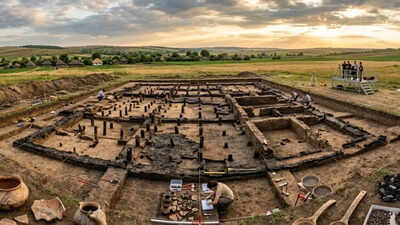
In Botoşani County, Romania, a team of archaeologists discovered a massive structure dating back 6,000 years. This discovery challenges our basic ideas about how human societies evolve.
According to a study published on the PLOS One website, the structure associated with the Cucuteni-Trypillia culture from about 4000 to 3900 BC, covers about 350 square metres. This is approximately four times larger than standard domestic dwellings of the period. Unlike major monuments of later times, this site does not show signs of elite wealth or a central leader. This suggests that prehistoric Europeans carried out large engineering projects through community efforts rather than the orders of rulers.
Located in Stăuceni-‘Holm, this discovery changes the way we think about prehistoric Europe. It proves that complex architecture can exist without complex social class hierarchies.
Scientists have been stunned by a 6,000-year-old giant structure hiding in Romania
The structure known as “Building 43” stands out as an unusual architectural feature from the Late Copper Age, specifically during the Cucuteni B1 phase. It is approximately 13 x 27 metres, covering a total area of approximately 350 square metres, as stated in a study published on PLOS One. Research indicates that people used sophisticated timber framing technology and large amounts of clay (plaster) to build it.
Building materials required hundreds of tons of clay and timber, indicating that the community made a significant collective effort, far greater than would be required for typical homes in the settlement.
Why did the Cucuteni-Tripilia culture burn their homes?
The research team conducted geomagnetic surveys and careful morphological analysis. They discovered that the huge structure was divided into internal parts. The main finding is evidence of “intentional shooting.”
Building No. 43, like many other buildings of the Cucuteni-Tripilia culture, was deliberately burned at the end of its use. Scientists found that some areas reached temperatures exceeding 800 degrees Celsius.
This suggests that the burning was likely a planned ritual, rather than an accident or act of war.
Researchers discovered henbane and poppy seeds
Excavation within the footprint and foundation levels revealed some rare pottery. Among them were an animal-shaped bowl and intricately designed ladles.
More importantly, the researchers discovered the burnt seeds of black henbane and opium poppy through detailed analysis. The finding of these psychoactive plant remains in a large common area indicates that the structure served as a “social center” or “ritual center.”
“Here, people are likely to come together to share experiences that may involve altered states of consciousness.
No luxury items found
The study published on the PLOS One website highlights an interesting point about site equity. Although the building is huge, there aren’t any luxury items like gold, copper, or rare imports that you would expect in the home of a king or chief. This information indicates that the Stăuceni people functioned as an evolving society without a single leader in charge. This massive structure served as a “community center,” demonstrating that ancient Europeans could achieve impressive engineering feats by working together socially, rather than under coercive authority.