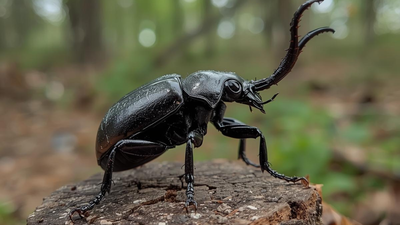
Have you ever crushed an insect underfoot and wondered why it keeps buzzing? Now, imagine a car tire rolling over; Most creatures would be crushed, but not this armored demon beetle.
Research published in the journal Nature found that this unusual desert dweller from the southwestern United States shrugs off forces that would flatten other insects, thanks to an exoskeleton stronger than steel. Scientists have only recently been able to crack the code, turning on this little beast and taking a look inside with high-tech scans. Their findings reveal a jigsaw-like armor that laughs in the face of overwhelming pressure, and inspires the future; Everything from bike parts to airplanes.
Why Iron beetle It can survive being run over by cars
The devil’s iron beetle (Phloeodes diabolicus) hails from the drylands of California and Arizona and cannot fly; It is an earth-hugger that has developed armor to repel predators such as shrews and coyotes. It weighs just three grams and features an exoskeleton that can withstand only 100 Newtons of tire force on dirt without twisting. “A car tire would exert a force of about 100 Newtons if it passed over the beetle on a dirt surface,” explained Pablo Zavatteri, a professor at Purdue University, in the study conducted by the team.
Using only compressed steel sheets, David Kisselos’ lab at the University of California, Irvine, pushed a single sample to 150 Newtons, 39,000 times the body’s weight, before any breakage occurred. Other ground beetles collapsed at half that. “This devil beetle can’t fly very far, so it’s adapted to living on the ground. It pretty much has to stand there and bear it,” Kesailus noted during experiments in which the beetle survived two car rollovers unscathed.
CT scans revealed the secret: the elytra (hard front wings embedded in the carapace) meet in a central seam that looks like interlocking saw blades.
Scientists have deciphered the truncated armor that protects the iron beetle
Here’s the genius part: physics meets biology in a double defense. When crushed, the blades of those puzzle pieces embedded in the string tighten tightly, preventing them from separating like cheap Lego pieces. The layers then separate gracefully, breaking down enough to absorb energy without completely collapsing.
“The suture kind of works like a jigsaw puzzle. It connects different puzzle pieces of the exoskeleton blades in the abdomen under the elytra,” Zavatteri described, after simulations and 3D-printed replicas confirmed the mechanism.
This setting dissipates force away from the weak neck, where most beetles explode. Only under extreme lab loads did it fail spectacularly, but real world tires? No contest. The layered protein fibers in Elytra are rich in glycine and interconnected just like a strong honeycomb, adding elasticity without fragility.
The Kesailus team measured it at just 105% more stringent than aircraft aluminum standards in pressure tests. “We had to test the folklore,” Kysailos admitted, laughing about verifying myths about roadkill with actual hit-and-runs.
Ironclad Beetle Engineering Inspiration: From Bugs to Bolts
The reformers of nature only dream big. Zavattieri’s team mimicked the stitches found in carbon fiber retainers, which were as strong as metal ones but much more flexible and would bend before breaking. “This work shows that we may be able to switch from using materials that are strong and brittle to ones that can be made strong and rigid by dissipating energy when they break.
“This is what nature enabled the devilish beetle to do,” Zavatteri concluded in his paper in the journal Nature.
Pictured bike helmets or drone frames do the trick with this clever beetle, a lighter kit that collapses completely when crushed, leaving you with no scratches. Kesselus’ team is experienced in biomimicry (they worked on batting mantis shrimp in a previous study), and now they’re looking at fixes for airplanes, too: wing joints or fuselage parts that prevent bird strikes.
The beetle’s low metabolism means that no energy is wasted during flight, and it all goes into the armor.
35% protein, 35% chitin, and a mineral matrix that holds it together only.Just outside the lab, this tale humbles us. In a world full of predators, for this little creature, evolution created a tank from scratch, without the need for technology. One spot in the wilderness? Don’t drive over it, tip your hat to the survivor who teaches us how to build tougher.