

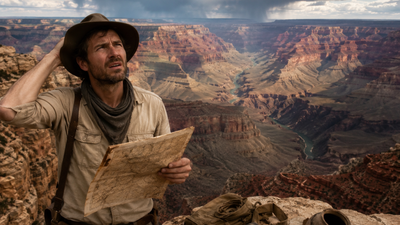
He entered a remote cave and expected to find nothing but geological formations and mineral deposits. Instead, according to one of the most controversial stories in American archaeology, the expedition uncovered ancient artifacts, engravings, and extraordinary evidence that seemed to challenge the conventional understanding of North American history.The claims were extraordinary. Reports described rooms filled with strange relics and symbols resembling those in ancient Egypt and artefacts unlike anything previously documented in the area. However, once the story surfaced, it seemed to disappear from public view. It was never officially confirmed, the alleged site remained elusive, and generations of researchers wondered whether the discovery was real, exaggerated, or entirely fabricated.More than a century later, the tale continues to fascinate historians, explorers and conspiracy theorists alike. At the heart of the mystery is a simple question: Has something remarkable been found in the depths of the Grand Canyon, or did one of archeology’s most enduring myths arise from a misunderstanding that took on a life of its own?
The alleged discovery of the Grand Canyon has sparked decades of speculation
According to Shaka’s guide, the story goes back to 1909, when an article in the Arizona Gazette claimed that an explorer named G.E.
Kincaid discovered an extensive cave system within the Grand Canyon.According to the report, the cave contains many rooms carved into the rock, along with statues, weapons, copper tools, and what were described as mummies. The article also claimed that some of the artefacts show Egyptian influences, raising speculation about ancient transoceanic contact long before European exploration of the Americas.The account quickly attracted attention due to the scale of the alleged discovery. If this information is accurate, it would represent one of the most important archaeological discoveries ever reported in North America.However, problems soon arose. No independent archaeological records have confirmed the existence of the cave. Researchers have never located the site described in the newspaper account, and no verified artifacts matching the report have appeared in museum collections.The lack of evidence has led many historians to believe that the story is either exaggerated or entirely fabricated. However, the mystery has persisted for over a hundred years, as there are still certain things in the case that cannot be explained with certainty.
Mummies were found in the Grand Canyon by ancient people
One of the most interesting parts of this case concerns the claim that mummies were found inside the cave.There were claims of burial chambers containing well-preserved bodies and artifacts, as well as various inscriptions.
These claims, especially since the artifacts were said to resemble those of the ancient Egyptians, have certainly attracted a lot of attention.But archaeologists have not found any reliable evidence to support these assertions. There are no verified excavation records, no mummies have been produced for scientific examination, and no peer-reviewed research has confirmed the alleged findings.This did little to diminish public fascination. The combination of hidden rooms, lost civilizations, and unexplained artefacts helped the story survive long after many similar legends had faded from memory.For some people, the lack of evidence points to a deliberate cover-up, while for others, it is simply the fact that sensational stories tend to travel faster than the truth.
Why does the mystery of the Grand Canyon still attract the attention of researchers and explorers?
The Grand Canyon is one of the most meticulously researched natural landmarks in the world. However, its vast size and challenging landscape fuel tales of caves and secret secrets.In many ways, the myth endures because it lies at the intersection of exploration and imagination.
A remote valley, an inaccessible cave, a mysterious artefact, and a vanishing discovery form the ingredients of a compelling mystery, regardless of whether the original claims are true.To date, no evidence has emerged to verify the existence of the alleged underground complex described in 1909. Historians generally view the account with a great deal of doubt, while archaeologists continue to assert that there is no physical evidence.However, the story refuses to disappear. More than a hundred years after its first appearance in print, the mystery remains a reminder of how easily fact, folklore, and speculation become intertwined.Whether it’s an extraordinary discovery vanished from history or simply a captivating newspaper story, the legend of the Grand Canyon continues to raise the same question that has intrigued readers for generations: What, if anything, was actually found inside this hidden cave?