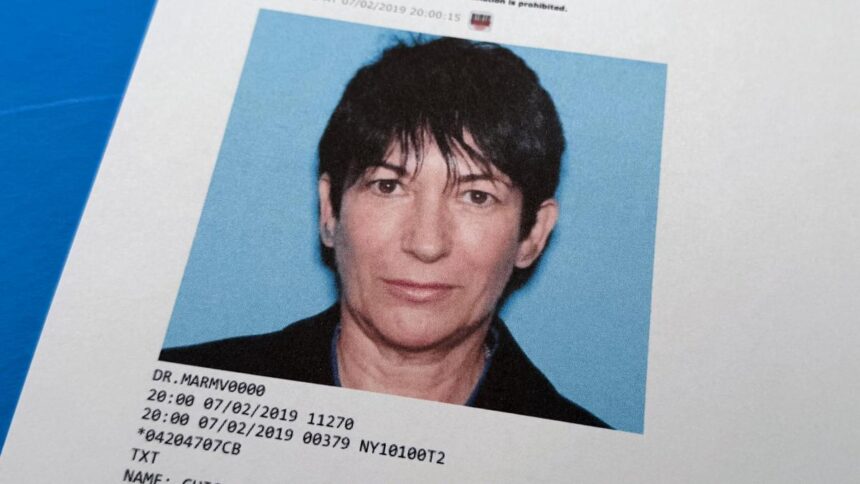

A document included in the US Department of Justice release of the Jeffrey Epstein files, taken on Tuesday, February 10, 2026, shows a photo of Ghislaine Maxwell in 2019. | Photo credit: AP
Lawyers for jailed British socialite Ghislaine Maxwell are fighting to release 90,000 pages related to disgraced financier Jeffrey Epstein and Maxwell, saying the law used to make millions of documents public is unconstitutional.

Lawyers filed documents Friday (Feb. 20, 2026) in Manhattan federal court to block the release of documents from a civil defamation lawsuit brought a decade ago against late Epstein victim Virginia Giuffre Maxwell. The Justice Department recently asked a judge to lift confidentiality requirements on the files.
Maxwell’s attorneys say the Justice Department did not obtain the documents during Maxwell’s criminal investigation — otherwise subject to confidentiality orders — improperly. They said the documents included transcripts of more than 30 depositions and private information about financial and sexual matters involving Maxwell and others.
Some records from the year-long exchange of testimony in the lawsuit battle have already been released publicly in response to a federal appeals court order.
Maxwell’s lawyers say the law passed by Congress in December to release millions of Epstein-related documents violates the Constitution’s separation of powers doctrine.
“According to the law of Congress, this court cannot abdicate authority or absolve itself of the responsibility to protect its files from abuse. To do so would violate the separation of powers,” attorneys Laura Menninger and Jeffrey Pagliuca wrote about the Epstein Files Transparency Act.
“Under the Constitution’s separation of powers, neither Congress nor the executive branch can encroach on judicial power. That power includes the power to decide cases and controversies conclusively and finally,” the lawyers added.
The release of Epstein-related documents from criminal probes that began weeks ago has revealed new details about Epstein’s decades of sexual abuse of women and teenage girls. Some victims have complained that their names and personal information were revealed in the documents, blacking out the names of their abusers.
Members of Congress have complained that only about half of the existing documents have been made public, with the exception of a few files that cannot be made public until a judge approves them, although Justice Department officials say they have all been released.
Giuffre said Epstein trafficked her to other men, including the former Prince Andrew, now known as Andrew Mountbatten-Windsor. She sued Mountbatten-Windsor in 2021, claiming they had sex when she was 17.
He denied her claims and the two settled the lawsuit in 2022. Days earlier, he was arrested and held for nearly 11 hours on suspicion of misconduct in sharing confidential trade information with Epstein.
In a memoir published after she killed herself last year, Giuffre wrote that prosecutors said she was not included in Maxwell’s sex-trafficking prosecution because they didn’t want her allegations to distract the jury.
Maxwell, 64, was convicted in December 2021 and sentenced to 20 years in prison. Epstein committed suicide in federal lockup in August 2019 while awaiting trial on sex-trafficking charges. Maxwell was moved from a federal prison in Florida to a low-security prison camp in Texas last summer after participating in two days of interviews with Deputy Attorney General Todd Blanche.
Two weeks ago, she declined to answer questions from House Oversight Committee lawmakers in a video call deposition to her federal prison camp, but indicated in a statement from her lawyer that she was “willing to speak fully and honestly” if she was granted a pardon.
The Justice Department did not immediately respond to a request for comment Saturday.
Published – February 22, 2026 03:20 am IST