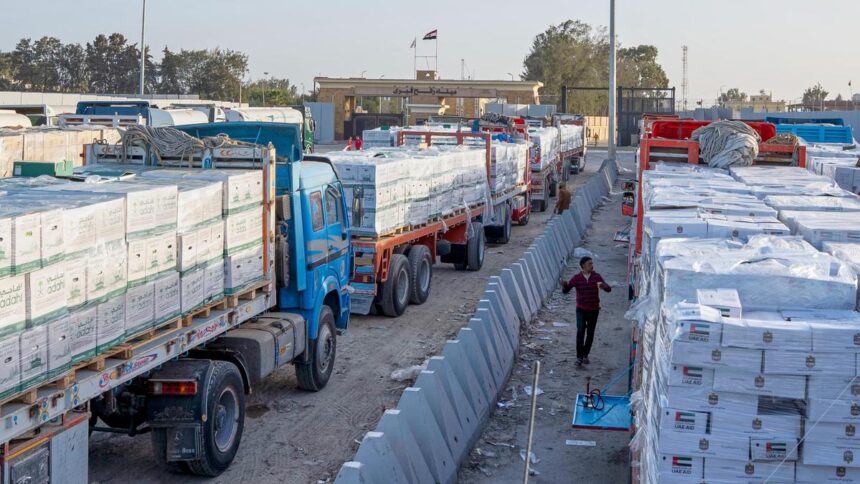
Palestinians in Gaza watched with hope and anticipation on Sunday as workers laid the groundwork to reopen the territory Rafah border crossing with Egyptits lifeline to the world. Israel says the crossing is scheduled to reopen on Monday (February 2, 2026) as a ceasefire with Hamas moves forward.
“Opening the crossing is a good step, but they have set a limit on the number of people allowed to cross and this is a problem,” said Ghalia Abu Mustafa, a woman from Khan Yunis.
Israel said the crossing was open in testing, and the Israeli military agency that controls aid to Gaza said residents could begin crossing on Monday. But at first only a small number of people could cross.
“We want more people to leave, it will be open so that sick people can go and come back,” said Suhaila al-Astal, a displaced woman from Rafah city, who said her sick daughter needed help abroad. “We want the crossing to stay open forever.” Israel’s announcement came a day after Israeli strikes killed at least 30 Palestinians, including several children, according to hospital officials — one of the highest death tolls since the ceasefire began on Oct. 10. Israel accuses Hamas of violating the new deal.
Nikolay Mladenov, director general of US President Donald Trump’s new board of peace in Gaza, urged the parties to “exercise restraint” and said his office was working with a new Palestinian committee chosen to monitor Gaza to find ways to prevent future incidents.
Tens of thousands of people initially enter and leave Gaza
The Rafah crossing has been largely closed since its capture by Israel in May 2024. About 20,000 Palestinian children and adults in need of medical care are hoping to cross into war-torn Gaza, and thousands of Palestinians from outside the territory are hoping to return home.
At first few people and no goods were allowed to cross. Prime Minister Benjamin Netanyahu said Israel would allow 50 patients in need of medical evacuation to leave each day. An official involved in the discussions, speaking on condition of anonymity to discuss diplomatic negotiations, said each patient could travel with two relatives, while 50 people who left Gaza during the war could return each day.
Zaher al-Wahidi, head of the Gaza Ministry of Health’s documentation department, told The Associated Press that the ministry had not been notified of the start of the medical evacuation.
Israel has said and will check people for exit and entry through the Egyptian crossing, which is monitored by European Union border patrol agents. If the system is successful, the number of passengers is expected to increase over time.
Israel stops the work of Doctors Without Borders in Gaza
On Sunday, Israel’s Diaspora Ministry said it was going to “terminate” Doctors Without Borders’ operation in Gaza by February 28.
Israel suspended the group’s operations in December after it refused to comply with new registration requirements for firms to submit lists of local employees. The medical charity said the rules could put Palestinian staff at risk.
Doctors Without Borders does not have an immediate response. It said Israel’s decision would have a “catastrophic impact” on its work in Gaza, where it provides funding and international staff to six hospitals and runs two field hospitals and eight primary health centers, clinics and medical centers. It also runs two of Gaza’s five stabilization centers that help severely malnourished children.
Israel has suspended two dozen humanitarian organizations from operating in Gaza for failure or refusal to comply with the new requirements.
The Diaspora Ministry, which proposed them, says they aim to prevent Hamas and other militant groups from infiltrating aid groups. Organizations call the rules arbitrary and warn that the bans will harm civilian populations that need help.
Gaza’s health sector has been devastated by two years of Israeli bombardment and restrictions on supplies.
Rafah is the main crossing of Gaza
Palestinian security officials passed through the Egyptian gate of the Rafah crossing on Sunday and headed to the Palestinian gate to join an EU operation monitoring exits and entries, said an Egyptian official who spoke on condition of anonymity because he was not authorized to speak to the media. Ambulances crossed through Egypt Gate, the official said.
Before the war, moving in and out of Gaza Rafa was the main crossing for the Isu people. The region has four other border crossings with Israel.
Israel seized the Rafah crossing in 2024 as part of efforts to combat arms smuggling by Hamas. The crossing was briefly opened for the evacuation of medical patients during a ceasefire in early 2025. Israel has again resisted reopening the Rafah crossing, but last week cleared the way for the recovery of the remains of the last hostages in Gaza to proceed.
Under the terms of the ceasefire, Israel’s army controls the area between the Rafah crossing and the zone where most Palestinians live.
Fearing that Israel could use the crossing to push Palestinians out of the enclave, Egypt has repeatedly said the crossing should be free in both directions. Historically, Palestinians from Israel and Egypt have applied for the crossing.
The ceasefire halted a two-year war between Israel and Hamas that began with a Hamas-led attack on southern Israel on October 7, 2023, which killed nearly 1,200 people, mostly civilians, and took 251 hostages.
Israel’s retaliatory offensive has killed 71,795 Palestinians, including 523 since the cease-fire began, according to Gaza’s health ministry. The ministry does not distinguish between civilians and combatants in its statistics. It maintains detailed accident records that are generally found reliable by UN agencies and independent experts.
The first phase of the ceasefire called for the exchange of all hostages held in Gaza for hundreds of Palestinians held by Israel, humanitarian aid and a partial withdrawal of Israeli forces.
The second step is more complicated. It calls for steps to establish a new Palestinian committee to rule Gaza, deploy an international security force, disarm Hamas and begin reconstruction.