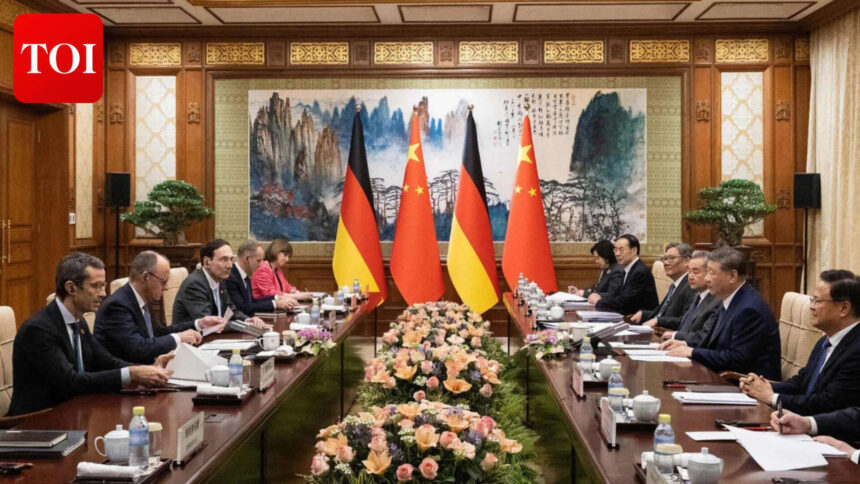
Chinese President Xi Jinping, second from right, meets with German Chancellor Friedrich Merz, second from left, at the Diaoyutai State Guest House in Beijing, China (Image source: AP)
German Chancellor Friedrich Merz on Wednesday called for closer cooperation with China as he pressed for fairer trade rules and urged Beijing to use its influence to help end the war in Ukraine.Merz, on his first trip to China since taking office in May last year, met Premier Li Qiang and subsequent President Xi Jinping in Beijing during a two-day visit aimed at strengthening ties with Germany’s largest trading partner, even as Berlin views Beijing as a systemic rival.“We have some issues that we need to talk about today during my visit,” the Associated Press news agency quoted Mears as telling Lee. “But I believe there is also great potential for further growth in our economy.”
He added that cooperation should continue “wherever possible.”Xi told Merz that he is ready to take bilateral relations to “new levels” and stressed that he “always attaches great importance to Sino-German relations,” Agence France-Presse reported. Merz described the trip as a “great opportunity” to strengthen economic relations, and said he hoped that joint government consultations, which were temporarily suspended due to political changes and the pandemic, would resume “very soon.”
Pressure on China over Ukraine
Merz indicated before landing in Beijing that he would ask for China’s help in ending Russia’s four-year-old war in Ukraine.He stressed that despite the differences, “it is no longer possible to address today’s major global political problems without involving Beijing,” noting that “Beijing’s voice is heard, including in Moscow.”Many European governments have expressed frustration that China has not done more to pressure Russia.
Beijing maintains close diplomatic and trade relations with Moscow and says its position on the conflict is neutral.“We hope that all parties will seize the opportunity to reach a comprehensive, lasting and binding peace agreement,” Chinese Foreign Ministry spokesman Mao Ning said earlier this week.
Background of trade tensions and tariffs
Merz’s visit comes amid global economic uncertainty caused by tariffs imposed by US President Donald Trump and demands from allies to take more responsibility for their security.China has sought to mobilize support from other countries to confront what it sees as increasing unilateralism and protectionism. In an apparent reference to the United States, Li said that “unilateralism and protectionism have gained ground and even become mainstream in some countries and regions,” adding that China and Germany should “jointly safeguard multilateralism and free trade.”Merz stressed that Germany’s policy towards China must be placed within the framework of a broader European approach.
He added: “Our message from the European point of view is the same: we want a balanced, reliable, orderly and fair partnership with China.” “This is our offer. At the same time, this is what we also hope and expect from the Chinese side.”
Trade imbalances and concerns about excess capacity
Economic imbalances remain a major sticking point. According to the Associated Press, Germany’s imports from China rose 8.8 percent to 170.6 billion euros ($201 billion) last year, while exports to China fell 9.7 percent to 81.3 billion euros ($96 billion).Germany’s trade deficit with China reached a record high of 89 billion euros (105 billion US dollars) last year.European leaders, including Merz, are seeking better market access for their companies and cuts in what they describe as systemic excess capacity in sectors such as electric cars and solar panels. “We also want to discuss how we can find a remedy, for example, where systemic excess capacities arise, where there are export restrictions, where there are access restrictions…that distort and prevent competition,” Merz said.German industry representatives urged Merz to address “excess capacity, competition distortions and export controls on vital raw materials,” AFP reported, warning of potential new trade conflicts with the EU if structural reforms are not made.
Strategic competition amid economic interdependence
While China overtook the United States to become Germany’s largest trading partner last year, Berlin also views Beijing as a strategic and systemic rival.Merz admitted before departure that China “demands the right to define a new multilateral order according to its own rules,” warning against illusions even as he stressed the need for global economic relations.The Chancellor is accompanied by a large trade delegation, which includes executives from major German automakers and industrial companies, which highlights the economic risks of the visit.