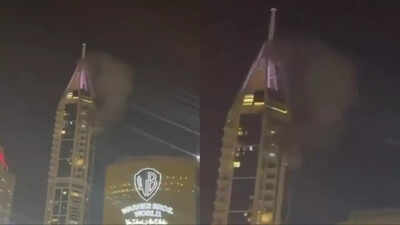
Dubai confirms that the Dubai Marina accident was due to an air interception: what actually happened in the Emirate of the United Arab Emirates
Dubai authorities have confirmed that the latest incident in the Dubai Marina area was caused by debris resulting from a successful air interception, reassuring residents that the situation has been contained and public safety remains intact.
The event occurred amid escalating regional tensions linked to the ongoing conflict involving Iran, the United States and Israel, which has led to missile and drone activity across parts of the Middle East that host US military bases.While the incident sparked concern after videos of smoke and damage circulated on social media, officials stressed that it was a minor accident caused by falling debris and not a direct attack on the city.
This clarification helped calm fears in one of the busiest residential and tourist areas in Dubai.
What happened in Dubai? Marina
According to the Dubai Media Office, debris from a projectile that was successfully intercepted by air defense systems hit the facade of a tower in Dubai Marina. The authorities confirmed that emergency teams responded quickly and secured the area. Officials said the incident was limited in scope and no injuries were reported in the tower, with damage mainly affecting the exterior of the building.
Dubai Marina is one of the emirate’s most densely populated neighborhoods, home to luxury residential towers, hotels and popular waterfront attractions. Given its international profile and status, even a small incident there quickly attracted attention online and in the international media. The authorities confirmed that the situation was quickly under control and residents could resume their normal activities.The incident did not occur in isolation. This comes during an ongoing wave of missile and drone attacks linked to the escalating conflict between Iran, the United States, and Israel, which has spread to many Gulf countries. Since the conflict intensified in late February 2026, UAE air defense systems have intercepted hundreds of drones and missiles, preventing most of them from reaching populated areas. However, fragments of intercepted projectiles sometimes bounce back to the ground, creating secondary hazards.Experts say this is a common challenge during missile interceptions. When defense systems destroy incoming threats in the air, pieces of debris can scatter over large areas before falling to the ground. In this case, authorities say the debris that struck the building in Dubai Marina was the result of one of these interceptions.
Dubai Air Defense and public safety procedures
The UAE Ministry of Defense actively responds to incoming threats using a network of advanced air defense systems designed to detect and intercept missiles and drones.
These systems include radar detection, early warning, and interceptor missiles that destroy incoming projectiles before they reach their targets.The authorities also took additional precautionary steps during the conflict, including:
- Issuing public safety alerts to warn residents of potential missile threats
- Temporarily closing airspace during active interceptions
- Deploy emergency response teams in key areas
- Monitoring critical infrastructure such as airports, ports and residential areas
During the recent event, residents across the UAE reportedly received mobile alerts advising them to seek temporary shelter during interceptions.
Shortly after, officials issued a “crystal clear” message confirming that the situation was safe.
Why can interception debris still cause damage?
Even when air defense systems work as intended, interceptions still pose risks to civilians. When a missile or drone is destroyed in the air, it breaks up into fragments. These parts can include:
- Pieces of the missile body
- Fuel tanks
- Electronics and steering systems
- Fragments of the interceptor missile itself
Depending on the height of interception, these fragments may fall back to the ground across a wide radius.
Military analysts point out that this phenomenon has been seen in numerous conflicts around the world, including missile defense operations in Israel, Ukraine and Saudi Arabia. In many cases, debris causes limited structural damage, but still poses a risk to people and vehicles on the ground.
Rapid response to emergencies in Dubai
The authorities credit the rapid containment of the Dubai Marina incident to the emirate’s advanced emergency response infrastructure.
Emergency teams, including Dubai Civil Defence, police units and medical responders, were dispatched as soon as reports of the incident emerged.
Their responsibilities included securing the damaged building, assessing structural damage, assisting residents if evacuation was necessary, and ensuring that no unexploded debris remained. Officials later confirmed that the damage was minor and that residents were fine.Videos and photos from the scene of the accident spread quickly on social media, showing smoke rising from a tower in Dubai Marina. These images led to speculation that the city had been directly targeted. But the authorities were quick to clarify the situation, explaining that the damage resulted from intercepted debris and not a successful strike.The Dubai Media Office urged residents and the media to rely on official sources to obtain accurate information, especially during periods of heightened regional tensions.
Misinformation during security incidents can spread quickly across the Internet, sometimes causing unnecessary panic.
The Bigger Picture: Gulf Security During the Iran-US-Israel Conflict
The Dubai Marina incident reflects the broader security challenges facing Gulf states during the current regional crisis. Since the escalation began, several countries in the region, including the UAE, Qatar and Bahrain, have reported missile or drone threats linked to the Iran-Israel-US conflict.
Many of these attacks targeted military installations or strategic infrastructure, but defense systems intercepted most of them before impact.According to official figures, hundreds of drones and missiles have been intercepted over the UAE since the conflict began, greatly limiting potential damage. However, falling debris from interceptions remains an unavoidable hazard in densely populated urban environments.
Security analysts say the next situation will depend largely on how the broader conflict develops in the coming weeks. If tensions escalate further, Gulf states may continue to enhance air defense readiness, early warning systems, and coordination with allied defense forces. Meanwhile, authorities will likely continue to issue public safety alerts whenever interceptions occur.For now, officials in Dubai maintain that the city remains safe and that the recent Dubai Marina incident was brought under control quickly and was limited in scope.