

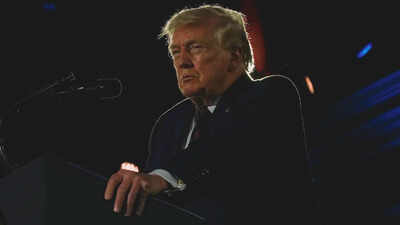
Archive photo: US President Donald Trump
TOI correspondent from Washington: In an expletive-laden social media post, US President Donald Trump on Sunday threatened to rain fire on Iran if it did not open the Strait of Hormuz, calling its leaders “crazy.”
” “Tuesday will be Power Plant Day and Bridge Day, all in one day in Iran. There will be nothing like it!!! Open the strait you crazy person, or you will live in hell – just watch! Thank God,” Trump posted on Easter Sunday, an important Christian holiday, celebrating the resurrection of Jesus Christ from the dead three days after his crucifixion.
He watches
“You crazy bastards”: Trump’s insulting comments about Iran after the pilot’s rescue; Dropping the new “Iran deal” date
The tone and language of the post were so vile and unexpected that the media checked whether the US President had actually posted such a message, just to confirm that he had.
There appeared to be an air of desperation in Trump’s post despite the rescue of an American pilot stranded in the Iranian desert in a daring operation just a few hours earlier, with some US analysts believing he is frustrated by his inability to overcome Iran.
In a phone interview with Fox News after his office, Trump said that he expects to conclude an agreement with Iran tomorrow (Monday), and that his team is negotiating with some of the Iranian leaders who received the pardon.
Trump was quoted as saying, “If they don’t reach an agreement and quickly, I’m thinking about blowing up the whole thing and taking the oil. You’ll see bridges and power plants collapsing all over their country.”But Iran defiantly mocked Trump in social media posts from state media, suggesting that there were no formal talks and that American interlocutors might be talking to forces that Washington expected would topple Iran’s ruling regime. In a previous post, Trump warned Iran that it had “48 hours before hell descends upon them,” referring to the possibility of launching expanded strikes on Iranian infrastructure, which the angry American president appears to prefer. US forces have already targeted a key bridge linking Tehran to Karaj – a video of which Trump posted – with Iranian media reporting civilian casualties. Administration officials have reportedly discussed more strikes on electric power plants and transportation networks, arguing that such targets have dual-use military value by supporting missile and drone logistics.The emerging US strategy has sparked intense debate within political and legal circles, with critics warning that such an approach could turn into collective punishment of Iran’s civilian population. Any large-scale attacks on infrastructure could have devastating humanitarian consequences for the Iranian people, who have already been suffering for a long time. But advocates inside the Pentagon say modern warfare is increasingly blurring the line between civilian and military infrastructure, arguing that weakening these systems is necessary to limit Tehran’s ability to wage war and develop advanced weapons, including the drones and missiles that have troubled the United States and Israel.
The United States also attacked steel factories in Iran. Opponents believe that such strikes risk violating international humanitarian law, especially the principles of proportionality and distinction. They also warn that targeting infrastructure could backfire at a strategic level, hardening Iranian public opinion and strengthening the regime’s resolve. The international community also appears uneasy, with European analysts expressing concern about escalation dynamics, while humanitarian organizations warn of cascading effects on water systems, healthcare and food supplies.