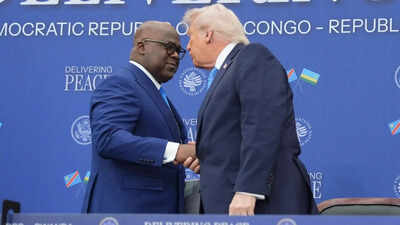
Archive photo: US President Donald Trump with President of the Democratic Republic of the Congo Felix Tshisekedi (Image source: AP)
The Democratic Republic of Congo will begin accepting third-country nationals deported from the United States starting in April under a new agreement with the Trump administration, the Kinshasa government said on Sunday.The Congolese government said in a statement that it would receive the deportees starting next month, although it did not mention the number of people it had agreed to receive. She added that this arrangement will be fully funded by the United States, without any financial burden on Congo.
He watches
Changes at the Pentagon deepened as Iran mocked Trump and questions grew about military purges and war plans
According to Reuters, the government also said that facilities have already been prepared near the capital, Kinshasa, to house the deportees.
The deal comes as the United States expands its African deportation network
The agreement makes Congo the latest African country to be drawn into Washington’s increasing use of so-called third-country deportations, a policy under which migrants are sent to countries other than their own to speed up removals from the United States.Congo has been in talks with the Trump administration about such an arrangement, with discussions also described by UN sources and diplomats briefed by US officials. At that point, key details including the number of migrants, their nationalities and the timeline have not been finalized.The United States has already sent third-country deportees to several African countries, including Ghana, Cameroon, Equatorial Guinea and Eswatini, according to Reuters.
Such arrangements have increasingly become a key part of Donald Trump’s hard-line immigration strategy, as the administration searches for more foreign partners as it seeks to speed up deportations.
Human rights groups and legal experts are raising concerns
The increasing use of third-country deportation deals has drawn criticism from legal experts and human rights groups.Critics have questioned the legal basis of these transfers and the treatment of deportees who are sent to countries of which they are not citizens.
In some cases, migrants were allegedly sent despite having court-ordered protections in the United States intended to prevent them from being returned to danger.According to the New York Times, the Trump administration has quietly pursued similar arrangements with a number of African countries, often offering incentives such as financing, visa relief, tariff relief or other diplomatic concessions in return.The White House has pushed American diplomats to secure such deals more quickly, with internal communications indicating that officials were encouraged to ask governments whether they would accept more deportees in exchange for greater support.Some migrants sent to third countries end up in detention facilities or detention centers in places with poor human rights records, weak legal systems and limited oversight.
The Congo agreement intersects with minerals and regional diplomacy
The timing of the Congo deal is also important.The arrangement coincides with broader efforts by the Trump administration to advance a peace agreement between Congo and Rwanda, while ensuring U.S. access to vital Congolese minerals.This overlap is likely to lead to greater scrutiny of whether cooperation on migration is linked to broader geopolitical and economic interests in Central Africa.While the Congolese government has now confirmed the deal, it has not publicly revealed how many deportees it will receive or what nationalities may be involved.Reuters had previously reported, citing a source at the International Organization for Migration, that the plan being discussed could include migrants from South America, including Venezuelans.