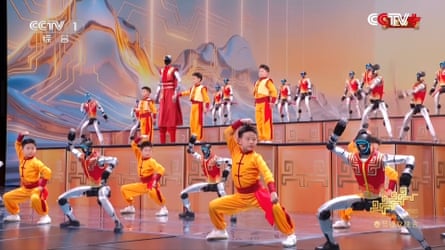
Dancing humanoid robots took center stage Monday during China Media Group’s annual Spring Festival Gala, China’s most-watched official television broadcast. They exhaled and turned back (landed on their knees), they spun around and jumped. Not one fell.
The show was impressive, but left some wondering: If robots can now dance and do martial arts, what else can they do?
Experts have mixed views, with some saying the robots have limitations and the show should be viewed through the lens of state propaganda.
Developed by several Chinese robotics firms, the robots performed a series of complex acrobatics, including kung fu, comedy sketches and dances performed alongside human performers.
Clips circulating online quickly drew comparisons to last year’s Lunar New Year broadcast, which also featured dancing robots but noticeably simpler moves.
Beijing uses these public robot demonstrations to “dazzle domestic and international audiences with China’s technological prowess,” said Kyle Chan, an expert on China’s technology development at the Brookings Institution in Washington DC.
“Far from AI prototypes or industrial devices, humanoid robots are the most visible examples of China’s technological leadership that ordinary audiences can see on their phones or televisions,” he said.
Intensifying competition in the technology sector between China and the US, Chan added: “Although China and the US are neck and neck on AI, humanoid robots is an area where China can be said to be ahead of the US, especially in ramping up production.”
George Steeler, head of robotics and automation at global technology consulting firm Steeler Technology and Marketing, also emphasized the symbolism of China’s prime-time broadcast.
“The visibility of the pipeline, from industrial policy to prime-time spectacle, sets the gala apart from comparable events elsewhere,” Steeler said in a statement.
Comparing this year’s performances to last year’s – when viewers saw “basically the same choreographic mode” with limited movements such as walking, twisting and kicking – a key sign of China’s robot progress is the “ability to execute large numbers of identical humanoids in synchronized and sustained movement,” Steeler said.
But Stiller also notes: “Theatrical performance doesn’t equate to industrial rigor, yet.” Robots are “the result of being trained hundreds or thousands of times – you can’t tell them to change direction or do something completely different,” he said.
“These dance motions have very little environmental awareness and must involve a balance-keeping controller along with simulated learning. This has little impact on reliability in a structured environment, which is required for factory-grade deployment. Also, advances in efficiency are not as fast as in locomotion,” he says.
The unveiling of China’s latest generation of robots underscores the country’s broader technological ambitions.
According to state data, by the end of 2024, China will have registered 451,700 smart robotics companies with a total capital of 6.44tn yuan (about $932.16bn). Major government projects such as Made in China 2025 and the 14th Five-Year Plan have made robotics and AI key Beijing priorities.
Morgan Stanley predicts China’s humanoid sales will not double to 28,000 units in 2026; And Elon Musk says he expects Chinese companies to be his biggest competitor as he focuses on the AI that embodies Tesla and its flagship humanoid Optimus. “People outside of China underestimate China, but China is an ass-kicker to the next level,” Musk said last month.
Such a visible display represents a new phase in China’s manufacturing masterplan, where “robotics will become a small pin in the transition from low-cost assembly to high-end, smart manufacturing,” said Marina Zhang, professor of technology at the University of Technology Sydney.
With Reuters