

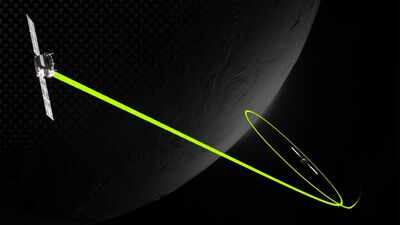
Image credit: The True Anomaly
For decades, space battles belonged to the world of Star Wars and science fiction. But as more satellites fill Earth’s orbit, military powers are now preparing for a future in which satellites may have to track, approach and respond to competing spacecraft in orbit.This idea moved one step closer to reality after the US Space Force announced the successful completion of the Victus Haze mission, in which two satellites carried out an orbital intercept simulation. The exercise tested how quickly the spacecraft could locate, approach and evaluate another satellite, demonstrating capabilities that could be used during future military operations in space.The mission included two commercial satellites built by different companies.
Rocket Lab’s Pioneer-class Puma satellite was launched aboard an Electron rocket on June 19 after receiving just 16 hours and 42 minutes of launch notice, setting a new record for the company’s spaceflight readiness. The satellite joins the True Anomaly spacecraft JACKAL-0004, which had already been launched into orbit on a SpaceX Falcon 9 rocket in May and was waiting for its counterpart.Once both satellites reached orbit, they began a series of operations designed to simulate the interception of a potential enemy spacecraft.
The satellites had to quickly locate each other, meet in space and evaluate the target. The US Space Force had set a deadline of 72 hours for the exercise, but the mission was completed 11 hours ahead of schedule, according to a statement from True Anomaly.Victus Haze is the second mission under the Space Force’s Tactically Responsive Space (TacRS) program. The first mission, Victus Nox, launched by Firefly Aerospace in September 2023, focused on improving space domain awareness.
Victus Haze went further by showing a tactical engagement between two satellites in orbit.During the mission, JACKAL successfully carried out several planned operations while tracking the Puma. According to True Anomaly, the spacecraft performed a propulsion burn, closed-loop tracking, and precise pointing and imaging before returning to its original orbit.“The Jackal performed exactly as designed, demonstrating precise thrust burn and nominal entry, successful closed-loop tracking, precise guidance, and imaging and characterization of the target before exiting to its primary orbit,” the company said.The two satellites also completed multiple threat awareness and space-domain response scenarios and executed dynamic engagements with each other “during the exercise,” the US Space Force said.“Victus Haze is poised to further demonstrate our willingness to rely on our commercial partners to deny, disrupt and counter any adversarial advantage, no matter where they attempt to operate in space,” said Acting Space Force Portfolio Acquisition Executive Col.
Bryon McLean said in a statement.Once mission operations began, True Anomaly transferred control of JACKAL to its space superiority program, called Mosaic, which planned and executed the mission alongside Rocket Lab’s Pioneer satellite platform.True Anomaly also said the mission demonstrated that quickly launching a satellite and identifying a newly discovered object in orbit is now part of the same capability.“Victus Haze proves that responsive launch and responsive characterization are one capability. Get a new object within hours, lock down the geometry, and deliver the images. The next step is cadence – faster, more often, and across more orbits,” the company said.