

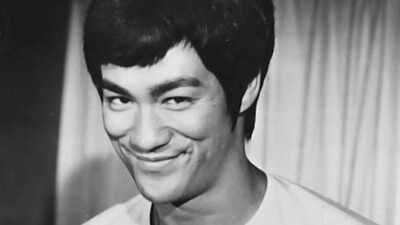
Bruce Lee (Photo: Wikipedia)
Most people, if they’re honest, spend a good portion of their lives trying to make things easier. Easier work. Easier relationships. An easier morning. There is nothing wrong with this instinct.
Difficulty hurts us, and we are forced to turn away from the pain. But Bruce Lee spent most of his short life testing a completely different idea. He believed that the desire for comfort was the very thing that kept a person young. And somewhere between practice halls in Oakland and a bedroom in Los Angeles, where he was once forced to stop moving altogether, he wrote lyrics that still get people moving. It is not complicated. But it’s not easy either.
Quote of the day by Bruce Lee
“Don’t pray for an easy life, pray for the strength to endure the hard life.”
What is Bruce Lee actually saying here
Read it once and it will look like something you might see on a motivational poster. Read it again and you’ll find something clearer underneath.Lee puts two options side by side. Praying for an easy life is, in essence, asking the world to be kind to you. So that problems diminish, obstacles move aside, and difficult things do not simply appear. It seems reasonable. Most of us perform this prayer in some form every day.
Praying for strength is something different. The difficulty is not required to disappear. It requires the personal ability to get through it without breaking. The world remains difficult. It gets harder.This is the whole argument packed into one sentence. Lee believes that the desire for ease is a kind of quiet surrender. A life built on avoiding difficulties builds nothing at all. True, lasting power only comes through testing.So the takeaway is clear. Stop asking about the path to become smoother. Start building legs that can handle whatever they throw at you.
Bruce Lee wrote this apartment on his back in Los Angeles
Lee has never given a famous public speech with this quote attached. They come from his personal diaries and notebooks, writings carefully preserved by his wife, Linda, after his death in July 1973. He wrote constantly, drawing ideas from Taoist philosophy, from Stoic thinkers, and from his own hours of training.
The notebooks read like a man doing things for himself, not performing them for the public.A certain period of his life gives the quote its real weight.In 1970, while training alone in his garage in Los Angeles, Lee seriously injured his fourth sacral nerve while performing a back exercise. The damage left him bedridden for six months. For someone who built his entire identity around movement and physical discipline, that sentence was harsh.
He couldn’t train. He couldn’t even stand without pain.What he did with this forced stillness is of great importance. read. books. he thought. The collection of ideas that later became The Tao Jeet Kune Do, published posthumously in 1975, was largely shaped during those months of convalescence. He was unable to go to the training hall. So he delved into why training is important and what its purpose really is.Praying for strength was not an abstract idea he built in comfort.
He was living it, whether he chose to or not.
Two prayers, two very different lives
Follow each choice forward and you’ll end up with two completely different people.The person who prays for an easy life begins to organize his entire existence around avoiding pain. They make the safe choice because the risky option may not work. They dropped the difficult conversation before it even started. They give up on the goal the first time it gets really difficult. As the years pass, this becomes a habit.
The world feels more difficult because they have stopped building the capacity to deal with it.Whoever prays for strength does the opposite. They tend to the hard thing. Not because they enjoy suffering, but because they understand it as the cost of gaining power. They fail and get back up. They do the uncomfortable thing and find out they can survive it. Over time, problems of the same size seem smaller because the person facing them quietly grows older.He’s not telling me that you should look for suffering. He is saying that when it arrives, and it will arrive, it is the quality of your response that shapes your life. You either get better at dealing with difficult things or you get worse at dealing with them. There is no place still standing.
Why is this territory harder now than ever before?
Culture has moved in two directions at once, both of which make this quote more important rather than less important.One direction is the crowd trap. Many people have picked up on Lee’s words and decided that they mean you should grind yourself into the ground, sleep less, never rest, and treat exhaustion as proof that you’re working hard enough.
This is a really bad reading of what he was saying. Lee was not glorifying suffering per se. He was talking about building real resilience. These two things are not the same thing.Another trend is avoidance dressed up as self-care. Comfort is real and important. But there is a version of taking care of yourself that has quietly become an excuse not to do the hard things. Not having the difficult conversation.
Don’t start the scary project. Not pushing when something is really important. Lee had no patience for that either.What he was referring to is a middle path that is really difficult to walk. Take difficulty seriously without manufacturing it. When life throws something difficult at you, face it with everything you’ve got. These are all instructions.
Put it into practice in your own life
You don’t need to be a martial artist or philosopher to use this idea.
It works on a normal scale, on a normal week.Stop waiting for the right circumstances. The project, conversation, and change you keep delaying won’t get easier by waiting. It will only happen later. Start where you are.Notice what you avoid. There is always one uncomfortable thing sitting in the back of your mind that you keep thinking about every day. This is usually the thing worth doing.Reframe what difficulty means. When something is difficult, most people take it as a sign that they are doing something wrong.
Lee says the opposite. Difficult usually means that you are somewhere worth being.Do the little things constantly. Physical exercise, honest relationships, learning new skills, and taking real responsibility. Each one is a small daily vote for the type of person you will become. None of them are comfortable. They are all collected.When you fall, ask what it teaches you. Lee spent six months in bed, unable to move.
He came out of it with some of the clearest ideas of his life. It turns out that the setback was part of the job.
Other voices arrived at the same place
Lee was not the first to come up with this idea. It continues to appear across centuries and cultures because people continue to discover its validity.Marcus Aurelius, writing in his private diary in second-century Rome, was constantly pushing himself not to want to carry a lighter load, but to build a stronger back.
Different words, same logic.There is an old Japanese proverb that says: Fall down seven times, get up eight times. Short and casual. The point is not that falling is acceptable. The point is, coming back every time is the important thing.The Stoic philosopher Epictetus, whom Lee studied closely, taught us that we suffer not from the events themselves but from our judgments about whether we can handle them. The difficult thing is rarely the real problem.
Our conviction that we cannot survive is just that.Different centuries. A different life. A stubborn recurrent finding. The ability to endure difficulties is not a reward you get after life becomes easier. It’s the thing you build by refusing to look away.
Final thought
Lee died in Hong Kong on 20 July 1973. He was thirty-two years old. He mustered in those years a real philosophy, greater discipline, and more creative thinking than most people have been able to achieve in twice the time.The notebooks survived. Linda Cadwell preserved everything. Years later, the world received the Tao of Jeet Kune Do, and quotes began appearing on walls, phone screens, and gym posters. Most people know one about water. This one deserves equal attention.Because he asks u Really, from the person reading it. He is not asking you to create suffering or wear hardship as a badge. It asks you to stop running away from the difficulty that already exists. To stop praying for the road to be smooth, and start asking for the endurance to walk no matter what road comes your way.Easy life doesn’t come. But the power is available to anyone willing to ask for it, and willing to do the hard work to actually build it.