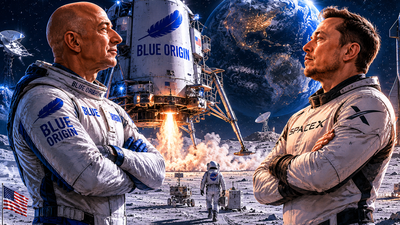
The rivalry between Jeff Bezos and Elon Musk has officially reached the moon. NASA announced Tuesday that it has selected Bezos Blue Origin to carry out the first in a planned series of three unmanned lunar missions aimed at preparing for a future lunar base, awarding the company a contract worth about $230 million.
The mission, expected to occur before the fall of 2026, will use Blue Origin’s Blue Moon lander to transport scientific payloads and test technologies near the moon’s south pole. While SpaceX remains deeply involved in NASA’s Artemis program, the decision represents a symbolic win for Bezos in the billionaire’s increasingly intense battle shaping the future of space exploration.
Jeff Bezos’ Blue Origin is at the forefront of NASA’s moon base ambitions
For many years, NASA’s idea of building a long-term human presence on the Moon existed mostly as an ambition tied to the Artemis program.
Tuesday’s announcement showed that the agency is now moving into the practical phase.Jared Isaacman, NASA administrator and entrepreneur, said the first three unmanned missions will help test landers, rovers, cargo systems and survival technologies needed to support astronauts on the moon in the future. More than a dozen additional missions are expected later as the agency works to establish an operational lunar base sometime within the next decade.
The first mission will target the Shackleton de Gerlach Ridge near the moon’s south pole, an area that scientists believe may contain water ice. NASA believes the area is important because future explorers can use the ice for drinking water and to produce oxygen and rocket fuel.
Why did Blue Origin beat SpaceX on the first mission?
The selection of Blue Origin is a big moment for Bezos, whose company has spent years trying to establish itself as a serious competitor to Musk’s SpaceX.Although SpaceX dominates commercial launches and remains central to NASA’s future manned lunar landings with its Spacecraft Human Landing System, Blue Origin has firmly focused on lunar cargo systems and infrastructure. NASA said the Blue Origin mission will help demonstrate key technologies such as autonomous landing systems and cryogenic fuel handling.The decision also reflects NASA’s growing strategy to encourage competition among private companies rather than reliance on a single contractor.
By keeping both Blue Origin and SpaceX involved in lunar exploration, the agency hopes to accelerate innovation while reducing risks associated with delays or technical setbacks.This competition has become increasingly personal. Bezos and Musk have spent years publicly criticizing each other’s approaches to spaceflight while competing for government contracts, engineering talent and influence within the industry.
The Moon has become the next great space battlefield
Behind the rivalry between billionaires lies a much larger geopolitical race. NASA is under pressure to accelerate lunar exploration as China continues to expand its lunar program and plans for a future lunar research station.The Artemis 2 mission earlier this year, which sent astronauts around the moon for the first time since 1972, reignited global interest in deep space exploration. NASA now hopes its growing partnership with private companies will help establish a permanent human presence on the Moon before competing nations do the same.For Bezos and Musk, the risks extend beyond a single decade. A company that helps build the systems that allow humans to live and work on the moon could shape the future of the global space economy for decades.