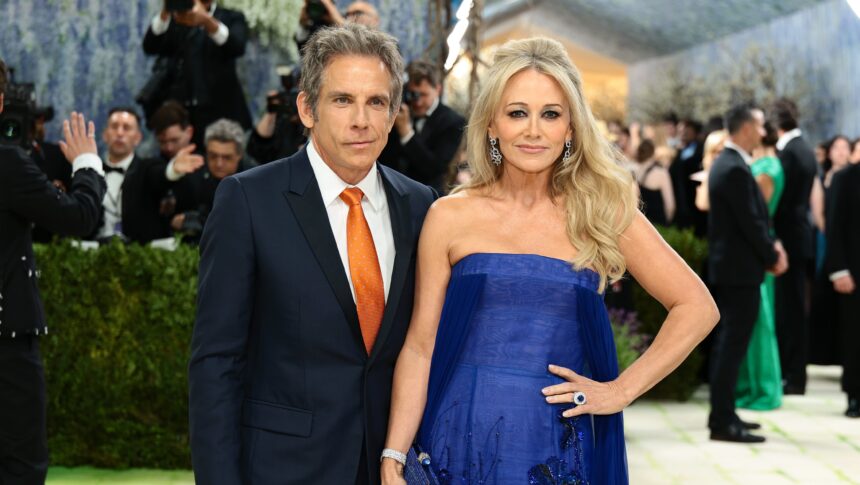

Ben Stiller and Christine Taylor They walked the 2026 Met Gala carpet on May 4, their first time together in a decade. A decade. That gap is the whole story.
In between those two red carpets, they publicly broke up in 2017. They quietly found their way back to each other during the pandemic. And now, they’re posing in couture at the Met as if nothing happened.
The Internet does what the Internet does. He described it as a fairy tale. He called it proof that true love wins. Post pictures of kissing with hearts in the comment.
I want to tell you something different about that contract. Because if you’ve been married for a long time, or want to be, the gap between those two red carpets is the part you really need.
The Hollywood legend keeps selling you out
This is the lie culture keeps telling you about long love. You find the right person, crack the communication code, and then run away.
It wasn’t. You really don’t.
You don’t get into a good relationship and then maintain it for the rest of your life. You reach temporary moments of feeling safe, fun, and trusting with each other. Then you lose it. Then you do the hard emotional work to get back out there again. Over and over again.
When Ben and Kristen met on set Heat Vision and Jack In 1999 and they got married a few months later, they met each other. This is how everyone works. The smart self, the charming self, the version of you that shines.
But eventually, your sexy self has to sleep with your vulnerable self. The part of you that fears being abandoned. The part that fears being a constant disappointment. These parts appear in marriage around the fifth year, the tenth year, and the fifteenth year, and they collide. messily.
Couples think that chaos means they are broken. This is where I would start with anyone in my office. Chaos is marriage. There is no version of long love where chaos does not arrive.
What seemed like a “split” between Stiller and Taylor in 2017 was perhaps the moment their vulnerable selves finally entered the room. Two professions. Two children. A pandemic is on the way. The nervous system goes into a state of biological panic, and the couple stops talking about feelings and begins living childhood survival strategies instead.
The dance under every long marriage
This is what I see every Tuesday in my office in San Francisco. The couple comes together after 15 years. They tell me they’ve lost the spark. They’re going through the motions. They are terrified that it is over.
Almost always, one lives in the shed and the other hides in the basement.
A shed partner is a good partner. They are trying. They read the articles. Their friends agree with them. They feel completely unprioritized.
The downstairs partner feels that no matter what he does, it’s a B. So they shut up. They are the distance. Sometimes this calm calcifies into a silent treatment, and the top partner reads it as evidence of his unimportance, and the whole circle narrows.
Both people are hurting. Both people are good. They think they’re fighting about the schedule, the in-laws, and the phone over dinner. They are not. They use the battlefield of any topic to heal attachment wounds. One felt abandoned. The other felt rejected. Same fight, different uniform, for years.
If you want to see your version of this episode in plain English, you can take our free relationship quiz. Most people get to know themselves within three minutes, and there is a special comfort in that.
Why their breakup is the most romantic part
Here’s my unpopular view. The decade that Ben and Kristen spent partly apart is not the darkest mark in Hollywood’s annals. I think this is the most romantic part of their story.
Culture wants paper relationships. Printed peace. Feeling connected without the cost of vulnerability. We pathologize breakups as if they were a fault in the system.
Disconnecting is a feature, not a bug. The only reason why a breakup is so painful is because the bond is so important. You fight because you love each other and you are important to each other. If it wasn’t important, I would be polite.
When a couple walks into my office in the middle of a fight, feeling sad and exhausted, I sometimes ask them to go to 7-Eleven and buy their most expensive bottle of champagne. I know, sophisticated 7-Eleven champagne. I celebrate the fact that they still mean enough to each other to be drawn to these courses. Conflict is evidence of love.
Much of what’s called toxic in popular culture is actually two nervous systems stuck in protest, and you can read the science behind trauma bonding to learn the longer version of why “just let go” is rarely the right reading for a long marriage in trouble.
Ben and Kristen are not settling for a hollow marriage. They allowed the system to collapse. Then they did the actual proof of work, the slow and arduous rebuilding of trust. This deserves more sympathy than any clean fictional story.
What would I say if they sat on my couch?
If they walked into my office tomorrow, I wouldn’t teach them communication tricks. I’ll stop them from trying to work out the logistics.
I’ll say what I tell every long-time married couple. You are both world-famous experts on your partner’s problems. If I hosted a global conference tomorrow about what’s wrong with Christine, Ben, you would be the keynote speaker. Christine, you address one bin. You both already have postdocs on each other’s flaws.
This story of the other never leads to healing. It never leads to growth. It is the path that the laboratory mouse continues to follow until it finally finds no food.
This move moves from two separate narratives about who is to blame to one shared story of what is happening between you. Your truth makes sense. Their truth is logical. Your panic makes sense. Closing them makes sense. You both hurt, and you both act in ways that hurt each other, because you love each other so much.
What does that red carpet actually mean?
So, when you see photos of Ben Stiller and Christine Taylor at the Met Gala, with their kind-eyed eyes, don’t read it as a fairy tale. Fairy tales are for people who have never been married for 15 years.
Read it as two people who allowed their relationship to fall apart, looked the wreckage in the face, and chose each other. slowly. Without an audience.
Love is not the absence of hurt. Love is the presence of reform. This is the picture.
___________________________________________________________________________
Empathi Founder Figs O’Sullivan, LMFT and his wife, Teale, are couples therapists and relationship experts at the Stars and Silicon Valley, founded Empathi, and built Figlet, our AI relationship coach, an AI relationship coach trained in their clinical work.