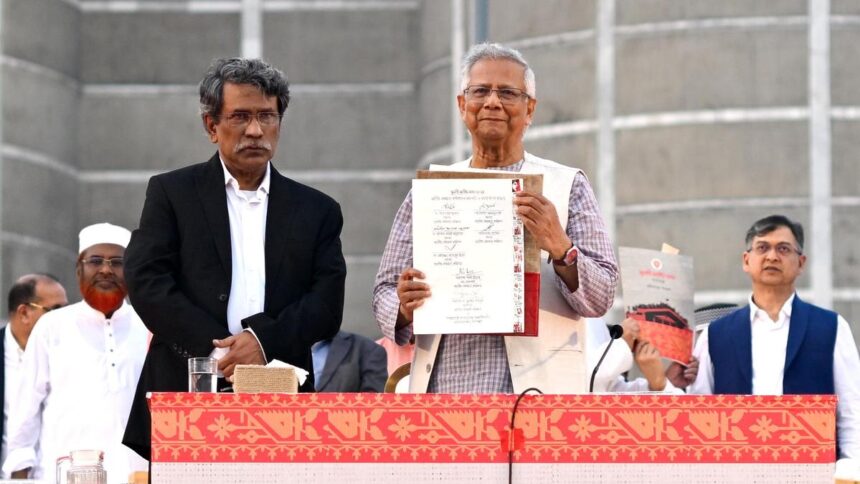

Interim leader of Bangladesh Muhammad Yunus displays the ‘July National Charter’ outside Parliament in October 2025. | Photo credit: AP
Bangladesh’s landmark referendum on constitutional reforms in July delivered a decisive mandate in favor of the National Charter 2025, setting the stage for the most sweeping reform of the country’s governance framework since independence. According to official results published by the Electoral Commission, more than 48 million voters supported the charter in the February 12 referendum, with 60.26% of participants voting “yes.” The vote coincided with the country’s 13th parliamentary election.
The approval places immediate political and legal responsibilities on the new government led by the Bangladesh Nationalist Party (BNP), which has a two-thirds majority in parliament. Although the BNP signed the charter last year, it did so with a note of disagreement on several key provisions that raised questions about how smoothly the reform process would proceed.
Elections in Bangladesh: Looking to the Future | Explained
The July Charter is a 28-page reform blueprint born out of the July 2024 coup that toppled Sheikh Hasina’s 15-year rule. It consolidates 80 reform proposals aimed at preventing what its architects describe as a “repetition of authoritarian and fascist rule”.
In February 2025, the interim government of Muhammad Yunus established six reform commissions to examine the constitution, judiciary, electoral system, police, public administration and anti-corruption mechanisms. Their recommendations were distilled into the July Charter through the National Consensus Commission process. In October 2025, 33 political parties, including the BNP, signed the charter. The document was given legal effect by a Presidential Order in November 2025.
Proposed changes
The referendum presented voters with four unified reform areas. The first is the formation of a non-partisan interim government to conduct future elections along with the restructuring of the Election Commission and other key constitutional institutions based on the guidelines of the Charter. Second, the establishment of bicameralism. A new 100-member Upper House will be formed based on the proportional votes received by the political parties in the national elections. Any future constitutional amendments require majority approval from this chamber.

Third, the implementation of 30 specific reform proposals previously agreed upon by major political parties. These include limiting the prime minister’s term, expanding presidential powers, securing judicial independence, strengthening local government, and widening the fundamental rights of citizens. Fourth, provisions for inclusive parliamentary representation. The mandate guarantees increased representation for women and stipulates that the Deputy Speaker and Parliamentary Committee Chairmen must be selected from the opposition benches. Additional reforms enshrined in the Charter include fundamental rights protections such as uninterrupted Internet access, better checks on executive authority, and measures to strengthen democratic accountability.
Approval of the referendum imposes certain obligations on the new parliament. According to the Constitution Reform Order 2025, the newly elected legislature will act as a Constitutional Reform Council with a fixed period of 180 working days to implement the provisions of the Charter.
Also read: In Dhaka, a new dawn and a gathering storm
Elected members are required to take two separate oaths, one as members of Parliament and the other as members of the Constitutional Reform Council.
The BNP has given “notes of disapproval” to several provisions, including the expanded powers of the President, proposed Upper House composition and legislative role, etc.

differences
However, shortly after the elections, the composition of the Upper House became a particular point of contention. While the referendum mandated the chamber on the basis of proportional representation using national vote share, the BNP’s manifesto proposed allocating upper house seats based on parliamentary strength.
The National Citizen Party (NCP), founded by student leaders who led the uprising, claims the referendum’s legitimacy is stronger than that of parliamentary elections. “Public opinion has more legitimacy than national elections, all members of parliament must enter the House with the responsibility of implementing the July Charter,” said NCP spokesperson Asif Mahmood Sajib Bhuyan.
Political analysts say the coming months will test whether the BNP’s commitment to the charter can withstand the practical challenges of implementation. Disagreements on specific provisions require negotiations between the government and opposition parties represented in Parliament.
Mohammad Yunus advisor Ali Riaz speaks He said the referendum provided a direct mandate from the people for substantial constitutional reform. “It should be seen as a public verdict and an expression of the people’s will for reform.”
Published – February 17, 2026 10:42 pm IST