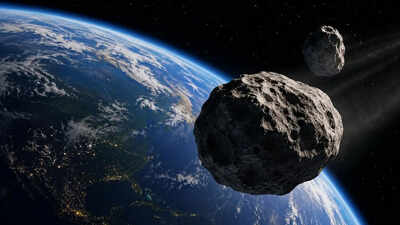
Astronomers don’t treat every “close approach” headline the same way the public does. On June 9, two near-Earth objects, 2026 LD and 2026 KM3, were tracked as they passed Earth at distances measured in the millions of kilometres.
On paper, it is described as “the size of an airplane,” a comparison that tends to amplify anxiety. But in terms of orbital mechanics, these are routine flybys that fall within what NASA and other space agencies classify as safe, non-threatening encounters. However, the tracking process itself is not ceremonial. Each pass feeds global planetary defense systems that are constantly improving how we predict asteroid paths for years or even decades to come.What matters here is not just the size of these rocks, but how precisely we know where they are going.
NASA Tracks ‘Airplane-Sized Asteroids’: When and What It Means
The plane-sized asteroids approaching Earth on June 9 point to two objects large enough that they would be observed if they entered the atmosphere, but only in a hypothetical sense.Asteroid 2026 LD is estimated to be 52 meters (170 feet) across. This puts it in a similar size range to a commercial airliner, such as the fuselage length of a Boeing 737.
Its flight distance is about 1.14 million kilometers, or about three times the distance between the Earth and the Moon.The second object, 2026 KM3, is smaller at about 34 meters (110 feet) and will pass at a farther distance of about 2.35 million kilometers.In terms of planetary defence, distance metrics matter as much as size. A 50-meter asteroid passing at or beyond the distance of the moon is not considered a risk under NASA’s current near-Earth object risk frameworks used by systems like JPL’s Sentry observing platform.
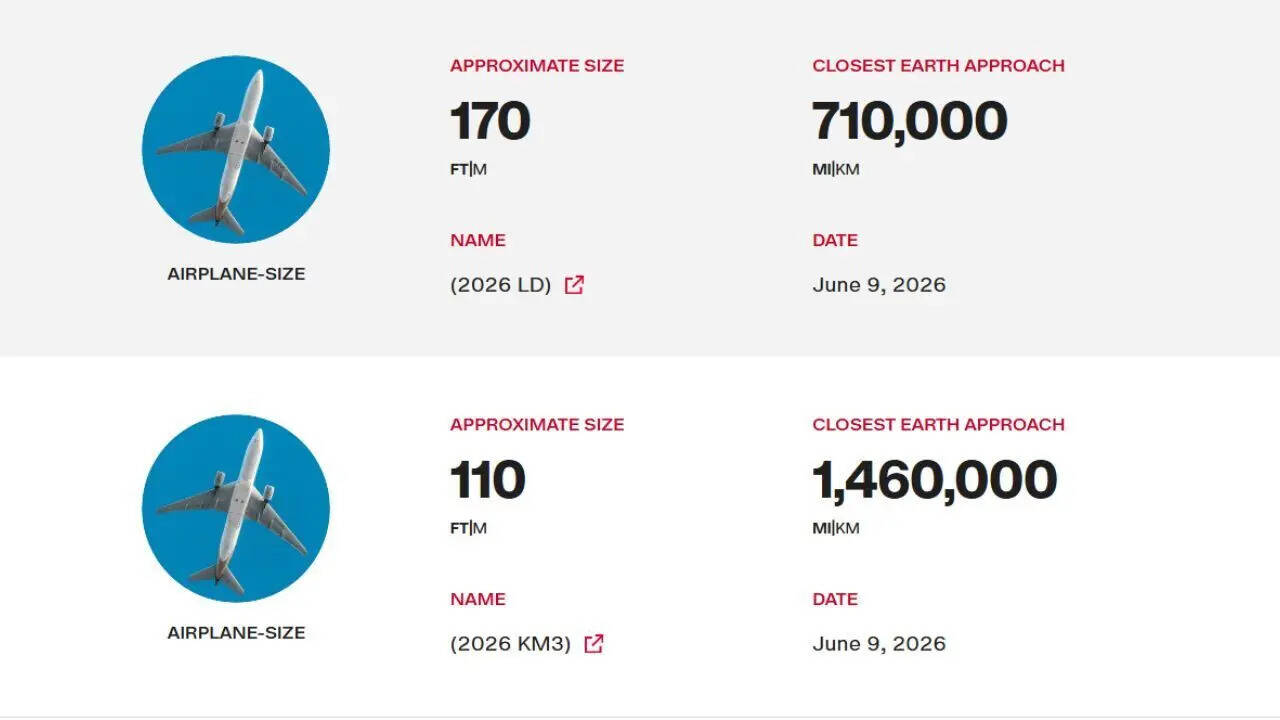
Computer: NASA Jet Propulsion Laboratory
Why are astronomers still tracking objects that are “not close” to Earth?
At first glance, tracking something more than a million kilometers away may seem unnecessary. But observing asteroids is less about the passing of the day and more about refining the path over time. Systems such as NASA’s Center for Near-Earth Object Studies continually update orbital models using optical telescopes and radar data when available. Each observation reduces the uncertainty in the asteroid’s expected path.
It is this uncertainty that is most important in predicting long-term risk. Even small forces, such as the Yarkovsky effect, where uneven heat causes a slight push over time, can gradually shift an asteroid’s orbit. It’s a subtle thing, but over the decades, it can transform something innocuous into something worthy of greater attention.It is a common misconception that “no impact risk today” means “no need to track.” In fact, most planetary defense work is about mapping possibilities for years to come, not responding to immediate threats.
The science behind asteroid tracking and why flybys still matter
Objects in the 30 to 60 meter range are scientifically interesting because they are near the lower limit of what could cause significant regional damage in the event of an impact. In the event that plane-sized asteroids approach Earth on June 9, both objects not only have good characteristics, but also have trajectories that place them millions of kilometers from Earth, without any calculated impact scenario.
Although neither object poses a threat, such events are not merely observational observations. They help calibrate detection systems, improve tracking accuracy, and validate orbital prediction models.