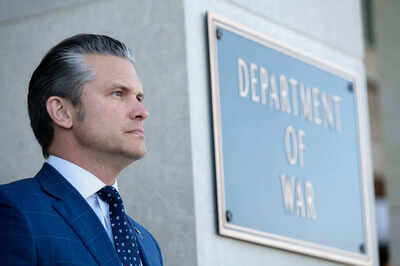
When the US Secretary of Defense demands unfettered access to your technology, “no” is not a routine corporate response. It is the Declaration of Independence. Anthropic, Claude’s maker, did just that.
It has refused to accept terms of a Pentagon contract that would allow the use of its artificial intelligence without explicit restrictions on domestic surveillance and autonomous lethal weapons. What could have been a bureaucratic dispute over procurement has now escalated into one of the defining political and technological showdowns of the age of artificial intelligence.It’s not just about one company, one contract, or one Defense Minister.
It is about whether private AI labs are able to impose ethical limits on the world’s most powerful military institution, or whether the logic of national security will eventually transcend those limits.
What sparked the confrontation
Anthropic works with US government agencies, including defense and intelligence entities, to provide access to Cloud under specific guardrails. These barriers were not symbolic. It explicitly prohibited certain uses, including mass surveillance of civilians and their deployment in fully autonomous lethal systems.
The Pentagon’s new contract framework is said to have removed or weakened those explicit restrictions, replacing them with broader language that allows them to be used “for all lawful purposes.” From the Pentagon’s perspective, this wording is standard. From an anthropological point of view, the matter is dangerously open.Anthropic refused to accept these terms. Its leadership claimed that removing explicit safeguards creates the potential for Cloud to be used in ways that could undermine civil liberties or enable machines to make life and death decisions without real human supervision.This refusal turned the quiet contractual review into a public institutional conflict.
Anthropic position: Draw the line before it disappears
Humanitarian leadership has framed its position as both a moral obligation and an artistic necessity. The company does not argue that the military should not use artificial intelligence. It argues that some uses should remain prohibited. The first red line is widespread local surveillance. Modern AI systems can analyze massive amounts of communications, video feeds, behavioral data, and metadata in ways that were impossible even a decade ago.
The human concern is not hypothetical abuse, but structural determinism. Once the ability exists without restrictions, its scope tends to expand quietly.The second red line is making fatal decisions independently. The Anthropic argument here is not based on philosophy as much as it is based on engineering reality. Frontier AI systems are powerful but not infallible. They can generate plausible errors, misinterpret context, and behave unpredictably under new circumstances.
Embedding such systems within autonomous weapons without human intervention introduces risks that cannot be fully predicted or contained.Anthropic CEO Dario Amodei has framed the company’s rejection as a necessary step to ensure that AI remains under true human control rather than becoming an autonomous tool for state violence.
Pete Hegseth’s position: Military authority cannot be subcontracted
The Pentagon, led by Pete Hegseth, is approaching this issue from a radically different premise.
The Army believes it cannot allow private vendors to dictate operational constraints through contract language.From the Pentagon’s perspective, AI is not a consumer product. It is a strategic capability. If the American military establishment is restricted while its opponents do not face such restrictions, the balance of power changes. The Pentagon’s insistence on broad access reflects a belief that operational flexibility is essential in modern warfare.Defense officials also stressed that military operations are subject to law and oversight. They argue that existing legal frameworks already regulate surveillance and weapons deployment, and that additional restrictions imposed by vendors are unnecessary and potentially dangerous.Behind this position lies a deeper institutional logic. The Army cannot allow a private company to become the final arbiter in determining what tools it may or may not use.
The political reactions reveal a deeper ideological divide
The confrontation immediately spilled over into politics, where it is interpreted through competing ideological lenses.Some lawmakers have hailed Anthropic’s decision as an act of moral clarity. Congressman Ro Khanna publicly called the rejection an example of ethical leadership, arguing that AI companies should not enable mass surveillance or autonomous killing systems.Others see the Anthropic position as naive or irresponsible. National security advocates argue that restricting military access to frontier AI weakens the United States relative to geopolitical rivals who may not impose such restrictions on themselves.This disagreement reflects a broader philosophical division over the relationship between technology and the state. One side fears the emergence of AI-powered surveillance and warfare devices with few limits. The other fears strategic weakness in a world where adversaries may fully weaponize artificial intelligence.
Why is Anthropic in a unique position to resist?
The human capacity to refuse is itself a sign of a structural shift in power. Unlike traditional defense contractors, Frontier AI Labs is not entirely dependent on military funding.
It has large commercial markets, private investments, and alternative sources of income.This independence allows companies like Anthropic to negotiate from a position of strength. It also introduces a new dynamic in national security policy. For the first time, critical military capabilities are being developed primarily outside government institutions.In previous eras, the state built and controlled its most important strategic technologies.
Today, these technologies are increasingly created by private organizations that maintain their own governance frameworks and ethical obligations.
Why is this important outside the United States?
The outcome of this confrontation will affect global standards related to military artificial intelligence. If the Pentagon succeeds in enforcing unfettered access, it will set a precedent where governments can force AI service providers to comply regardless of internal safeguards.If Anthropic succeeds in maintaining explicit restrictions, it may be able to create a new model in which private companies play a direct role in setting the ethical limits of military technology.Other countries are watching closely. The relationship between AI developers and state power will shape the nature of war, surveillance, and governance in the coming decades.
Bottom line
This is not just a dispute over contract language. It is the first major confrontation between an AI frontier laboratory and the military over the limits of machine power.Anthropics asserts that some uses of AI should remain off limits even to the state. The Pentagon emphasizes that national security decisions cannot be delegated to private companies.Claude is the immediate subject of conflict. The deeper question is who ultimately controls the most powerful technology ever created? Is it the governments that spread it, or the companies that make it?