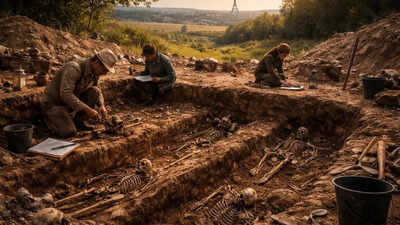
There are records of entire human groups that mysteriously disappeared from parts of northwestern Europe, especially what is now France, thousands of years ago, leaving behind abandoned sites and unexplained phenomena.
Modern archaeological study using genetic data provides insight into these mysterious disappearances. The study established that there was a sudden mass extinction of one population, which was later replaced.The discoveries were made at a site located near Paris. It shows how ancient societies can be wiped out by diseases, environmental changes, and population dynamics.
Discovery of the Paris tomb Reveals population gap and replacement
Among the main discoveries, the most interesting are the findings of archaeological excavations near Paris.
It has been determined that the remains found at the grave site belong to two different time periods, separated by a period of about 200 years.Initially, the early remains belonged to a specific population, but after 200 years, a new population with completely different genetic characteristics emerged. In a study conducted by Nature Ecology & Evolution, it was concluded on the basis of genetic analysis that there was a population replacement and not just a migration of people.
This means that the previous population became extinct or greatly reduced in number.
DNA analysis Shows complete population turnover
Genetic testing was pivotal in the accident investigation. The researchers conducted genetic testing on individuals who were present before and after the accident at the site.It turns out that there is no relationship between the two groups, indicating a complete replacement in demographics. It was not a continuation but a replacement of people.A phenomenon like this is uncommon but important because it illustrates the disappearance and replacement of an entire society.
Causes of population collapse: disease and environmental pressures
It should be noted that there may have been several reasons for the decline in the previous population. The first important reason can be linked to the emergence of some deadly diseases, leading to a rapid decline in the overall population.However, the environment itself can have an impact on development, making life and obtaining food more difficult.All this may have led to a population collapse rather than a steady decline.
Evidence of regrowth of abandoned land and forests
Ecological evidence also supports this idea. Study of pollen in the area reveals that farmland was deserted during this time.As human intervention decreased, forests slowly grew back into abandoned agricultural fields. This is a clear sign of a sudden decline in population.There was a large space left vacant for a long time before another group took over.
Migration and demographic replacement after collapse
Since the population decline, other groups have come to this area. The genetic makeup and culture of these peoples was distinct.These migrations compensated for the lost population and led to the complete replacement of the old population with new ones.
Why does this discovery change our understanding of human history?
This research points to the weakness of humans. The research indicates that with all the progress in their development, there may come situations in which entire human societies could disappear due to disease, environment and numbers.However, more importantly, the study suggests that not only has progress been made by humans, but also sometimes there has been a radical collapse, followed by replacement.
What does this tell us about ancient human survival?
Evidence collected from the excavation of a Paris cemetery and DNA analysis provides insight into how ancient civilizations reacted to difficulties. This proves that life was not guaranteed, and the environment could have affected the entire region.This realization is a sign that human history is always evolving, shaped by persistence and vulnerability.