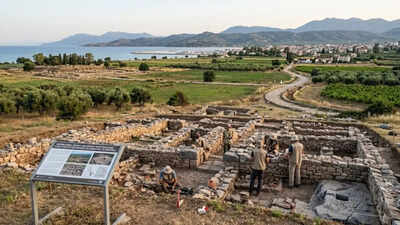
Through the lens of advanced technology, researchers have finally revealed the enduring architectural and economic heartbeat of this ancient Greek landscape. A recent archaeological study by the Swiss School of Archaeology in Greece (ESAG) has identified a sprawling rural network of more than 200 sites covering an impressive 6,000-year period of continuous human activity in the Eritrean Plain region of Evia, Greece.
ESAG conducted the survey using state-of-the-art LiDAR technology to penetrate the dense canopy and document a complex rural organization linking prehistoric settlements with medieval churches in the region. More than 30 square kilometers of land were mapped, yielding findings such as ancient farms, industrial quarries, medieval roads that connected different areas of rural settlements to the urban area of Eritrea, and the Temple of Artemis in Amarinthus.
The survey results provide unprecedented insight into how the people of Greece managed to develop and sustain themselves for 6,000 years from their early agricultural beginnings until the end of the 19th century.
Archaeologists have discovered 200 Ancient sites in Greece
The survey was conducted between 2021 and 2025, looking at the lands surrounding Eritrea. After conducting extensive fieldwork, the team gained new insights into many of the settlements or administrative units that served as the hinterlands of the city-state.
Many of these areas have been classified as separate regions, and some resemble organized social units. As part of their findings, the team documented olive presses found in rocks in most areas and extensive road systems that provided social, economic and cultural connectivity to densely populated areas, such as the Amarinthus Reserve.
The role of 3D terrain mapping in modern archaeology
The use of LiDAR (Light Detection and Ranging) is essential to further discover hidden locations related to these areas.
According to the Swiss School of Archaeology in Greece – Annual Reports, by using LiDAR as a remote sensing technology, researchers were able to obtain high-resolution 3D terrain maps that reveal the locations of buried walls, terraces and ancient roads that would otherwise be invisible. By integrating this information into a Geographic Information System (GIS), the team analyzed the factors influencing the spatial distribution of human activity over time throughout this part of Greece.
How did rural communities in Eritrea withstand the empire?
Artifacts found in the area show that the Eritrean plains were always inhabited. According to the Greek Ministry of Culture, the rulers changed from Mycenaean administrators to Roman and Ottoman administrators; There was a persistent agricultural population living there, tending the farmland and maintaining the farms for 6,000 years.
Why 200 site mapping is important today
The process of mapping the 200 settlements achieves two goals. First, it enhances our historical understanding of the region. Second, mapping forms the basis for the protection of the region’s cultural heritage under Greek law. Amidst the increasing urban development in Evia, this map will provide a record of the archaeological heritage sites that once existed in the area in order to mitigate the destruction of unexcavated cultural layers before they can be excavated.