

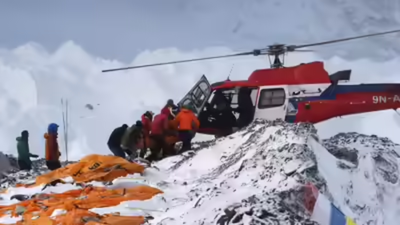
Nepal’s spring Everest climbing season opened this week amid a police investigation into an alleged insurance fraud worth about $20 million, in which guides, helicopter operators, hospital staff and agents are accused of organizing or exaggerating medical emergencies to spark costly helicopter evacuations and false insurance claims.
Police said the methods included mixing baking soda into food to cause nausea and bloating, over-administering Diamox – a medication that helps with high-altitude acclimatization – along with excessive drinking of water to mimic the symptoms of high-altitude cerebral edema, and in some cases using laxatives to weaken hikers to the point where they could no longer continue on foot. Fake flight manifests, loading papers, invoices and hospital records were allegedly used to support these claims.
“Hospitals, helicopter operators and guides are also linked to this chain; we are investigating this matter,” said Shiva Kumar Shrestha, spokesman for the Nepal Police’s Central Bureau of Investigation.Operators said abuse of air rescue flights had increased in recent years and had begun to affect the availability of helicopters for real emergencies. Mingma Sherpa, owner of Kathmandu-based Seven Summit Treks, said: TOI The repercussions could extend beyond the current situation if international insurance companies lose confidence in Nepal’s rescue chain.
Lukas Furtenbach, President of Austria’s Furtenbach Adventures, said: TOI The allegations, especially those of tampering with food and hospital records, have threatened confidence in Nepal’s rescue system. He added: “The level of organized crime here is staggering. We are talking about millions of dollars being funneled through hospitals providing fake discharge summaries to patients who never got sick.”Investigators said the extortion operation took place between 2022 and 2025, and involved more than 300 fake rescues, in some cases allegedly deliberately making hikers sick before flying them to Kathmandu and billing foreign insurance companies through falsified or tampered with records.Police have charged 32 people with crimes linked to organized crime and expanded the investigation to include the owners of Mountain Rescue Services, Charter Service Nepal and Shridi Hospital.
Of the defendants, nine are in custody while 23 are still on the run. “In our initial investigation, we found that these companies were involved in around 300 fake rescue operations,” Shrestha said.One main method, investigators said, was to load multiple hikers onto a single helicopter and bill multiple insurance companies as if each person had been flown on a separate private plane. They also claimed that exhausted hikers were pressured to exaggerate symptoms and, in some cases, were deliberately pushed into a state of distress so that evacuation appeared to be the only option.Central Bureau of Investigation (CBI) chief Manoj Kumar KC said: “We have compelling evidence of the companies and individuals involved in the fake rescue operation. They will all be prosecuted…”Garrett Madison, expedition leader at US-based Madison Mountaineering who has climbed Mount Everest 10 times, added: “We see it every season: helicopters flying in circles for people who have a headache or are a little tired from walking.
You have turned your life saver into a mountain taxi service. My concern is for the person who already has cerebral edema or a broken limb – will the helicopter be available to them…
?”The investigation also examined how committees moved through the system. In a recorded statement, Dr Jirwan Raj Timilsina of Shredi Hospital said: “The hospital has also given commission from its profits to tour companies and rescue companies to boost the business.”Nepal Tourism Board CEO Deepak Raj Joshi said corrective measures could help restore confidence.
He watches
Everest storm terror: 1,000 trekkers stranded in Tibet as powerful blizzard hits Himalayas
Stay up to date with our live blog for minute-by-minute coverage of the Israel-Iran war including breaking news, missile attacks and the latest updates on the Middle East crisis.