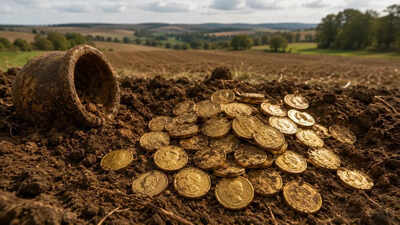
In a quiet field in northern Luxembourg, something glimmered beneath the soil that did not belong to the present. At first, it seemed like just another odd piece of metal, easily overlooked in a landscape filled with history.
But what lay underground near the village of Holzthum soon began to point to a much older story, said to date back to the final centuries of the Roman Empire. A hoard of Roman gold coins, untouched for about 1,700 years, is slowly reshaping archaeologists’ view of this corner of Europe. This discovery attracted attention not because of its sudden drama, but because of its strange stillness, as if it had been waiting through time for someone to notice it. According to Archeology News, until now, Roman gold coins found in Luxembourg are still being studied and preserved. Its total value is estimated at hundreds of thousands of euros, although experts point out that its historical significance far outweighs its monetary value.
141 Roman gold coins discovered in Luxembourg
The Roman gold coins discovered in Luxembourg were not scattered or broken, but rather carefully preserved in a concentrated hoard. Archaeologists working in the Holzthum area have discovered 141 nuggets, each dating from the late 4th and early 5th centuries AD.
These coins appear to have been minted during a period when the Roman Empire was already under pressure, and its western territories were becoming increasingly unstable.What makes this find particularly striking is not only the quantity, but also the range of emperors represented. The images on the coins indicate a changing political landscape, where power changes hands frequently and power rarely lasts for long. Experts suggest that such a group may have been hidden during a moment of uncertainty, perhaps when border areas began to feel less safe.
Rare coins of the emperor appear in a Roman gold hoard in Luxembourg
Among the hoard, a collection of coins stands out for a different reason. Some pieces bear the image of Eugenius, a ruler whose reign was short and hotly contested. His rule is said to have lasted only two years in the early 390s AD, and ended in defeat after an internal struggle within the empire.This short base is one of the reasons why these particular coins are rare. It carries the weight of a political moment that did not last, occurring during a period when loyalty and legitimacy were constantly in question.
In a way, coins reflect this instability. They are polished and formal, but they are associated with a ruler whose authority was never entirely secure.Archaeologists working on the Luxembourg hoard have pointed out that such coins are not often found in collections, especially in a well-preserved archaeological context. This added an extra layer of interest to the discovery.
The defensive tower that may indicate the location of the treasure
The location of the treasure has proven to be as important as the coins themselves.
The treasure was found near what appear to be the remains of a late Roman defensive tower, a small fortified structure that likely served as a lookout point along the empire’s northern border.This part of the Roman world, then known as Gallia Belgium, was no quiet backwater. It was a border region intertwined with military presence, trade routes, and often shifting alliances. The tower near Holzthum may have been part of a wider network designed to monitor movement through the area.Some graves found nearby indicate that the site was not purely military. The combination of burial remains and defensive architecture suggests a settlement with multiple layers of use, its function perhaps changing over time as the empire’s hold on the region weakened.
How a single coin sparked a major investigation into Roman treasure
The discovery did not happen in one moment. It reportedly began with a chance find in 2019 when amateur archaeologists found a gold coin in a nearby field. This single piece led to official investigations and a full excavation campaign that began the following year.