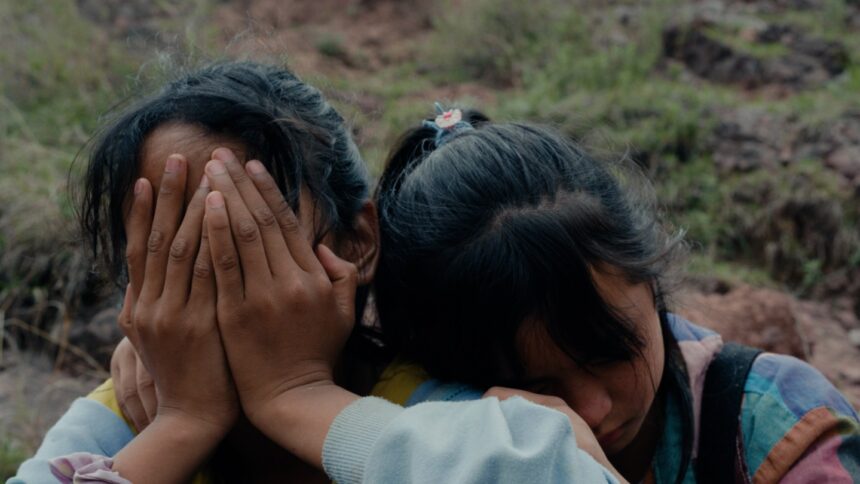
Is it a documentary? Is it an improvised fantasy? No, both! It is called Whispers in Maythe second feature film from Dongnan Chen (Singing in the wild), which explores the transition from childhood to womanhood through the eyes of three Chinese girls on a road trip.
One of the three girls is Qihuo, who has a secret, which is that she has just had her first menstrual period. This makes her ready for the traditional “skirt-changing” coming-of-age ceremony. With her migrant worker parents away, she goes on a trip with her two best friends to buy a skirt. Whispers in May Mixing documentary with an unscripted flight of fancy to follow them and take us to the edge of childhood and womanhood.
Whispers in May It will have its world premiere on Sunday 15 March, in the main competition slate of the Copenhagen International Documentary Film Festival CPH:DOX.
Muyi Film’s Jia Zhao produced the hybrid doc with Chen’s Tail Bite Tail Films in co-production with Malin Hüber for her film in Sweden and Heejung Oh for Seesaw Pictures in South Korea.
Chen met Qihuo on a trip to Liangshan. “At 14, she was at a point where childhood was starting to slip away,” she recalls. “The world was ready to name her — a woman, a wife, a migrant worker — before she could choose her own path.”
This inspired Chen to do so Whispers in May. The director spoke THR About the creative process behind the film, its hybrid format, the “casting” of the girls, and what you do next.

How did you find or “dump” the girls?
She initially traveled to the Liangshan Mountains for a commission for shorts focusing on Nusu women across generations. During the research, I had the opportunity to read articles written by local school children, and their voices were amazing. Some imagined a future where they could live and die unnoticed in the basement of a dim city, while others fervently dreamed of rows of suitors in luxury cars stretching from Liangshan all the way to Paris.
But one line was a quiet pain: “I’ve granted many wishes, but none have ever come true.” This line belongs to Qihuo. When I met her, it was love at first sight, a feeling that is difficult to explain, but that is how almost all my films begin. From that first day, Qihuo became a constant presence, calling us to ask where we were or if we had eaten, and eventually following us everywhere. And I discovered and grew my first white hair!
As we talked more, I learned that she was temporarily “homeless.” Her parents were away as migrant workers, and the grandfather who raised her had recently died. She moved between the houses of her various relatives, but would often sneak back to her grandfather’s old house. In this isolation, she carried the secret of her menstruation. In her community, this leads to the skirt-changing ceremony, a ritual that indicates that she is no longer a child in her family of origin and can be married off for a large dowry. This has become the hour. I felt like we were racing against time to do something.
Please tell me how many forms of hybrid film there are: how much traditional documentary have you documented, and how much improvised or fictionalized film?
I think the film is a dream that runs parallel to reality. Documentary elements provide the soil: the rugged reality of the Liangshan Mountains, the absence of parents, and the danger of the skirt-changing ceremony. But with the girls we planted flowers on that soil.

Qihuo’s deepest desire was to leave home and see the world, so we chose the road trip format as an extension of their immediate environment. For girls, the distinction between fantasy and reality doesn’t really make sense. I simply invited them to treat film as a space in which they could be the heroes and co-creators of their own adventure.
The interesting thing is that once we stop thinking about the boundaries between the two, the process becomes beautifully blurry. I can no longer clearly tell which moments were choreographed and which happened spontaneously. By letting the girls play for themselves, I gradually felt like we were achieving something truer to the facts. After all, we all have a story like this, right? One that exists beyond the confines of our daily lives. Or to look at it another way: We don’t just have to live the life we’ve been given; We can invent them as we go along. I hope this film empowers these girls to realize that they can be authors of their own adventures, both for this film and for later life.
How did you and your team work with the children? They have so much energy and so much charisma, but I suppose you need to cooperate and protect them?
For me, this production has always been a playground rather than a set. At the root of this film was the girls’ own agency to be on the road, so protecting their courage and curiosity was vital not only as a moral responsibility, but also to the film’s existence.
We didn’t have a script, but we had a shared outline of possibilities at the beginning. We watched the clips together during production to spark conversations about where we were going next. This allowed the film to breathe and follow its rhythm, so photography became something we discovered together.
During this process, the girls truly revealed to me the fierce yet quiet resistance of childhood. Seeing them on the road, away from the prescribed fate and towards an unknown horizon, showed cinema in its purest and most authentic form. It got me thinking about what we can achieve with film. It is very powerful to expand the boundaries of life. Which
We also maintained a transparent dialogue with parents and the school to build a foundation of formal trust, while providing a private and sacred space for girls until they were willing to participate on their own terms.

I love the way we see beautiful nature and how it seems to contradict society and its standards and expectations. How important is this to you?
In the wilderness, the landscape reflects the girls’ unbridled energy. Nature nurtures them as they grow and is an extension of their internal landscape. It gives them a suspended freedom, where noise or expectations do not drown out their laughter and sorrows. They are not objects of a social category, but simply exist as they are.
Yet this beauty has its weight. In Liangshan, the mountains are layer upon layer; The thing that protects their innocence is also what isolates them. Construction scenes throughout the film hint at this changing reality, and the girls often wonder, “What’s behind the mountains?” These mountains are more than just physical barriers. They also carry the weight of local community standards and the arduous path to a world they have not yet seen.
Is the myth of the Kokatams that we hear about in the film true? Where do you come from?
During filming, the girls would tell each other stories at night, and Koktamat was the one who shared them most often. They had heard about it from their grandparents and were truly terrified of it. It is an oral story that is transmitted across generations, and because it is not a written text, it breathes and changes. I later learned that many communities in Liangshan have different versions, although the essence remains the same. It is their shared heritage, but it is also their shared imagination. So, we decided to embrace this flexibility and created our own version of the legend together.
While Kokotamat is a mutant who wears the faces of a thousand women to lure children away and swallow them whole, the girls escape a fate wearing the same face for generations. And in research into Nusu folklore [the Nuosu are anethnic groupinsouthern China]I was struck by how many of these stories were very similar to Western tales, such as those of the Brothers Grimm. There must be psychological reasons for this cross-cultural similarity, as fairy tales serve as survival guides for young girls by encoding the dangers of the adult world. The skirt-changing ceremony is their version of the wolf little red riding hood.

Can you tell me how you chose the title of the film?
The movie titles are different in three languages because the feel of each language is unique. The English title originates from the Nuosu title, This is it (May, hidden). We happened to make this movie in May. It wasn’t really planned, but it reflects The last moments of childhood. The transition to womanhood is not a loud explosion; It’s a quiet, drifting slip before reality settles in.
My friend Arthur Jones helped me with the English translation. After watching the movie, he was attracted by the gentle and small sounds – the wind caressing the mountain flowers and the girls’ voices. He felt it May whispers He captured the essence of what was “hidden” but translated it into a sensory experience. To get the Mandarin address, we used Spring fantasy (春日幻游).
Will we see more films from you? Do you have any new films in the works?
I’m in early development on a hybrid narrative feature about a woman who tries to preserve her hometown through the camera, only to find that the more she records, the more the real world turns into a mosaic of digital fragments.
Drawing from my decade-long experience photographing real people, the project explores the fragility of storytelling in a world saturated with images and the search for the truth that may exist beyond the frame.