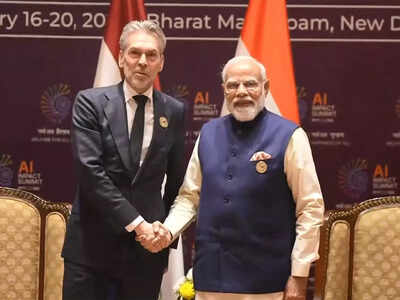
Prime Minister Modi with Dutch Prime Minister Dick Schoof
Outgoing Prime Minister of the Netherlands, Dick Schoof, in an interview with TOI’s Siddhartha, said he is concerned about the concentration of AI development, and calls for reducing dependence on a few economies, while emphasizing the need for responsible use of the technology.
Excerpts:What is the focus here?Both China and the United States have their own AI strategy. It was important to have a meeting in India because we don’t want to depend on one or two powers, we want to create our own artificial intelligence. This was also one of the main themes. The other theme is that we want responsible AI, not just AI for profit or control, but responsible AI that relates to the human values of privacy and trustworthiness. Therefore, there is concern about concentration risks because most AI innovation and development occurs in the United States or China.Yes, and it comes into the bigger picture. In Europe, we have a lot of discussions these days that we don’t want to be too dependent on just one company or country.
We want to diversify. This is also why the EU has concluded a lot of new trade agreements, including with India, but it also relates to other issues. Europe is intensifying its defense spending within NATO due to the Russian threat. We do not want to become too dependent on the United States, and the same applies to other economies.
It is more about autonomy, but at the same time about partnerships with different countries. Is this also a sign that Europe has not done enough in the past few decades to stay at the forefront in terms of new technologies and innovation?Everyone in Europe agrees that we are lagging behind and have to move forward, especially in high technology, biotechnology, etc.
We are now having a lot of discussions about how to achieve this and provide funds for innovation and make sure that we promote renewable energy, artificial intelligence, advanced technology, data centers and so on. So how does India fit into this scheme of things?India is a very interesting partner as it is now advancing rapidly and successfully in the field of advanced technology and artificial intelligence. For example, we have ASML in the Netherlands, which is famous for its lithography machines that produce many chips. It has a big ecosystem in the Netherlands, and a lot of Indians work there.
We can work together because India has a huge talent base. ASML is also discussing with the Indian government whether it can use its hardware and build a chip factory in India. Regulation is one area of concern for AI innovators and companies. How do you balance the two?It’s important to strike a balance, otherwise you can easily over-organize. But there must be reliable guarantees for artificial intelligence. I have called for systemic pressure on Russia to end the war with Ukraine. What role do you see India playing in this? India has a special relationship with Russia, and as Prime Minister Narendra Modi said, he wants peace, just like the rest of us. So maybe he could use that special relationship.
We are not putting pressure on India, we are putting pressure on Russia, and we want them to end the war. India was buying oil from Russia and there was pressure from the US to stop it. Europe, including the Netherlands, buys processed fuel from India, and also buys liquefied natural gas from Russia. How can this be addressed and should India stop buying oil from Russia? First, we are on the verge of not getting energy from Russia at all, and we will probably get to that point in a year or two. There are some other countries that still use oil from Russia. We are putting pressure on them because oil is one of Russia’s main sources of income.