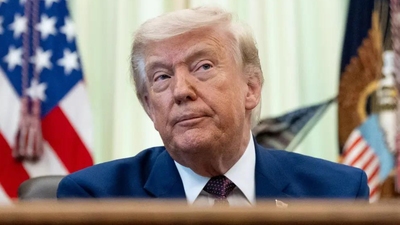
Archive photo: US President Donald Trump
TOI correspondent from Washington: For nearly a decade during the Trump era, one of the enduring mysteries in American politics has been whether Republican lawmakers still have an effective backbone.Some rare sightings were reported this week on Capitol Hill, where GOP lawmakers, in a series of small but apparent acts of rebellion, voted against top MAGA priorities, giving rise to what congressional observers have called a rare and little-studied phenomenon: independent thought.The biggest surprise came on Wednesday when the Republican-controlled House of Representatives voted 215 to 208 to approve a resolution aimed at preventing Trump from continuing the three-month-old war against Iran without authorization from Congress.Four Republicans, Thomas Massie of Kentucky, Brian Fitzpatrick of Pennsylvania, Tom Barrett of Michigan, and Warren Davidson of Ohio, joined Democrats to support the measure.The resolution remains largely symbolic, and must still win approval in the Senate, where Republicans hold a 53-47 majority, and even if it passes there, it would almost certainly face a presidential veto. Overriding the veto requires a two-thirds majority in both chambers, which makes its chances roughly the same as Iran offering to voluntarily pay the US war bill.
Still, the symbolic insurrection represents the latest setback for Congress for a president whose grip on the Republican Party has been tight.The House vote was particularly notable because Republican leaders postponed a similar vote weeks ago when it seemed likely to pass. Instead of disappearing, the opposition grew.Meanwhile, Senate lawmakers are expected to vote Thursday on amendments that would block the Trump administration’s now-aborted plan to create a $1.8 billion fund to compensate people who Trump claims were wrongly prosecuted or investigated by the Biden administration.This proposal was denounced as a potential corruption fund and its legitimacy and political wisdom were questioned.Republicans leading the resistance include Sen. Thom Tillis of North Carolina, who pushed for amendments to ensure the fund could not be revived, and Sen. John Cornyn of Texas, who was recently rejected by Trump in the Texas primary.Several GOP senators privately expressed anger at Congress being asked to bless a politically explosive idea that many viewed as unnecessary and difficult to defend at home.However, there is an important rule governing Republican independence in the Trump era. The closer a legislator comes to retirement, the stronger his principles become.The joke in the Senate is that courage is most abundant among senators who have already declared they are not seeking re-election when they discover constitutional objections, budget concerns, and deeply held convictions that seem to have been misplaced for several election cycles.This is because Trump maintains his strongest political weapon: the primary challenge – internal party elections where he can support a loyalist against a dissenter. The president has repeatedly demonstrated his ability to target dissidents, who have been “primarily bullied” and sent into political oblivion.However, something seems to be changing. The Iran war, rising economic costs, disputes over spending priorities, and growing anxiety about executive power have created pockets of resistance that would have been difficult to imagine even a few months ago.Opposition has emerged not only over Iran, but also over the administration’s spending requests, intelligence appointments, and various budget battles.None of this means that Trump is losing control of the MAGA-infused Republican Party; He remains hugely popular among Republican voters, continues to dominate conservative media and retains the power to make or break several political careers with a single social media post.But Washington is the city that measures the smallest ripples, and by that standard the recent events are a notable jolt.While votes are still small and rebellions are limited, some GOP lawmakers are reminding Trump of an uncomfortable constitutional detail: Congress is technically a separate branch of government.