Only the US has reached the limits of its power and may have already lost its role as a world leader, Frederick Merzthe German Chancellor, warned Donald Trump at the start of the Munich Security Conference.
Merz revealed that he had held preliminary talks with the French president. Emmanuel Macronon the possibility of joining France’s nuclear umbrella, emphasized his call for Europe to develop a stronger self-sustaining security strategy.
In a speech on Friday designed to set a firm yet conciliatory tone about the future of the transatlantic partnership, Merz argued that the old order is over and that the US is reaching the limits of going it alone in this new era of superpowers.
Referring to those who warned that the international rules-based order was about to collapse, Merz said: “I’m afraid we have to put it more bluntly. This order, however imperfect, no longer exists in that form.”
Merz translated his message into English, saying: “In times of great power rivalry, even the United States is not strong enough to go it alone. Dear friends, being part of NATO is not only a competitive advantage for Europe. It is also a competitive advantage for the United States.”
“So together let’s repair and restore the Atlantic Trust,” he added.
The German chancellor’s speech opened the annual gathering of top global security figures, including several European leaders and the US secretary of state. Marco Rubio.
Trump was the US vice president at last year’s summit, just weeks after his second term in office JD Vance surprised European leaders By lecturing them about the state of democracy and freedom of speech in the continent – a moment that set the tone for the previous year.
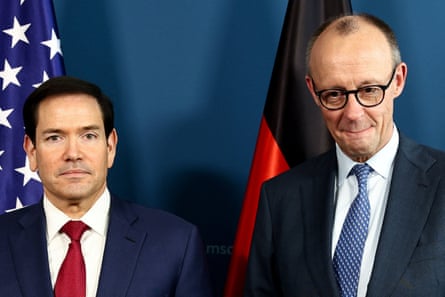
A series of announcements and moves from the Trump administration targeting allies followed, including last month when Trump threatened to impose new tariffs on several European countries. Secures US control over Greenlanda semi-autonomous territory of NATO ally Denmark.
Merz drew much applause from an audience filled with hostility toward US unilateralism when he directly criticized the current American administration: “The culture war of the Maga movement is not ours. Freedom of speech ends with us when that speech speaks against human dignity and fundamental law. We don’t believe in tariffs and protectionism, but we stand by the climate agreement.”
“In the age of superpowers, our freedom is no longer taken for granted. It is threatened,” he said, adding that “assertion of this freedom requires tenacity and willpower.” Challenging Trump’s one-sided style, Merz added: “A dictatorship can have followers, a democracy can have partners and allies.”
At the same time, he said, Europe must let go of its overdependence on America: “We will not do that by abolishing it. Nato.”
He urged the US president to recognize that this is still possible Exhausts Russia economically And militarily, it is ready to come to the negotiating table on Ukraine.
With Germany one of the European countries doing the most to boost its own defense spending, Merz clearly felt in a strong position to insist that the US needed to do more to listen to European concerns about its security and the legitimacy of NATO’s stable European pillar.
Describing the Munich meeting as a seismograph of the state of US-European relations, he said the Ukraine war “has brought Europe back from a vacation from world history. Together we have entered an era marked once again by power and big-power politics.”
These big powers, says Merz, “make their own rules. It’s fast, hard and often unpredictable. These powers use natural resources, technologies and supply chains as bargaining chips.”
Merz spoke on the fourth anniversary of Russia’s invasion of Ukraine, the same hall where Vance used his speech a year later to criticize Europeans for not taking enough control of their own defense arrangements and ignoring the demands of their voters.
Merz responded by saying it was crucial for the continent to change its way of thinking and take full advantage of the “enormous” military, political, economic and technological potential of “sovereign Europe”. Germany is a “Partnership” in Europe Striving for “empowered leadership” but retaining “hegemonic phantasies”.
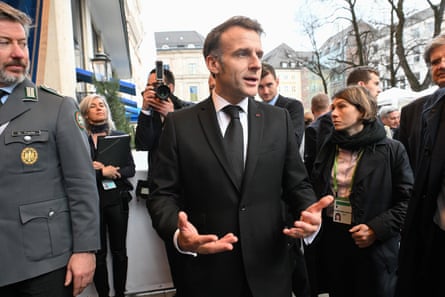
Merz says he has opened talks with Macron about a European nuclear deterrent. He said it should be firmly integrated into NATO’s nuclear arsenal and not lead to protecting some parts of Europe more than others. The chancellor stated that Germany is not leaving NATO, but wants to establish a “strong, self-sustaining pillar” of the alliance.
Macron called for greater European defense sovereignty in his speech, a French theme for more than a decade, as the French president’s entourage was vindicated by growing US signs that it is scaling back its commitments in Europe. French nuclear weapons differ from the UK in that they are not part of NATO’s scope and do not rely on US technology.
Merz pointed out that EU treaties contain a mutual defense clause – Article 42 – in the event of “armed aggression” against one of the EU member states. “We now have to explain how we want to manage it in a European way – not as an alternative to NATO, but as a self-supporting pillar of the alliance,” he said.
However, there is tension between France and Germany about their roles in a revised NATO, in which the US will play a less dominant role. Germany has targeted the key post of Chairman of the Military Committee.