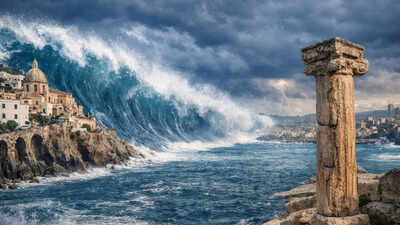
The Mediterranean Sea has been viewed over the years as a body of water that is not vulnerable to major natural disasters such as tsunamis. However, scientific evaluations have shown that this assumption does not necessarily apply.
Coastal regions in southern Europe, such as the Côte d’Azur, which are densely populated, and other major cities such as Nice, have shown significant levels of exposure to tsunami risk due to natural disasters such as earthquakes, landslides, and volcanic eruptions. Studies conducted by institutions such as the University of Montpellier, in cooperation with international bodies such as UNESCO, have shown that there is a possibility of medium-level tsunamis occurring in short periods of time.
Mediterranean tsunami risk in the next 30 years driven by plate tectonic activity
The Mediterranean Sea, despite its quiet nature compared to other oceanic regions such as the Pacific, is still an area of geological activity. The region is considered a meeting point of different tectonic plates, which are always vulnerable to disturbances in the form of earthquakes, capable of displacing huge amounts of water into the sea, thus creating a tsunami wave. Historical records indicate that several tsunamis have occurred in this region, hitting various areas along its coast, such as the Côte d’Azur.
Such events do not always receive due attention and importance, as they are less frequent in this region than in other parts of the world, but their potential threat cannot be ignored, given the high density of human settlements along its coast.Scientific studies and assessments conducted within the framework of UNESCO have indicated that there is a high probability of a tsunami wave exceeding a meter in height occurring in this region in the near future.
Such a prediction is not made on the basis of any specific event, but through statistical analysis of other geological activities in this region, such as earthquakes and underwater landslides, which are common in this region, indicating a high probability of a tsunami wave occurring in this region in the near future.
Mediterranean tsunami waves caused by underwater earthquakes
Tsunamis in the Mediterranean region are usually caused by sudden disturbances on the sea floor.
These disturbances can be caused by various factors, the most common cause being earthquakes. Landslides and volcanic activities can also contribute to tsunamis. When the seafloor moves suddenly, it creates movement in the water column above it. When water moves over the sea floor, it creates waves.
These waves can pass through deep water without being felt, but when the waves reach shallow water they become much larger.
Since the Mediterranean Sea is an enclosed basin, the effects of a tsunami could be exacerbated.
Historical events that show the real risks
Previous events also show that tsunamis in the Mediterranean region are not just theories, but actual events. Past events in the Côte d’Azur region include tsunamis with far- and near-field triggering mechanisms. Earthquakes and underwater landslides are some of the past events that have led to sea level changes, strong currents and waves.
In some cases, sea levels were observed to fall before rising as tsunami waves.
Preparedness, monitoring and public awareness
Today, risk management techniques often use scientific modeling in addition to general preparedness techniques. Studies conducted by institutions such as the University of Montpellier have helped define evacuation zones, expose residents, and design effective escape routes. Cities like Nice have incorporated these techniques into urban planning. Although early warnings are necessary in such cases, experts stressed that preparedness on the part of residents is equally vital, especially in areas where evacuation must take place within minutes.