


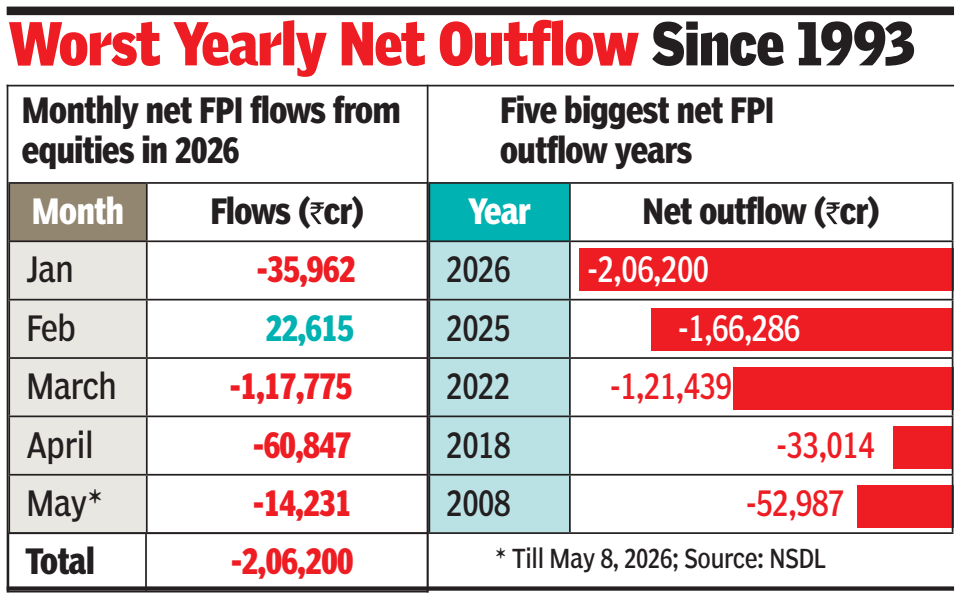
MUMBAI: Net outflow of foreign portfolio investors (FPIs) from the stock market for the current year has crossed the Rs 2 lakh crore mark for the first time ever. This also showed total foreign holdings in Indian stocks falling to a 14-year low of 14.7%, a level much lower than the comparative data of domestic institutions, which stands at 18.9%, a report by JM Financial showed.So far, in just over four months to May 8, foreign institutional investors have netted nearly Rs 2.1 lakh crore from India, making it the worst annual figure since 1993, the year fund managers were allowed to invest in domestic stocks, data from Sebi and NSDL showed. More than half of this amount was in March alone, shortly after the war in West Asia began and the rupee fell below $95, its lowest level ever against the dollar.
In April, the sale slowed to Rs 60,847 crore. In the whole of 2025, the total equity outflow was Rs 1.7 lakh crore.
A Goldman Sachs report said that although the intensity of FDI selling has slowed, it will take some time before foreign funds start buying Indian stocks again.“The bulk of the foreign selling is likely to have ended, following record outflows in recent months.” The report said. “Various approaches using flows, positioning and ownership trends suggest that foreign flows are now close to downside scenarios.”
Analysts at a major US-based global financial firm estimated that the downside risks of increased foreign selling could be limited to around $4-5 billion, which translates to roughly Rs 50,000 crore at the upper end of the range.On the other hand, the report indicated that although the bulk of foreign sales have likely ended, “Foreign repo operations could remain constrained in the near term, for several reasons.”First, empirical evidence suggests that foreign funds will not immediately return to buy in India when oil prices fall.
“Foreign capital did not return to Indian stocks in the early April oil patch, despite significant selling during the previous oil price spike in March. “Previous evidence suggests that foreign flows tend to be modestly positively associated with lower oil prices in the short run.”Second, earnings revision has become an increasingly important variable guiding foreign inflows into Indian stocks. While much foreign selling may have already occurred in anticipation of the next downturn, poor visibility around the recovery is likely to limit foreign repurchasing in the near term.Finally, “Compared to North Asian markets, India offers a less attractive risk reward as it trades at much higher growth-adjusted valuations, as well as persistent investor concerns about the potential negative impact of AI.” The report said.