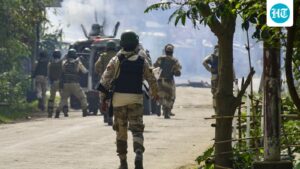
On this day last year, terrorists disguised as tourists entered the Baisaran meadows of Pahalgam in Jammu and Kashmir through the surrounding forests and killed 26 people.

One of the deadliest attacks on civilians in recent years in India occurred on April 22, 2025, in the picturesque Baisaran meadows near Pahalgam in Jammu and Kashmir, triggering a massive counter-terrorism operation that lasted for months and culminated in the elimination of three terrorists deep in the Dachigam forests.
On this day last year, terrorists disguised as tourists entered Besaran meadows through the surrounding forests. They were armed with automatic weapons and targeted tourists on the basis of their religion. The terrorist targeted the men before shooting non-Muslim tourists.
The fact that there was only one entrance and exit made the area a slaughter ground for innocent citizens. This cowardly act led to the death of 26 people and the injury of 17 others in an incident considered the most horrific attack on civilians in India since the 2008 Mumbai attacks.
Amid the chaos, an Indian Army officer, Colonel Prashant Bhatt, who was on leave, reportedly guided a group of tourists to safety through a gap in the fence, saving multiple lives.
Immediate response and evacuation
Security forces responded quickly. The Army, along with the Central Reserve Police Force and Jammu and Kashmir Police, launched evacuation and containment operations within hours.
“The priority of the 15th Corps was the immediate response to ensure the situation was under control, the safety of civilians, the evacuation of the injured to the hospital, and the pursuit of the perpetrators,” people familiar with the matter said.


People familiar with the matter said: “The pursuit operations of more than 250 kilometers for more than 93 days and the siege of 300 square kilometers finally reached an operational area of 25 square kilometers.”
On July 28, a PDF unit tracked ground signatures deep into the forest and confronted the militants.
A daring PARA (SF) agent eliminated three hardened terrorists and brought the perpetrators of the massacre to justice. All three attackers were killed in the ensuing shootout.
Forensic evidence and cross-border links
The weapons recovered from the spot, including an M4 rifle and AK series rifles, have been forensically matched to the Pahalgam attack. Digital evidence also confirmed the Pakistani origin of the attackers and their relationships with their cross-border handlers.
The recovered mobile phones highlighted that Suleiman Shah got clear directions from their handlers in Pakistan to carry out the killing in Pahalgam, ordering them to check identity cards and kill only Hindustani.

Army helicopters evacuated the seriously injured, while troops provided first aid on the ground. Survivors later credited the quick response with preventing further casualties.
Identify the attackers
Within 24 hours, intelligence agencies identified the suspects as three terrorists of Pakistani origin linked to the Lashkar-e-Taiba.
“Late in the evening, based on HUMINT, TECHINT and photo identification by survivors, the terrorists were identified as Suleiman Shah, Hamza Afghani and Gibran Bhai,” the sources said.
Sketches were drawn up based on eyewitness accounts, and a massive manhunt was launched across south Kashmir.
Chase 93 days
The ensuing chase spanned 93 days and covered more than 250 kilometers of rugged terrain. The forces deployed advanced surveillance tools, including drones and thermal imaging, while ground forces conducted continuous search operations.
This period mobilized all intelligence agencies and operational forces into a single entity that worked in absolute synergy, with the aim of eliminating the perpetrators.
Despite multiple close calls, the terrorists managed to evade capture for weeks, exploiting the dense forests and mountainous terrain across the Lidder Valley, Tral, and eventually Dachigam.
The final showdown is at Dachhigam
By mid-July, intelligence had narrowed down the terrorists’ location to a 25-square-kilometre area in the dense Dachigam forest. A coordinated operation involving army special forces, intelligence agencies and local police closed the escape routes.
Investigators also found hundreds of files containing jihadist materials and documents linked to Pakistani security institutions.
Coordinated effort
Officials credited the success of the operation, dubbed ‘Operation Mahadev’, to smooth coordination between the Army, CRPF, Jammu and Kashmir Police and intelligence agencies.
Operation Mahadev was the result of perseverance, energy, relentless dedication, synergy and clinical precision that brought the perpetrators of the massacre to justice.
The operation not only succeeded in neutralizing those responsible but also highlighted the emerging challenges of countering terrorism in the complex terrain of Kashmir.

He is the author of Indian Mujahideen: The Enemy Within (2011, Hachette) and Confronting the Himalayas: The Chinese Assertion and the Indian Response (2014, Hachette). He was awarded the K Subrahmanyam Prize for Strategic Studies in 2015 by the Manohar Parrikar Institute for Defense Studies and Analyzes (MP-IDSA) and the 2011 Ben Gurion Prize from Israel.Read more