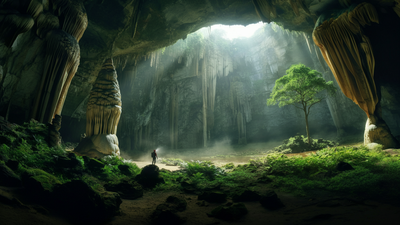
Deep in the jungles of central Vietnam, hidden behind dense forests and roaring subterranean rivers, lies a cave so massive that a Boeing 747 could fly through its largest chamber without touching a single wall.
Son Doong is officially the largest known cave passage in the world, stretching 5.6 miles long and rising 65 stories in places. Its caves are wide enough to hold a football field and a half, and large enough to contain the Great Pyramid of Giza. But despite its massive size, this geological giant spent decades completely unknown to the world, and even after it was first found, it took nearly two decades to find it again.
how He betrayed him Discover the largest cave in the world in the jungle of Vietnam
Son Doong was first discovered in 1990 by Ho Khanh, a Vietnamese villager who found the entrance while sheltering from a storm. Inside, he was greeted by darkness and an immediate 300-foot drop, so he never explored the massive cave. Ho Khanh was a local forest man from Phong Nha region, who spent years trekking through these forests in search of food and timber. He heard the roar of wind and water coming from an opening in the limestone cliff, and sensed the size of what lay beneath, but he had no way of going any further.
What followed was a remarkable 17-year gap. Despite its enormous size, it took 18 years for Ho Khanh, the man who first found the entrance, to rediscover Hang Son Dong deep in the Vietnamese jungle. During the early 2000s, Ho Khanh guided members of the British Cave Research Society through the jungle. For a long time, he was unable to move the entrance. However, in 2008 he finally rediscovered it and captained the British team again.
The forest has swallowed the entire entrance. There is no trail, no marker, no coordinates, only memory and instinct guiding him through miles of dense tropical growth.
The 2009 expedition confirmed that Son Doong is the largest cave on Earth
On 7 April 2009, Peter Macnab, a member of a British caving expedition team in Vietnam, was the first person to enter Son Doong Cave. On April 14, 2009, the expedition team announced the largest cave in the world. Led by veteran Howard Limbert, the team descends into a world that has never seen human footprints before.
“Every corner I passed was completely new and completely exciting,” McNab said. “And it kept getting better and better as you entered the cave.
“In April 2009, after nearly ten days of surveying and measuring Son Doong, the expedition encountered a giant wall of calcite blocking the road. Due to the lack of specialized equipment, they were unable to proceed further. They returned the following year with climbing equipment, and on 17 March 2010, the British Cave Expedition in Vietnam team completed the climb up the calcite wall called the “Great Wall of Vietnam” out of the cave and completed a full survey, confirming its length to be more than 9 km and its volume to be 38.5 million cubic metres.
In April 2013, Guinness World Records officially recognized Hang Son Doong as the largest cave in the world.
The geology behind Son Doong: millions of years in the making
Son Doong was not formed overnight. According to scientists, Son Doong Cave was formed more than two million years ago by the erosion of limestone by an underground river, making the cave a rare and valuable geological formation that provides insight into the ancient natural history of the Phong Nha-Ki Bang area.When an underground river passed through layers of sunken limestone along a geological fault, it formed Son Doong Cave. Over millions of years, water eroded the rocks and formed a huge underground tunnel between the mountains. In certain parts, the loose roof fell, forming large holes that gradually expanded through chemical effects. These holes, called dolin, are what makes Son Doong different from any other cave on the planet.
They let the sunlight pour in, and the sunlight changed everything. Research published in the Journal of Sustainability (2022) found that even limited human presence in closed underground ecosystems can disrupt the chemical and biological balance of the cave, underscoring why the pristine formation of Son Doong is rare and worthy of protection.
Forest, clouds and new species: the extraordinary ecosystem within Son Doong
As light began to filter through the collapsed sections of ceiling, life followed. Biologists have discovered more than 200 species of plants living in Son Doong, including herbaceous plants, mosses, vines, shrubs and large trees more than 40 meters high.
Inside the cave there are rivers, forests, and even atmospheric clouds, and even light rain falls inside Son Doong due to the difference in temperature and humidity between the cave and the outside environment.The wildlife found here is equally extraordinary. More than seven new species have been found at Son Doong, including fish, woodlice, millipedes, spiders and scorpions, all of which share the same feature of having no eyes and a transparent body. These creatures were recognized by German and Vietnamese biologists as a new species. The 2022 bat survey published by the Institute of Environment and Biological Resources confirmed the presence of at least six species of echolocating bats living within the cave.
In early 2025, a team from the National Museum of Nature in Vietnam reported the presence of a new species of land snail inside the cave, adding to the growing list of organisms recorded in the area.
Son Doong Tourism: Why only 1,000 people are allowed in per year
The cave was opened to adventure tourism in 2013, but access has always been tightly controlled. Only 1,000 people are allowed to visit the cave annually, from January to August, and only one authorized company can operate the tour to explore Son Doong.
This company is Oxalis Adventure, and the cost of one expedition is about $3,000 per person, including permits, guides, porters, and camping equipment.The restriction is not arbitrary, but is scientifically supported. Research in Applied Science (2025) found that even small fluctuations in visitor numbers can significantly destabilize the underground microclimate of caves, affecting temperature, carbon dioxide levels and the organisms that depend on them.
Overtourism has been shown to have negative side effects on the conservation of heritage cave sites, and the sustainability and protection of cave heritage has become a growing concern globally.
Why Son Doong still has secrets to reveal
Hydrologists are also examining the underground river that flows through the cave. Some areas require cave diving to explore, and many underwater passages remain only partially surveyed. Researchers are trying to understand how these water systems connect to nearby caves like Hang En.
Biodiversity studies inside the cave and its surrounding areas have recorded 194 species of vascular plants, 79 species of birds, 11 species of bats, and 118 species and forms of invertebrates, and scientists believe that much more has not been discovered under the dark rooms and no one has reached it yet.Explorer Howard Limpert, who over decades has discovered about 500 caves in Vietnam, described the trip through Son Doong as “the best adventure in the world.” For Ho Khanh, the man who first heard that wind roaring from beneath the earth, it was just a moment in the forest that he could not explain until the world finally realized it.