

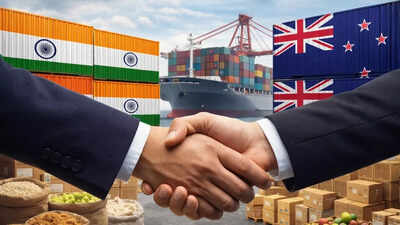
India and New Zealand are set to sign the much-awaited Free Trade Agreement (FTA) on Monday at the Bharat Mandapam, in the presence of Union Commerce and Industry Minister Piyush Goyal and New Zealand Trade and Investment Minister Todd Maclay.
The agreement, which was finalized in December 2025 after negotiations that began in March of the same year, aims to strengthen trade relations and expand economic engagement between the two countries.The agreement is expected to come into effect in the coming months, with Goyal noting that it will serve as an incentive to expand trade relations. “In a few months, this will be a way to increase trade between India and New Zealand,” Goyal said.Speaking about the relationship, Maclay said that relations between the two countries are at their strongest. “It’s very strong. In fact, it’s probably the strongest relationship I’ve ever known. We, as the New Zealand government, have said that we want to make our relationship with India and its government a strategic priority… I think we will see direct flights between India and New Zealand. And more people can come and visit for tourism.”
…We are about to sign a free trade agreement.”
He watches
“India expands global trade” Union Minister Piyush Goyal talks about New Zealand Free Trade Agreement
Here’s what the agreement means for India
Access to free markets and expansion of tradeThe agreement is expected to provide duty-free access for Indian exports to New Zealand, opening up huge opportunities for local industries. “Goods exported from India to New Zealand will go without any taxes, creating huge opportunities, including for the leather industry in Agra and other sectors,” Piyush Goyal said. It is expected that approximately 70% of goods coming from India to New Zealand will not face any import duties.Promoting micro, small and medium enterprises and traditional sectorsThe deal is likely to benefit many labour-intensive sectors that rely on micro, small and medium enterprises, especially in export-oriented clusters such as Agra, known for its leather and shoe industries. “We will get new opportunities for leather works in Agra, handloom and handicrafts in Uttar Pradesh… for our one-stop producer… for carpenters making goods for sculptors and many other opportunities,” Goyal said.Agra, one of the largest leather and footwear hubs in India, is expected to benefit from improved market access once the agreement comes into force.Services, visas and workforce mobilityThe agreement includes provisions to facilitate trade in services, including a temporary work visa route for Indian professionals. This will allow up to 5,000 visas per year, with stays of up to three years, covering sectors such as IT, engineering, healthcare, education and construction.It also includes professionals such as AYUSH practitioners, yoga instructors, Indian chefs and music teachers, with the aim of enhancing workforce mobility between the two countries.Regulatory facilitation and sector cooperationThe FTA is expected to streamline regulatory processes and reduce non-tariff barriers by enhancing cooperation. It includes faster access to Indian medicines and medical devices through recognition of international inspection standards, reduced duplication and reduced compliance costs.In agriculture, New Zealand will work with India on an agri-technology action plan focusing on kiwifruit, apples and honey, aiming to improve productivity, quality and supply chains.Investment and tradeThe agreement aims to double bilateral trade to $5 billion within five years, from the current level of about $2.4 billion. New Zealand has committed to investing $20 billion in India over the next 15 years in sectors such as manufacturing, infrastructure, services and innovation, with a focus on job creation.
The agreement is also expected to enhance economic resilience and support inclusive growth in line with India’s national priorities.
What New Zealand earns
Under the agreement, New Zealand will get tariff reductions or elimination on 95% of its exports to India, including products such as wool, coal, timber, wine, avocados and berries. Customs concessions will also be expanded to include goods such as kiwifruit, seafood, cherries and Manuka honey, with some exports subject to quotas.Meanwhile, India has excluded several sensitive sectors, including dairy products, onions, sugar, spices, edible oils and rubber, from tariff concessions to protect farmers and domestic industries.
Goyal and Maclay visit the Taj Mahal
Before the signing, Goyal and Maclay visited the Taj Mahal, accompanied by their wives, and spent nearly two hours at the site.During his visit, Goyal held discussions with local industry representatives from sectors including leather, textiles, spices, handloom, handicrafts and carpets.“I was fortunate that today I had the opportunity to have a very detailed and meaningful discussion with the Agra industry. The excellent work being done in Agra, across various industries, be it the leather industry, textiles or the spice industry, and the way it has been exposed to several sectors like handlooms, handicrafts and carpets, shows that Agra will play a crucial role in the future, especially in exports,” he said.
We also discussed several issues that are hampering the rapid growth of the Agra industry.”He added that plans to set up a new industrial zone near Agra are being explored as part of a wider drive to set up 100 such zones across the country.