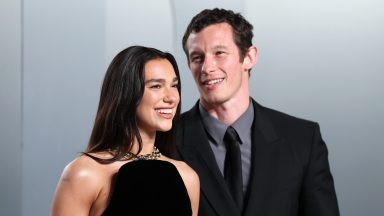
Dua Lipa future Callum Turner at a concert in London this weekend, and the internet did what it always does. He shouted. Zoom in on the dress. The two-year timeline has been pulled from soft launch to “I do.”
The “Material” singer and the “Eternity” actor seem impossibly in sync. Same taste as independent films. Same book club energy. The same easy chemistry on every red carpet they’ve shared since 2023.
And this is the part no one wants to read on their phone right now: The wedding is the easy part.
The hardest part is what happens in the fourteenth month of marriage, when the version of them they fell in love with begins to slip, and the nervous system poses a question that no Vogue spread can answer. Are you really there for me? Am I really enough?
Wedding is a ritual. The work is biological.
A party is more than just a party. It is a formal announcement to two nervous systems that this person is now your primary attachment figure. Your safe harbor. Your home base.
This is a huge biological promise. From cradle to grave, humans are interconnected beings. We are wired to need emotional connectedness to feel safe in the world, and the person we marry becomes the person our nervous system scans first, last, and constantly.
Early in the romance, both people turn on what I call the protective parts. Seducer. The wonderful friend. Effortless friend. You perform the version of yourself that you believe is the most chosen, because at that point it is safer to seduce than to be raw.
Dua and Callum have had two years of that. Two years of test launches, shared book recommendations, and photo shoots like it smelled good. This is not fake. This is how falling in love actually works.
But somewhere after the wedding day, performance gives way to everyday reality. And in everyday reality, you bump into each other with unresolved attachment wounds. When one partner senses distance, the other partner’s nervous system does not register this as a simple matter of scheduling. It registers him as a threat to survival.
This is when the cycle of protest and withdrawal begins. One arrives. One retreats. They both get hurt. They both react in ways that accidentally hurt the other. I call it the Waltz of Pain, and every couple I’ve ever worked with has danced it.
The trap that awaits couples who seem so perfect
This is the particular danger for couples who look like a magazine spread on their wedding day.
When the outer life is pure, both people begin to carry unconscious expectations that the inner relationship should be completely smooth. They have arrived. They succeeded. The aesthetic is closed. So any moment of normal relational friction leads to catastrophic failure.
I see this constantly with high-achieving clients. Executives. Designs. Performers. Their sensitivity to feeling hurt actually goes up, not down, the more successful they are. They sit in my office wondering how they can tour, or run a studio, or run a company, and still can’t get through Tuesday dinner without someone shutting down.
It’s getting worse. Smart and successful people are exceptionally skilled at thinking about pain. When conflict arises, they send the representative. The polished, articulate, beautifully dressed public version of themselves. They charge the relationship like a boardroom. They become world-class experts on their partners’ flaws while completely evading their own raw emotions.
Underneath all this competence, there is usually a frightened person quietly suffocating for fear of being either a perpetual disappointment or completely alone. This is also the moment when fans and tabloids begin to project antisocial fantasies onto marriage, which can veer into the trap of obsession as love where intensity is mistaken for intimacy. If you’re concerned about where your attachment wire points are, find out the dynamics of your attachments before you need them in combat.
Conflict is evidence, not pathology
Mainstream culture and the comments section will tell you that any sign of friction in a celebrity marriage is evidence of a toxic relationship. Healthy love is supposed to look flawless. an effort. Sponsored.
I think this is backwards.
Volatility is the nervous system that tells you that this person is important. Couples fight because they love each other so much that the pain of separation is biologically unbearable. If Calum didn’t matter to Dua, her body wouldn’t care to form a reaction. If it didn’t matter to him, he wouldn’t shut up to protect himself. The defense is evidence of the bond.
When a couple comes in after a brutal three-day fight, I sometimes tell them to go buy champagne. The fight is proof that their relationship is real enough to hurt this much.
There are no bad guys here. There are two realities, one episode, and two frightened humans trying to survive the horror of losing each other. Labeling a partner as toxic or narcissistic provides false certainty and feeds the cycle. True empathy sees the frightened person beneath the awful behavior, which is also the science behind breadcrumbs and most other patterns the gossip industry likes to dismiss as pathological.
What I will actually tell them
If Dua and Callum walk into my office a year from now, exhausted from the pressures of being a couple, that’s where I’ll start.
Give up the dream of never fighting again. The magic is not in avoiding rupture. The magic lies in how quickly and honestly you make the repair.
Then build what I call “the sovereign we.” The myth of hyper-individualism, where marriage is just two separate, sovereign people living parallel lives, collapses under the weight of true intimacy. True love has three sovereign entities. I. You. we. The United States is a living organism with its own needs, and protecting it is more important than winning an argument over who texts and who texts back.
The movement underneath it all is small and brutal. Notice when you’re stuck on a story of your partner’s flaws. Turn the lamp inward. Drop beneath the anger into the soft thing underneath, the longing, the shame, the fear. Then say that soft thing out loud, without a single drop of criticism attached to it.
This is the actual proof of work in marriage. Not wedding photos.
The font is worth a screenshot
Wedding is a beautiful promise. Marriage is what happens when two people continue to choose to walk toward each other in the dark, even after the dress has been dry-cleaned and the guests have gone home. Dua and Callum have just made a promise. Now they have to spend the rest of their lives learning what it actually costs to keep them. This is not a warning. This is the good news.
_________________________________________________________________________________
Figs O’Sullivan and his wife, Till, are San Francisco-based couples therapists, relationship experts at Stars and Silicon Valley, and the founders of Empathi, who built Figlet, an AI-powered relationship coach trained in their clinical work.