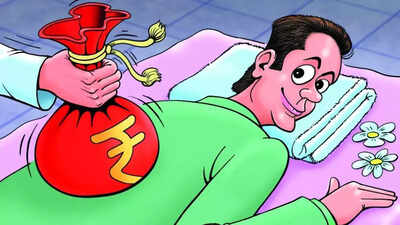
Of the 30 index stocks, 26 closed in the red
At a time when global markets are witnessing extreme volatility due to geopolitical uncertainty, the rise in Securities Transaction Tax (STT) on financial derivatives trades hurt investor sentiments on Dalal Street on Budget Day.
This, in turn, led to a sharp sell-off that saw the Sensex fall by around 1,500 points – the largest point loss on Budget Day – to close at 80,773 points. The sell-off also left investors poorer by Rs 9.4 lakh crore, the biggest loss on Budget day in terms of market capitalization of the BSE.Today’s trading was characterized by high volatility. The Sensex rose over 400 points when the FM began her speech, fell around 1,100 points after the STT rate hike proposal was announced, partially rebounded by mid-session to trade 600 points lower during the day and then sold off to close below the 81K mark for the first time in four months.
Budget 2026 overview: What citizens and businesses should know
On the NSE, Nifty also followed a similar path to close 495 points (2%) lower at 24,825 points. Fund managers and market players feel that the intraday selling was exaggerated, exacerbated by the absence of most institutional players since it was a Sunday. “The market reaction (to the hike in interest rates on government bonds) was a bit exaggerated, although the decision itself was not expected,” said Tahir Badshah, president and chief investment officer of Invesco Mutual Fund.
“I think the markets should stabilize in two or three days.” Badshah said the budget is in line with the path set by the government in the past few years, showing a conservative approach in setting targets.“The revenue and expenditure targets for FY27 are achievable. Since inflation is lower now, the nominal GDP growth rate of 10% may be on the higher side as inflation normalizes during the year,” the senior fund manager said.
In Sunday’s market, 26 of the 30 stocks closed in the red. Among the index components, Reliance Industries, SBI and ICICI Bank contributed the most to the day’s loss. Buying in software services companies Infosys and TCS mitigated the decline.
Bahrain Stock Exchange data showed that in total, 2,444 stocks closed in the red zone, compared to 1,699 stocks that closed in the green zone.High STT aims to limit F&O speculation The decision to raise the securities transaction tax (STT) for trading in equity derivatives means that futures and options (F&O) trading will be more expensive from 1 April.
The STT ratio on futures trading rises from 0.02% to 0.05% now, and on options premium and options exercise to 0.15% from 0.1% and 0.125%, respectively. This could double the legal costs of trading F&O contracts.While the move is aimed at curbing excessive speculation by retail traders who are mostly suffering from losses, investors have been selling shares of those companies that derive a major portion of their sales from the sector. Angel One shares collapsed nearly 9%, BSE shares fell 8.1%, Billionbrains Garage Ventures, which runs the Groww trading platform, lost 5.1%, and Nuvama Wealth Management lost 7.3%.
The STT rise comes on the heels of a Sebi survey which showed that 91% of retail investors lost money in the F&O market with the average loss per investor exceeding Rs 1 lakh per annum.
Institutions and some high-net-worth players earned most of the profits from this sector.The 18% GST on foreign investment brokerage has been removedThe Budget proposed to eliminate the 18% GST levied on brokerage paid by foreign portfolio investors in India. Among the host of changes proposed by the Finance Minister to the GST laws, one of them was to remove clause (b) of sub-section (8) of Section 13 of the Integrated GST Act, 2017. This has been “deleted to ensure that the place of supply for ‘intermediate services’ will be determined in accordance with the default provision under Section 13(2) of the Integrated GST Act,” the budget proposal said.