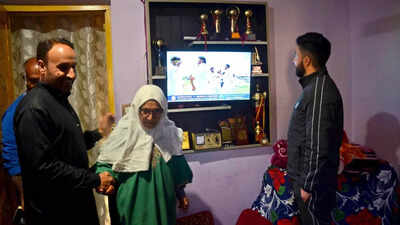
Aqib Nabi’s family members watch the Ranji Trophy final (TOI photo)
Baramulla: About 40 km west of Uri, near the Line of Control, lies Sheri village. Along the Jhelum Valley Road northwest of Srinagar. There, a narrow lane off the main road takes you to the house of cricketer Aqib Nabi Dar.
It’s barely wide enough for three people to walk side by side, but remember the address. Because we should not forget in a hurry.Small mountain villages are usually crowded, but the shops in Shiri were open on Saturday, but business was slow. Men stood in the narrow streets, and groups of boys gathered, holding cell phones in their hands. It seemed aimless, but there was a purpose. They were constantly checking their phones, sharing updates, consuming mobile data by the minute, and were updated with the final score of the Ranji Trophy in distant Hubballi.
J&K are making history! Jammu and Kashmir wins 1st Ranji Trophy 2025-26 | Emotional family reactions
Inside the two-story house, family members sat in a small room, huddled in front of a modest-sized television. Next to the TV, in the narrow room, was an almirah. Its box contains many cricket medals that Al Aqib has won over the years. The room was quiet except for the sound of television commentary.His grandmother Fuzzy, her withered eyes fixed on the screen, smiled whenever the camera showed the eagle.
Father Ghulam Nabi Dar, a government school teacher, leaned forward as he sat, closely following each ball. Like a rosary prayer, he quietly repeated the names of the players and details of the match as the final hour reached its hour. When Jammu and Kashmir won, the family looked at each other. And he smiled softly. The members hugged each other.
Moments later, the announcement came that Aqab Nabi Dar had been chosen as the best player in the tournament.
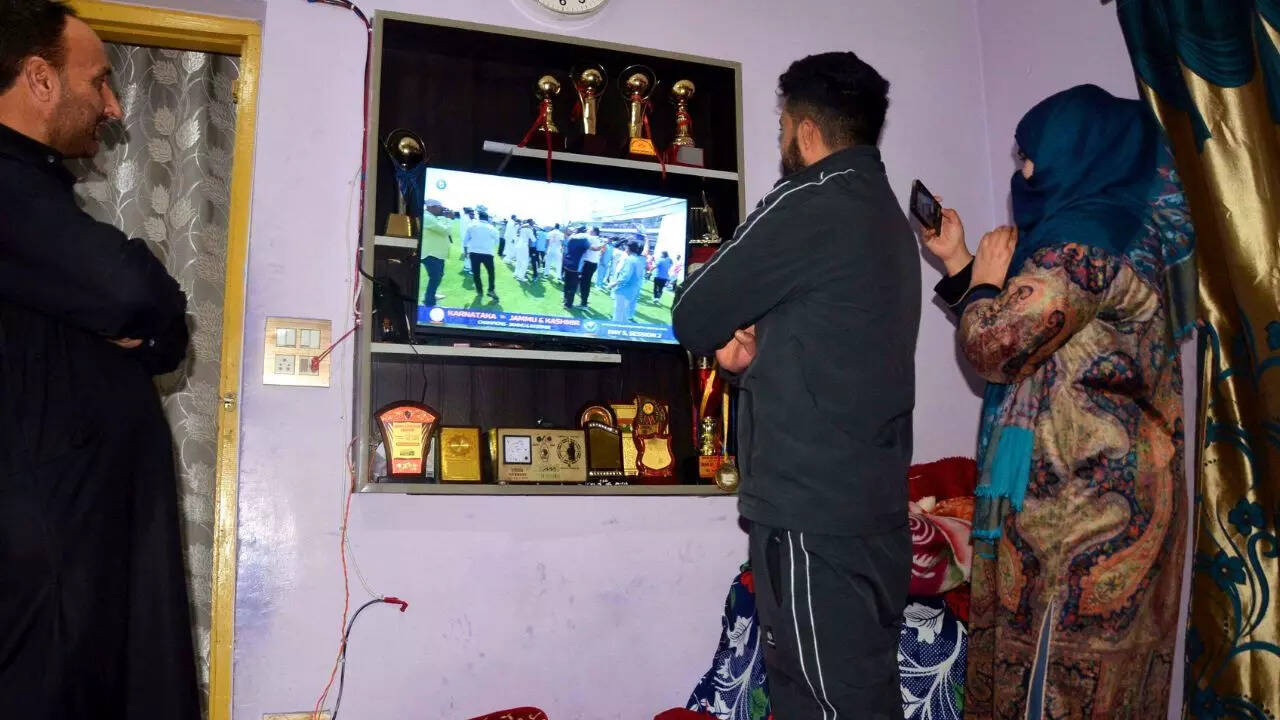
Aqib Nabi’s family members watch the Ranji Trophy final (TOI photo)
The room was silent, as if it had been before the prayer, when he began his post-match interview.“He’s a shy boy,” his father said, smiling without taking his eyes off the screen. When the TV announcer reminded Al-Aqib that his father had once wanted him to become a doctor, and when Al-Aqib smiled in response, Ghulam Nabi took off his glasses and wiped his eyes. In Kashmir, most parents encourage their children to pursue medicine as it is usually a respectable and safe profession.
Ghulam Nabi said he often worried that cricket might keep his son away from studies. He talked about a time when Aqib was prevented from going out to play, locked him inside a room, and even tied him with a rope to prevent him from leaving. Around 2015, he missed out on a medical seat by two grades, Ghulam Nabi recalls, as if to banish a bad memory.
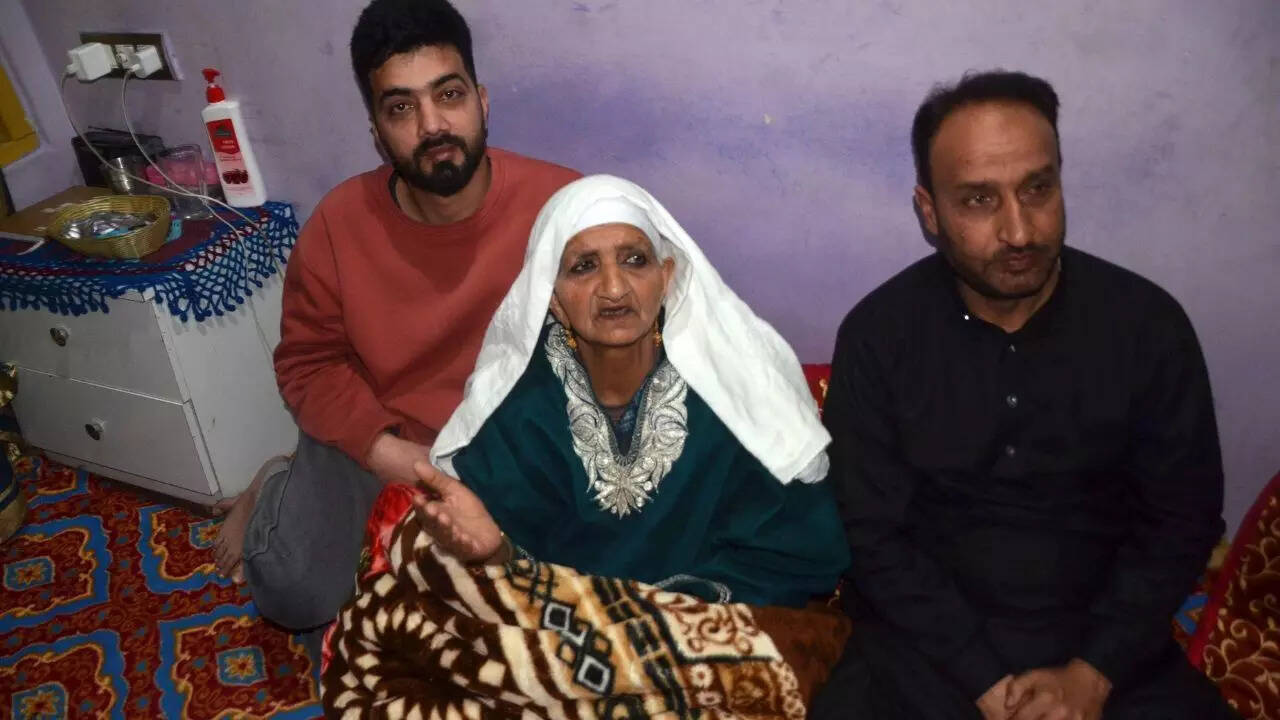
Aqib Nabi’s family members (TOI photo)
Medicine’s loss was supposed to become cricket’s gain, and the father understood this in time.“Later, I realized how serious my son was about the game, and I let him play,” he said.
Then he added, smiling sheepishly, “I also used to play cricket when I was young.”Now, Ghulam Nabi only hopes to see his son play for India. “My dream is to see him in the Indian jersey,” he said.The proud father’s phone kept ringing with calls from relatives, neighbors and reporters as scenes of historic rejoicing played on television. “People are calling affectionately,” he said, struggling to respond to each one of them. Women from neighboring houses came to congratulate Oqab’s mother and grandmother.
They hugged them and prayed.In another room, Bilal Ahmed Dar, 30 years old, Aaqib’s cousin, was watching the match alone on his phone, preferring to follow the matches quietly, he said. Bilal spoke about the lack of proper cricket facilities in Cheri when Aqib was growing up. Even today there are only basic facilities around. To train, Aqib would travel nearly five kilometers to a small land near Lower Jhelum across the river.
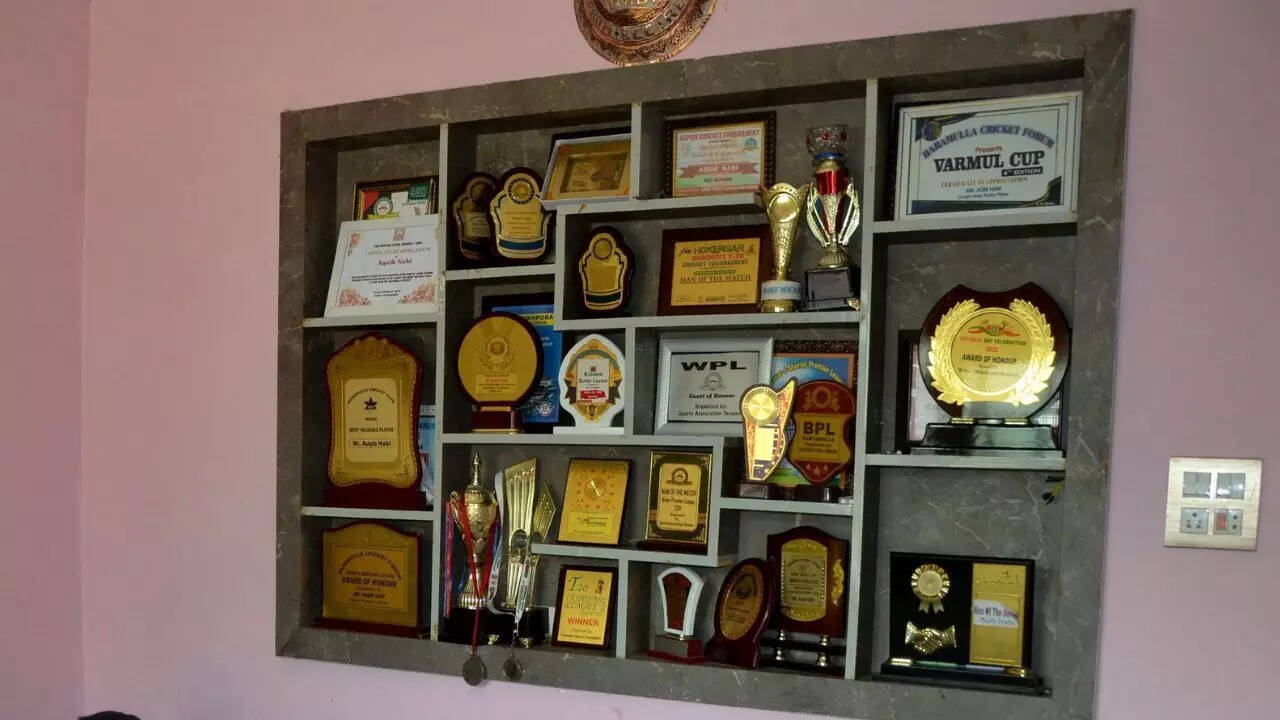
Aqib Nabi’s medals over the years (TOI Photo)
Bilal is closely following Aqib’s career. He remembers almost every match his cousin has played since being selected for the Ranji team. Over the past two years, Bilal said Aqib has taken 104 wickets, 44 last year and 60 this year, and feels proud when he sees famous cricketers paying tribute to Aqib on social media. “When top players tweet about it, it means a lot,” he said.Aqab is a science graduate from the University of Kashmir and remains humble despite his success, Bilal said, recalling the day of the IPL auction. “Aqib and I were watching the auction in this room,” Bilal said.
“Initially, when his name came up, no team picked him for a few seconds, we were silent. Then Delhi made a bid and we felt relieved.”As bidding increased and more franchises joined, the price continued to rise. “When it reached Rs 8.40 crore, we couldn’t believe it. We were happy,” he said. Within minutes the news spread throughout the village. People started gathering outside the house, beating drums and celebrating. “There was a huge rush,” Bilal said. “But he’s so shy. He doesn’t even come out.”