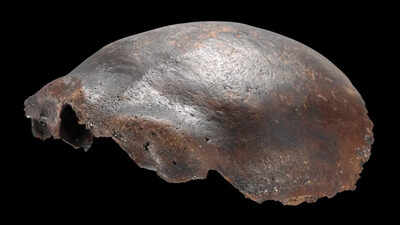
In 1973, a partial human skull was discovered in Hanoversand, Germany, during archaeological work. It did not contain any obvious cultural objects nearby, which made early classification difficult.
At first glance, the bone seemed unusual. Its appearance bears features that appear partly Neanderthal and partly modern human. This observation has led some researchers to suggest a possible hybrid origin between Neanderthals and Homo sapiens. The idea has gained interest because both species are known to have overlapped in parts of Europe and the Middle East. Over time, interpretation changed as new dating methods and analyzes were applied.
What once seemed like a rare hybrid condition now appears to be something more common within modern human diversity.
Hanoversund skull Early discovery of the frontal bone Neanderthal hybrid theory
According to the scientific reports, titled: Morphological Analysis of a Modern Human Frontal Bone from Hanoversand, Germany, the fragment was a frontal bone, found in northern Germany. It was not a complete skull, just part of the upper forehead area. The lack of surrounding artifacts make the context unclear. No tools. There are no burial objects. Just the bone itself.Researchers at the time had limited material to work with. Focus on form and structure.
The specimen showed features that seemed unusual compared to typical modern human skulls from similar periods. Initial studies described the bone as showing a mix of Neanderthal and Homo sapiens traits. The timing appears to fit early assumptions about hybridization between the two groups. Radiocarbon dating at one stage determined the age of the sample to be about 36,000 years. This period overlaps with known contact between Neanderthals and modern humans.For this reason, the idea of hybridization has gained significant attention. This was not a wild claim at the time. Hybridization is well established in genetic evidence today. Small percentages of Neanderthal DNA are still present in most non-African human groups.
New dating guides completely rewrite the timeline
Subsequent analyzes have changed the picture slightly. More precise dating methods indicate that the bone is much younger than first thought. It is estimated that it is close to 7,500 years old.
By then, Neanderthals had already been extinct for tens of thousands of years. There is no longer direct interference. Hybrid origin has become unlikely based on timing alone.Instead, the specimen fits within the Mesolithic Age, a phase of human history marked by populations of modern Homo sapiens living across Europe with the development of tool use and social structures.
3D analysis confirms that the bone falls within modern human diversity
A recent study applied three-dimensional comparison techniques.
The bone was measured and compared to a large data set of Neanderthal and modern human skulls from different periods.The results place the Hanoversand frontal bone firmly within the diversity of modern Homo sapiens. Not an intermediary. Not mixed. Only within the range of natural variation of the human skull.The researchers noted that previous impressions of the “Neanderthal-like” features may have come from its shape, which appears somewhat unusual compared to some reference specimens.
But this difference also exists among modern populations, including medieval and Holocene skulls.
Genetic evidence confirms ancient hybridization between species
Neanderthals and modern humans interbred in the past. Genetic evidence clearly supports this. They likely occurred in multiple regions, especially in the Middle East about 100,000 years ago, and later in parts of Europe. Some populations have carried mixed traits for thousands of years. Fossil remains from some cave sites indicate a possible mixture of cultural and biological features.However, these cases belong to a much older timeline than the Hanoversand discovery. By the time this frontal bone formed, Neanderthals no longer existed. The entire population landscape shifted to the Homo sapiens groups that adapted across Europe during the Mesolithic.