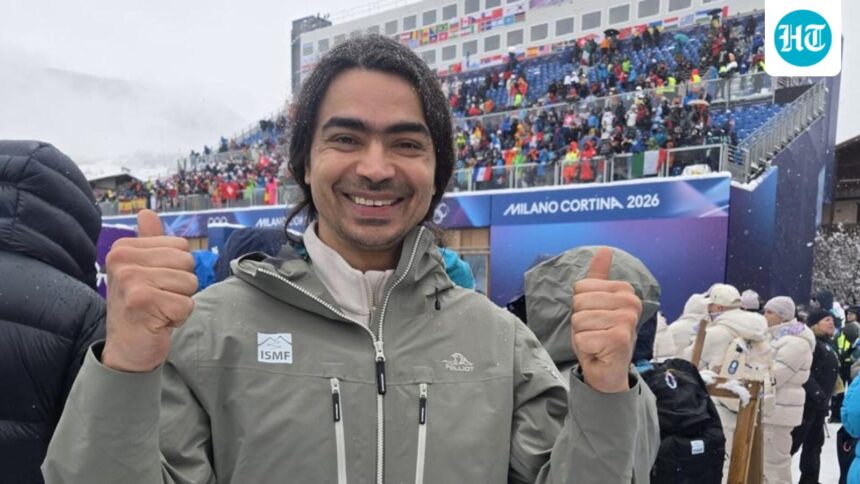
Bengaluru: Shiva Keshavan grew up in the Himalayas, in Manali, where his father ran an adventure sports company and organized trekking. When skiing began, Shiva had to climb the mountains because there were no ski lifts. He worked as a mountain guide and took an advanced course in mountaineering. Eventually, luge—a sport in which athletes lie on their backs and race feet-first down an icy track—became his calling, and Shiva went on to compete in six Winter Olympics (the only Indian to do so), turning into something of a mascot for an unlikely tropical country.
At 44 years old, Shiva finds himself returning to what he calls his “roots” in a sport making its debut at the Winter Olympics in Italy. Ski mountaineering – or SkiMo – is the newest Winter Olympic sport, and Shiva, who was appointed head of sport and events for the International Ski Mountaineering Federation (ISMF) last year, is part of the core organizational leadership team overseeing its debut at the Games. He is the only Indian in this group.
“I started following SkiMo when I realized it was going to be a part of the Games. It was like going back to my roots. The application process was open, so I sent my CV as a professional, and went through a few rounds of interviews. My experience developing the sport in India and being a world-known former athlete helped me with that assumption,” said Shiva, who is based in the northern Italian town of Bormio, which hosts ski mountaineering events. “It’s an absolutely crazy sport if you think about it. There’s speed and endurance. They’re probably some of the fittest athletes I’ve ever seen.”
SkiMo arrived at the Winter Olympics for the first time Thursday in Bormio, in the heart of the Lombardy Alps — with athletes gathering at the foot of the famous Stelvio slope, running up skis equipped with climbing skins before taking off their skis, strapping them to their backpacks and switching into boots to climb a set of stairs, all while braving a blizzard. Once they reached the top, they jumped back into their sleds, peeled off their skins and raced down the hill. The total height of the individual sprint is 70 meters and the track length is 610 metres, and transitions come with time penalties if the rules are broken. A typical single event—the race, the move, the lunge—lasts about three minutes.
For the first time in its history, the Winter Olympics have two host cities – Milan and Cortina d’Ampezzo, separated by more than 400 km, 15 competition venues and six Olympic villages. It is also the first time since 1998 (his first appearance in the Games) that Shiva has not been in close proximity to a major track. “Since the places are so far apart, I had to content myself with watching bobsleigh races live on TV and talking on the phone with my former Italian teammates, who are now here as coaches,” says Shiva, who was born to an Indian father and an Italian mother. “It was also great to see the Indian team wearing proper uniforms, perhaps for the first time. It’s something I’ve never experienced in my time (Shiva competed in his last Games in 2018). We were pretty much on our own – we’d go pick something to wear, often stitching logos on ourselves.”
For someone who has spent the better part of his career training and seeking sponsors and with the Games at the heart of his efforts, this year’s edition was not all pleasant surprises. “Decentralizing the Games makes sense from a sustainability perspective, but it also takes away from the atmosphere of the Olympic Games. The Olympic Village is a kind of utopia – where athletes from different sports and countries live together and share meals. This is difficult to achieve in the current hosting environment for the Games.”
Ski mountaineering runs from February 19 to 21, concluding the Games, and Shiva believes it is, in many ways, the ideal winter sport for India – primarily because the necessary infrastructure is minimal.
“For skiing, you need to build $50 million worth of ski lifts, and the slope has to be certified. For skiing, there will probably be a $100 million investment to build an artificial ski run. Ski mountaineering is the kind of sport that doesn’t require that kind of infrastructure or those conditions. You use a pristine mountain slope – set it up, run the event and leave the mountain as it was. Here in the Games, the slope that was used for alpine skiing events is changed and reused for ski mountaineering. In Home to us, we have the Himalayas, which are almost perfect for SkiMo.