


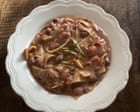
TThroughout the 1990s and into the early 2000s, under the banner of story, art and folklore, the Romanian publishing house Newton Compton He published a series of 27 books on regional Italian cooking. Some, such as Jean Carola Francesconi’s 1965 epic La Cucina Napoletana, were reprints of well-known books, while others were commissioned specifically for the series. There is a huge discrepancy. Some of the 20 areas occupy 650 dense pages, sometimes spread over two volumes, while other areas contain 236 pages in larger fonts, with everything in between. This is all great, although I can’t help but feel tenderness for the 14-point font areas.
In the face of the great diversity of regional culinary customs, knowledge and rituals, I also feel tenderness for shared traditions; Those that are specific to a place, but at the same time cross local and national boundaries, as do the stories of the ingredients. takes Pasta and beansThe beans are boiled in water with fat, and perhaps aromatic herbs and vegetables, then pasta is added for a dense dish that may require a spoon. Almost all regions (and towns and individuals) have a very general and specific version – white beans, potatoes, la rosemary in Lazio, for example; Lardo, sage and lots of rosemary in Piedmont; nutmeg, bread and pasta in Liguria; Lardo, marjoram, tomatoes and hot peppers in Abruzzo – an invitation to a sort of pick-and-mix. And embrace new ideas as well, because cooking is a living and evolving thing.
Cesar Battisti, chef and owner Ratana in Milanis great at all of this, noting: “It’s true that we need to be guardians of tradition, but we also need a little courage to desecrate it a little, and in a clever way, but we have to do it.” With these words he suggests a pasta fagioli that follows a familiar pattern — soaked beans are added to the sofrito, followed by water, then pasta — but also takes inspiration from Thailand and includes coconut cream, scallions, chili peppers, and optional lime.
We were pleased with the contents of the steamers, especially the addition of coconut cream, which lightens the color to gray and makes the dish look luxurious while still being fresh. I agree with Battisti when he suggests making food hot with chili peppers, but of course you have to decide. The same applies to lemon (“Unexpected item”, Or an unexpected ingredient), which turns the dish around like a bright spark.
I’ll leave the last word to Battisti: “These dishes should not be discussed, they should be tried, and you should try to prepare them again, try. That means: These are not dishes to discuss, but rather dishes to try. Although you can also try and discuss.
Fagioli pasta with coconut, spring onions, chili pepper and lemon
serves 4
200 grams of dried borlotti beans-Soaked overnight in plenty of cold water
5 tablespoons of olive oil
3 green onions– White onion cut into cubes, and the green parts cut into thin slices
1 stick celeryCut into cubes
1 small carrotPeeled and cut into cubes
1 fresh red pepperchopped
2 sprigs fresh rosemary1 picked and chopped, and the other left whole
2-3 tablespoons Coconut cream
200 grams TagliatelleAlmost broken
juice 1 Lemon (optional)
Drain and rinse the soaked beans. Place the olive oil, scallion whites, celery, carrots, half the red hot pepper, and all the rosemary in a heavy skillet and cook over medium-low heat, stirring, until the vegetables begin to soften and become translucent. Add the soaked beans, a liter and a half of fresh water, and a little salt, and leave until it boils, then reduce the heat and leave it on low heat for an hour, or until the beans are cooked.
Remove half of the soup, mix well, then return it to the pan with the coconut cream and salt to taste. Place the pan back on the heat and let it simmer. Add the broken tagliatelle and simmer, stirring regularly, until the pasta is cooked – you may need to add more water.
Serve, topping each bowl with sliced green onions and a little chopped red pepper, and encouraging those who want to add a squeeze of lemon.













![root-vegetable-hash-with-avocado-cream-[vegetarian]-–-one-green-planet](https://globalindiabroadcastnews.com/wp-content/uploads/2026/02/19793-root-vegetable-hash-with-avocado-cream-vegetarian-one-green-planet-300x200.jpg "root-vegetable-hash-with-avocado-cream-vegetarian--one-green-planet | GIBN")