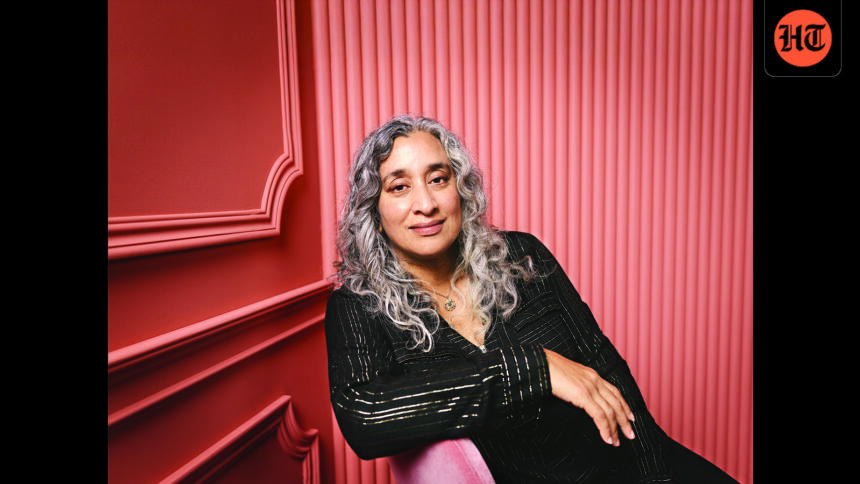
“In scary times, it’s important to tell the truth,” says the director, who has two nominations for her documentaries at the upcoming Academy Awards. For her, this truth is always present in cinema.

Geeta Gandhibir is no stranger to the limelight.

The 55-year-old American director was mentored by Spike Lee and Sam Pollard.
The documentaries I worked on with them won several awards. These include an Emmy for When the Levees Broke (2006), a four-hour film about the devastation in New Orleans caused by Hurricane Katrina in 2005 and the government neglect that followed. and the Peabody Award for Exceptional Journalism for the sequels “Inshallah” and “Da Creek Don’t Rise” (2010).
However, this year is clearly different.
She was nominated for two Academy Awards for Best Director: for the documentary The Perfect Neighbor and the 31-minute documentary short, The Devil’s Busy.
Very few female directors have been nominated for an Academy Award. Not to mention two projects in the same year. In fact, it was only in 2010 that a woman won the Academy Award for Best Director (Kathryn Bigelow, for The Hurt Locker). “Why are women brought down to this degree? It’s a strange feeling, you know?” She says.
It’s these kinds of questions that lead her into filmmaking. Why did a white woman in Florida, disturbed by the noise of children playing near her house, think she could get away with killing a black mother of four? Why would a former prisoner show up outside an abortion clinic to shout scary slogans at strangers? Why would a woman grieving for her two children choose to work amidst this hostility every day?
The first of these questions underpins the film The Perfect Neighbor, set in Ocala, Florida, in the years 2022 and 2023. The answer to the second question unfolds in “The Devil is Busy.”
Both offer a visceral, almost uncomfortable sense of being on the scene as events unfold. This—plus the unusual themes and access—is what makes Gandpierre’s novel unique.
For example, “The Perfect Neighbor” is presented largely through police body camera footage, which is presented in chronological order with minimal narration. One might expect this to become monotonous, but the slow unraveling of the future shooter, and the neighborhood and system’s “Oh my God, not this again” reaction, leaves the viewer, knowing what is coming, aghast at the sheer ordinariness of the criminality.
Then the shot is fired. The woman, 35-year-old Ajike Owens, died. And nothing is normal in the following moments. The ex-husband was told he was now the sole parent of his four children; He should call his ex-wife’s mother to tell her what happened. While his ex-mother-in-law sobs on the phone, he goes to a meeting with the kids, who hours ago had a loving, vibrant mother and now have nothing.

The footage that the viewer has already seen leaves no doubt as to what happened; There is no room for “what if” or “could have been”. There is only a senseless, violent crime, and the tragedy it begins to leave in its wake.
“Our communities of color are criminalized after something terrible happens to us. Our children become adults. The footage we collected makes it impossible to do that here,” says Gandbir, the “we” referring to her Indian origins.
In this sense, she adds, the people whose stories she tells are “collaborators” and not “subjects.” There is one reality with it, a common world; Who seems, more often than not, determined to find ways for others.
Gandbeer says Owens was a family friend. When the shooter, Susan Laurench, was sent home without charge, over controversy over whether Florida laws applied, a community made up of the black woman’s family, friends, and neighbors decided to keep the fight alive, and ensure that the case at least went to trial (Laurensch was eventually convicted).
“Keeping the story alive was very important,” says Gandbir. Hence the idea of the film came from.
***
The documentary form is also a political statement.
“I think representation is very important in film. It’s especially important to do that in documentaries because this form, in many ways, began as a colonial practice,” says Gandbir. She cites the example of Nanook of the North (1922), written, directed and edited by Robert J. Flaherty. The silent film combines elements of documentary and docudrama to chronicle the daily “struggles” of an Inuk man and his family in the Canadian Arctic. It’s a strange idea at best; Exploitative at worst; Other, any way one looks at it.

“You have someone from outside the community coming into the community. There’s often a skewed power dynamic, and this work can be very extractive. That’s troubling to me,” she says.
By contrast, the best documentaries do not turn their lenses on an unfamiliar culture, but rather monotonously seek to surprise in their ways. Instead, the lens disappears. There is no narrator. The themes, not the scenes, remain at the heart of the story.
This is important, says Gandbir. “In scary times, it is important to tell the truth in the best way possible.” For her, that was always cinema.
I grew up in Massachusetts in a large, extended family. “I had a happy childhood,” she says. She majored in visual arts and cross-cultural anthropology at the State University of New York (SUNY). Later, at Harvard, she studied visual arts with an emphasis in animation, and took courses in women’s studies.
Filmmaking, for her now, is more than just correcting the record, preserving the truth and securing an invisible face and voice; Although all of these things are also very important. Filmmaking, for her, is about driving change.
“After The Perfect Neighbor, my sister-in-law, Takima Robinson, an executive producer of the film, co-founded the Standing in the Gap Fund, an organization that helps families affected by race-based violence and works to address statute laws, state by state,” she says.
In the wake of The Devil is Busy, Gandbhir and her team are working alongside Planned Parenthood and other organizations fighting for reproductive justice. “The impact is what I hope people get involved with.”
She adds that if we cannot lead change, in our deeply fractured world, we will have failed young people. “My kids who are going to university won’t accept my apology. They’ll ask: What did I do to fix it? I don’t have any other skills. I’m a filmmaker. So I want to make work that is at the intersection of art and political activism.”
What’s next? Given the state of things, it might be a political comedy, says Gandbir.
(Geeta Gandbheer’s documentaries are available on Netflix and JioHotstar. The Oscars will be awarded on March 16)





![korean-style-spicy-tofu-and-fried-brussels-sprouts-[vegetarian]-–-one-green-planet](https://globalindiabroadcastnews.com/wp-content/uploads/2026/02/21036-korean-style-spicy-tofu-and-fried-brussels-sprouts-vegetarian-one-green-planet-300x200.jpg "korean-style-spicy-tofu-and-fried-brussels-sprouts-vegetarian--one-green-planet | GIBN")