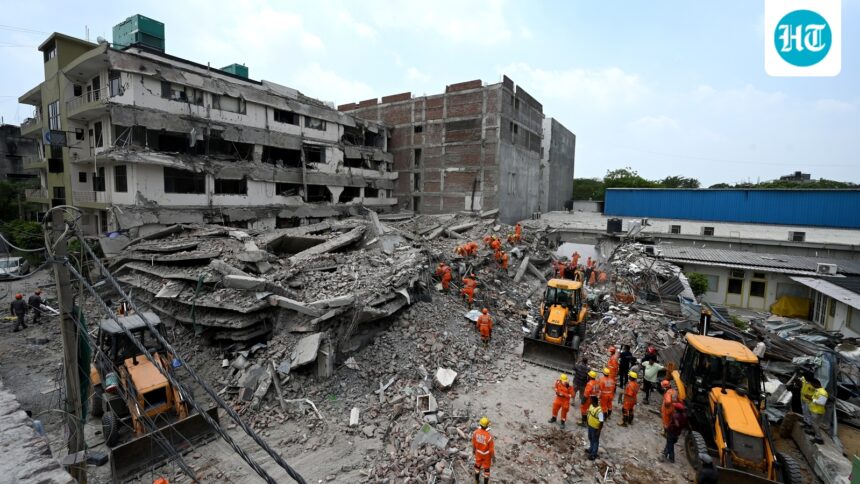
A court-appointed amicus curiae has issued a scathing indictment of the Municipal Corporation of Delhi (MCD) over the May 30 collapse of an illegally constructed building near Saket Metro station that killed six people, saying the tragedy was the result of years of official inaction despite repeated warnings, litigation before the Delhi High Court and documented violations dating back to 2012.

In a case report filed before the Supreme Court, senior advocate Ajit Kumar Sinha, who was appointed as amicus curiae by a bench led by Justice Ahsanuddin Amanullah, sought a detailed investigation into the role of MCD officials, conduct a city-level structural audit of the buildings falling under the jurisdiction of the municipal body, and conduct a comprehensive operation to seal and demolish illegal structures.
MCD did not respond to HT’s repeated requests for comment on the report.
The report was submitted as part of the larger proceedings in which the Supreme Court is monitoring illegal construction and land misuse across the country. The amicus curiae told the court that Sackett’s collapse showed how he allowed blatant building code violations to continue for years despite repeatedly alerting authorities.
Read also | Saidulagab building collapse: The owner of the building is a family that owns several properties in the area
At least six people were killed and 14 others injured when the five-storey building collapsed on West Meadow in Sidulagab on May 30. Most of the victims were young medical and engineering graduates who were present in a nearby canteen that was crushed under the rubble.
It is worth noting that the friends’ comments come days after a fire broke out at a bed and breakfast in Hoz Rani that killed 22 people, which once again raised questions about MCD’s role after multiple violations by the owner came to light.
The report traces the building’s history through official municipal records and concludes that illegal construction was carried out in phases over more than a decade. According to the amicus curiae, the property was first seized by the company in 2012 for the construction of an unauthorized basement, ground floor and first floor. In 2015, the second and third floors were also seized as unauthorized. Despite these measures, no effective action followed. It is claimed that the fourth and fifth floors were only recently added, which eventually led to the collapse.
Read also | Doctors, engineers and a canteen owner are among those killed in a building collapse in Delhi
“The company failed to fulfill its legal obligations despite repeated notification of violations” and also failed to close the building or take necessary action when constructing the upper floors, according to the report filed through attorney Govind Ji.
Much of the report focuses on how the controversy repeatedly reached the Delhi High Court, but failed to be implemented effectively.
The building owner approached the Supreme Court in December 2020 and complained that the then South Delhi Municipal Corporation was proposing demolition without prior notice. The court ordered the company to listen to the owner and make a decision in accordance with the law while registering an undertaking not to carry out any further construction work in the meantime.
Later that month, a nearby resident filed another petition alleging unauthorized construction and inaction of the civic authorities. During the hearing, the company assured the court that construction would only be permitted in accordance with building regulations and that action would be taken if any unauthorized activity was detected. The court ordered the company to listen to all concerned parties and issue appropriate orders.
However, according to the amicus curiae, the building remains standing and illegal construction is alleged to be continuing.
Read also | MCD closes 42 facilities and demolishes 26 in a citywide enforcement campaign
The report also refers to a petition filed by Abdul Saqr before the Delhi High Court in April this year seeking intervention against the ongoing unauthorized construction at the site. During those proceedings, MCD’s lawyer told the court that there had been “no construction at all” and described the dispute as a private dispute between landlord and tenant. The petition was later withdrawn.
The amicus curiae claimed that this statement was clearly incorrect.
“Shockingly, the lawyer representing the municipal corporation… made a statement that there was absolutely no construction going on at the property in question. This false statement led to the case being dismissed,” the report said, adding that the petition specifically referred to illegal construction at the site.
The report goes on to point out that such illegal construction could not have continued from 2015 onwards unless law enforcement officials “turned a blind eye,” especially since the matter had already reached the Supreme Court on multiple occasions.
It is noteworthy that the report comes days after the Supreme Court, while hearing the nationwide illegal construction case, registered concerns raised by its amicus that areas in Delhi like Lajpat Nagar and Sarojini Nagar are rife with unauthorized constructions that pose a risk of major disaster.
The court noted at the May 20 hearing that buildings constructed far beyond the prohibited plans were inherently unsafe, and warned that such violations may indicate “tacit collusion and complicity” between authorities and violators.
Against this backdrop, the amicus urged the Supreme Court to direct the Ministry of Civil Development to explain how the Saidulagab building was allowed to remain standing despite repeated violations and to disclose the actions taken against the erring officials. He has also sought directions to conduct a structural audit of buildings across Delhi, demolition of illegal structures in a time-bound manner, action taken reports from the Delhi government and police, and a compensation framework for the families of those who died in the collapse.
The Supreme Court is expected to consider the report next month as part of ongoing proceedings to examine illegal constructions and implementation failures across urban India.