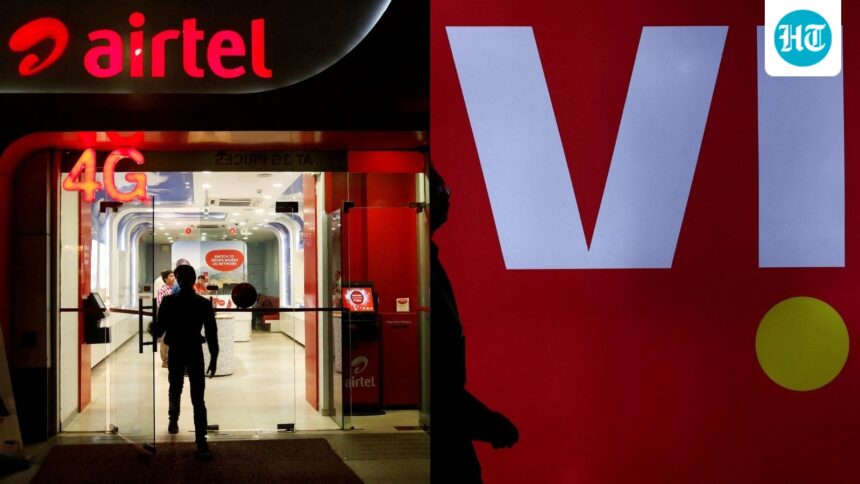
In a relief to telecom operators Bharti Airtel and Vodafone Idea, the Bombay High Court on Monday quashed the demand notices filed by the government seeking to levy a one-time spectrum charge (OTSC) on the tax levied on spectrum beyond 6.2 MHz from 2008 onwards.

In the 13-year-long legal battle, this ruling is likely to provide complete relief to more than 100,000 people $24,000 crores for companies. As per Airtel’s FY25 Annual Report, it has disclosed potential liabilities towards OTSC worth $6,600 crores. Its total liabilities to OTSC increased to $16,500 crore as of end-March 2025, including interest $9,954 crores.
Vodafone Idea’s exposure was at $7,581 crore, according to its annual report for fiscal 2025. It is not clear whether the amount includes interest. The amount can rise based on interest calculations.
Welcoming the ruling, an Airtel spokesperson said: “This ruling marks an important milestone for the telecom sector in India by eliminating legal and financial uncertainty and creating a more supportive environment for future investments.” Vodafone Idea did not respond to Mint’s queries till press time.
A broader legal battle over the OTSC is pending before the SC
While the Bombay High Court has now quashed the claims against Airtel and Vodafone Idea, the broader legal battle over OTSC remains pending before the Supreme Court through multiple parallel proceedings.
A division bench of Justices Manish Pitali and Shriram V. allowed Shersat filed petitions filed by telecom operators and quashed the Centre’s November and December 2012 decisions, as well as subsequent demand notices issued to the companies. The court ordered the return of bank guarantees given by the operators in relation to the disputed claims. It also canceled all subsequent measures taken by the authorities.
“We have come to the conclusion that the petitioners have been able to establish a case in their favor seeking to set aside and set aside the impugned decisions and subsequent notices of demand,” the court said. “The respondent has not been able to justify the said decisions and its actions of retrospectively imposing a one-time spectrum fee on the petitioners.”
What is the dispute?
The dispute dates back to 2012, when the government decided to impose a one-time fee on spectrum holdings that exceed the specified limit. The Department of Telecommunications (DoT) subsequently raised demands on existing telecom operators for spectrum beyond 6.2 MHz retrospectively from July 2008.
Airtel and Vodafone Idea had opposed the move before the Bombay HC in 2013, arguing that they had already paid license fees, entry fees and spectrum usage fees under their licensing agreements, and that the government lacked the power to impose additional fees retrospectively years after spectrum was allocated.
The Supreme Court granted temporary protection to the operators in January 2013, preventing the government from taking coercive measures while the case was pending.
The court noted that telecom operators were already paying license fees and spectrum usage fees under the current regime and that the government had failed to create a contractual or legal basis for introducing retrospective surcharges for spectrum that had already been allocated.
The court rejected the Centre’s argument that spectrum, being a rare natural resource, justified the tax, and held that while the government holds the spectrum in public trust, it remains bound by the terms and conditions of licenses granted to the operators.
She noted that the state cannot retroactively change contractual financial obligations without clear authority.
Legal experts said the Transport Ministry could appeal the Bombay High Court ruling to the Supreme Court, which may have the final say on the issue.